


Description
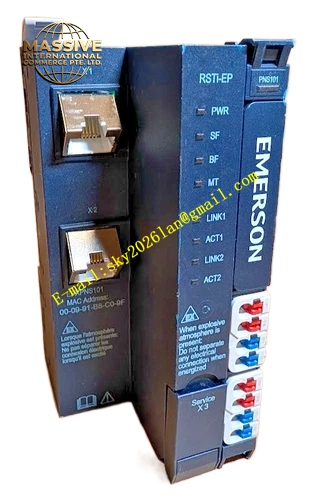
Emerson PMC PROFINET
Technical Specifications:
- Brand: Emerson
- Product Type: PROFINET Communication Module / Network Adapter
- Communication Protocol: PROFINET (IEC 61158 / IEC 61784)
- Network Interface: Industrial Ethernet (RJ-45)
- System Compatibility: Emerson PACSystems and Industrial I/O platforms
- Redundancy Support: Media Redundancy Protocol (MRP) client mode
- Topology Support: Daisy-chain/line, star, and ring (MRP) configurations
- Data Rate: 10/100 Mbps Ethernet
Functional Features:
- PROFINET Protocol Support: Enables seamless integration of Emerson controllers into PROFINET-based automation networks for real-time I/O data exchange
- Industrial Ethernet Connectivity: Standard RJ-45 interfaces provide reliable, high-speed network communication
- Topology Flexibility: Supports daisy-chain, star, and MRP ring topologies for adaptable network architectures
- Media Redundancy: MRP client mode provides network-level redundancy for enhanced system availability
- High-Speed Data Transfer: Supports rapid I/O scanning for time-critical control applications
- Diagnostic Capability: Built-in diagnostics enable real-time monitoring of network health, link status, and communication errors
Application Scenarios:
- Process control systems requiring PROFINET integration with field devices
- Manufacturing automation with PROFINET-enabled drives and actuators
- Distributed I/O architectures connected over industrial Ethernet
- Machine control applications with PROFINET I/O devices
- Hybrid automation systems combining Emerson controllers with third-party PROFINET equipment
- Water/wastewater, oil and gas, and chemical plant automation
Performance Parameters:
- Network Speed: 10/100 Mbps
- Protocol: PROFINET RT (Real-Time)
- Redundancy: MRP client mode
- Topology: Line, star, ring (MRP)
Material Composition:
- Industrial-grade printed circuit board
- Ethernet PHY transceiver ICs
- PROFINET protocol processor
- RJ-45 industrial Ethernet connectors
- Modular housing with DIN-rail or chassis mounting provisions
Structural Features:
- Compact modular form factor
- Front-panel RJ-45 Ethernet ports
- Status LEDs for link activity, communication status, and diagnostics
- DIN-rail or chassis mounting options
- Keyed connector for correct orientation
Working Principle:
The module connects to the Emerson controller’s internal system bus and implements the PROFINET protocol stack for industrial Ethernet communication. It translates internal I/O data into PROFINET telegrams for transmission over the Ethernet network to PROFINET controllers, IO supervisors, and IO devices. Incoming PROFINET data from field devices is received, decoded, and forwarded to the host controller for processing. The MRP client functionality monitors ring topology health and automatically reroutes data in the event of a network segment failure.
Installation Requirements:
- Mount the module in the designated slot of the compatible Emerson controller chassis or DIN rail
- Connect industrial Ethernet cables (shielded twisted pair) to the RJ-45 ports
- Configure the PROFINET device name and IP address using the engineering tool
- Verify network topology matches the configured redundancy scheme
- Ensure proper cable shielding and grounding for electromagnetic compatibility
Usage Precautions:
- Verify firmware compatibility between the PROFINET module and the host controller
- Use industrial-rated Ethernet cables rated for the installation environment
- Confirm PROFINET device naming conventions match the network configuration
- Monitor diagnostic LEDs for communication fault indication
- Do not exceed the maximum number of PROFINET devices supported per module