


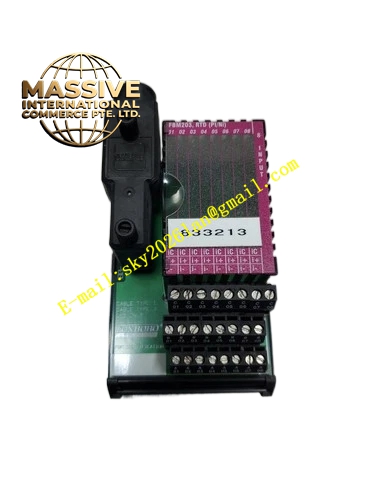
Description
Foxboro FBM203
Technical Specifications
- Channel Count: 8 independent, channel-isolated inputs.
- Input Type: 2-wire or 3-wire RTD (Platinum, Nickel, Copper).
- Communication: 2 Mbps redundant module fieldbus.
- Update Rate: Configurable, typically 500 ms per channel.
Functional Features
- Channel Isolation: Each input is galvanically isolated from all other inputs and ground, eliminating ground loop errors and crosstalk.
- Sigma-Delta Conversion: Utilizes advanced A/D conversion with configurable moving-average filters to reject power line frequency interference.
- Hot-Swappable: Can be replaced online without disturbing the field wiring or adjacent modules.
- Flexible Configuration: Supports various RTD curves and configurable filter time constants via system software.
Application Scenarios
Extensively used in refineries, chemical reactors, and power plants for precise temperature monitoring of pipelines, vessels, and heat exchangers.
Performance Parameters
- Accuracy: ±0.02% of span at 25°C.
- Input Impedance: > 10 MΩ.
- Lead Wire Resistance: Compensation for up to 100 Ω per lead.
Material Composition
Rugged extruded aluminum enclosure with internal conformal-coated printed circuit boards to resist moisture, dust, and corrosive gases.
Structural Characteristics
- Dimensions: Standard 200 Series FBM size (110 x 50 x 120 mm).
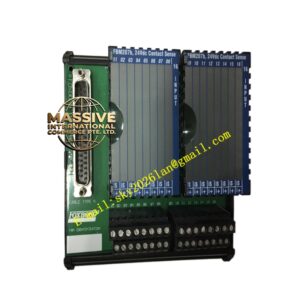
- Termination: Connects to the field via a dedicated Termination Assembly (TA).
- Indicators: Individual channel LEDs for status and alarm indication.
Working Principle
The module excites the RTD sensor with a precision constant current, measures the resulting voltage drop, and converts it to a digital value using a Sigma-Delta ADC. The data is then transmitted over the redundant fieldbus to the Field Control Processor (FCP).
Installation Requirements
- Must be mated with the correct RTD-specific Termination Assembly (TA).
- Use shielded twisted-pair cables for field wiring, with shields grounded at the TA.
- Ensure the chassis backplane is clean and free of debris before insertion.
Precautions for Use
- Verify the RTD type and wiring configuration (2-wire vs. 3-wire) matches the software configuration.
- Do not apply external voltage to the RTD input terminals.
- Handle the module with ESD-safe practices during installation or removal.