



Description
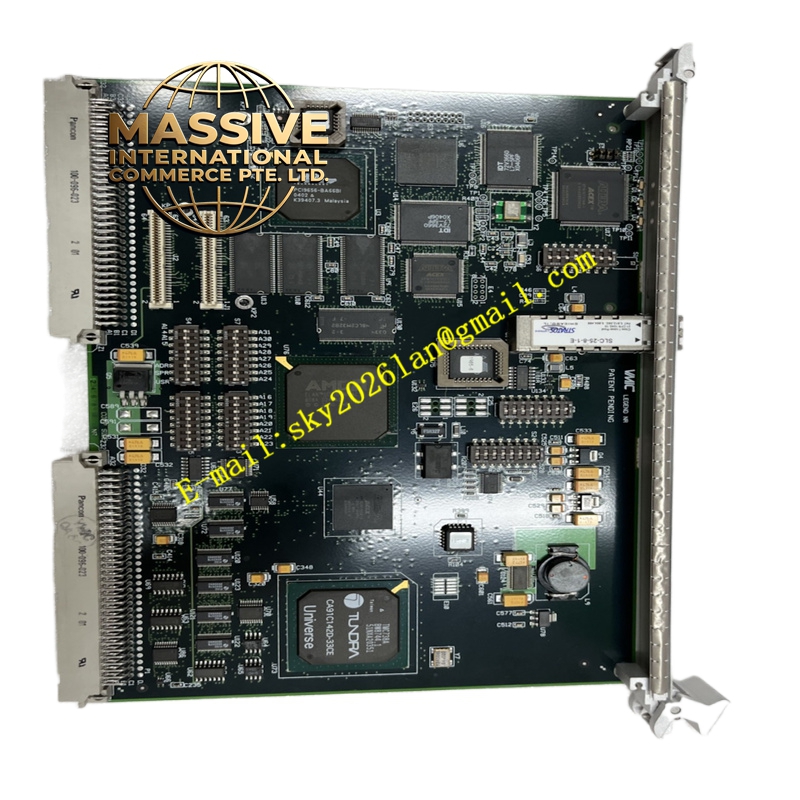
GE VMIVME-5565 Technical Specifications:
- Network Speed: 2.12 Gbaud serial fiber-optic connection.
- Data Throughput: Sustained transfer rates up to 174 MB/s (depending on packet size).
- Latency: Ultra-low, deterministic node-to-node latency of 450 to 500 nanoseconds.
- Network Capacity: Supports up to 256 nodes in a single ring or star topology.
- Onboard Memory: 128 MB or 256 MB SDRAM with ECC (Error Checking and Correction).
Functional Features:
- Transparent Memory Sharing: Data written to local reflective memory is automatically broadcast and written to the exact same memory address on all other nodes without CPU intervention.
- Zero Processor Overhead: The dedicated RFM network controller handles all data routing, completely bypassing the host VME CPU.
- Global Interrupts: Any node can trigger a hardware interrupt on any other node or all nodes simultaneously via a single command.
- Redundancy: Supports redundant transmission modes and optional node bypass to maintain network integrity during hardware failures.
Application Scenarios:
- Redundant turbine control systems (e.g., GE Mark VI).
- Real-time hardware-in-the-loop (HIL) simulation and testing.
- Multi-node motion control and synchronized robotics.
- High-speed data acquisition and distributed sensor networks.
Performance Parameters:
- Packet Size: Dynamic packet sizing from 4 to 64 bytes for optimized bandwidth.
- Fiber Optics: Supports multi-mode fiber (up to 300 meters) and single-mode fiber (up to 10 kilometers).
- Bus Interface: VME A24:D32 or A16:D32 slave interface.
Material Composition & Structural Characteristics:
- Optical Interface: Standard fiber-optic transceiver ports (SC or similar industrial connector).
- Form Factor: Standard 6U VME form factor.
- Indicators: Front-panel LEDs for link status, data transmission, reception, and error detection.
Working Principle: The host CPU writes data to a specific address in the VMIVME-5565’s local SDRAM. The RFM controller intercepts this write operation, packages the data into a fiber-optic frame, and broadcasts it around the network ring. Each receiving node’s RFM controller extracts the data and writes it to its local SDRAM at the identical memory address, making the entire network appear as one massive, shared RAM array.
Installation Requirements:
- Fiber Routing: Use appropriate multi-mode or single-mode fiber patch cables; avoid sharp bends that exceed the minimum bend radius.
- Topology: Configure the network as a unidirectional ring or use a managed hub (e.g., ACC-5595) for a star topology to allow hot-swapping and fault isolation.
- Node ID: Set the unique node identification via hardware jumpers or software configuration.
Usage Precautions:
- Fiber Cleanliness: Always use lint-free wipes and isopropyl alcohol to clean fiber connectors before mating; dust causes signal attenuation and bit errors.
- Memory Boundaries: Ensure host software respects the physical memory boundaries of the RFM board to prevent bus errors.
- Firmware: Keep the RFM controller firmware updated to utilize the latest error-correction and performance enhancements.