



Description
Bently 3500 22M
Technical Specifications
- Model Number: 3500/22M
- Module Type: Transient Data Interface
- Communication: 100 Base-T Ethernet / 100 Base-FX Fiber Optic
Key Features
- High-Speed Data Extraction: Captures and transmits high-resolution transient waveforms during machinery trips or alarms.
- Dual Communication Ports: Supports both copper Ethernet and fiber optic connections for flexible network integration.
- Data Buffering: Retains historical waveform data even if communication to the host is temporarily lost.
Application Scenarios
Installed in every 3500 framework that requires connection to System 1 State Monitoring Software for advanced diagnostics, predictive maintenance, and post-trip analysis.
Performance Parameters
- Network Speed: 100 Mbps
- Data Update Rate: Real-time for steady-state, high-speed for transient capture
Material Composition
Ruggedized industrial enclosure with advanced EMI/RFI shielding to protect high-speed digital communications from analog sensor noise.
Structural Characteristics
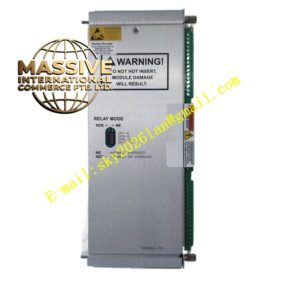
Full-height module form factor. Must be installed in the first slot immediately to the right of the power supply module. Features front-panel RJ-45 and fiber optic ports.
Working Principle
Continuously polls the 3500 backplane for alarm triggers. When a transient event occurs, it captures high-frequency waveform data, packages it into TCP/IP packets, and transmits it to the host server over the network.
Installation Requirements
Must be placed in Slot 1 (next to the power supply). Connect using standard Cat5e/Cat6 Ethernet cables or 100 Base-FX fiber optic patch cables.
Usage Precautions
Ensure the network switch supports 100 Mbps full-duplex. Avoid running network cables parallel to high-voltage power lines to prevent electromagnetic interference.