


Description
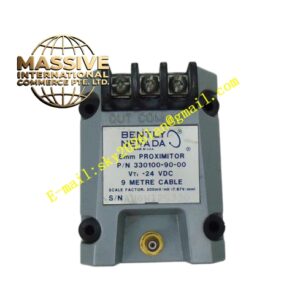
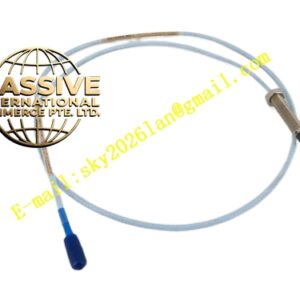
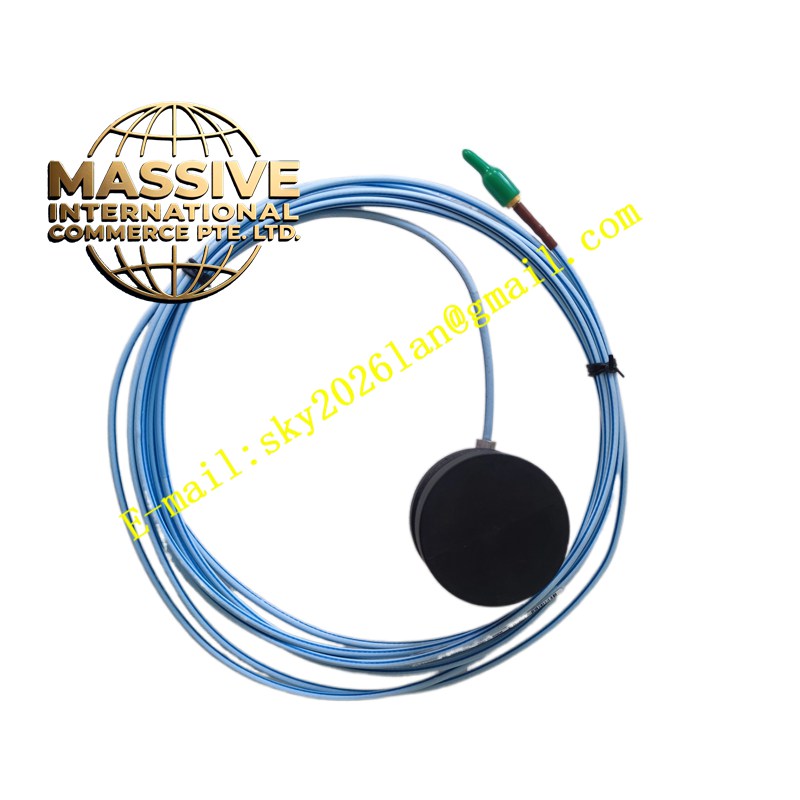
Bently Nevada 330103-00-02-10-02-00
Technical Specifications
| Parameter | Specification |
|---|---|
| Manufacturer | Bently Nevada |
| Product Family | 3300 XL 8 mm Proximity Transducer System |
| Sensing Diameter | 8.0 mm (0.31 in) |
| Mounting Thread | M10 × 1 metric thread |
| Unthreaded Length | 0 mm (flush mounting configuration) |
| Overall Case Length | 20 mm |
| Total Cable Length | 1.0 meter (3.3 feet) |
| Connector Type | Miniature coaxial ClickLoc connector, standard cable |
| Agency Approval | No special certification required |
| Linear Range | 0.25 mm to 2.3 mm (10 to 90 mils) |
| Output Sensitivity | 7.87 V/mm (200 mV/mil) |
| Recommended Gap Setting | 1.27 mm (50 mils), producing approximately -9 Vdc |
| Output Signal Range | -1 Vdc to -17 Vdc |
| DC Resistance | 7.59 Ω ± 0.50 Ω |
| Operating Temperature | -51°C to +177°C (-60°F to +350°F) |
| Frequency Response | DC to 10 kHz |
| Scale Factor Deviation | Less than ±0.025 mm (±1 mil) from best fit line |
Functional Features
- Non-contact eddy-current measurement principle eliminates mechanical wear
- Patented TipLoc molding creates a stronger bond between probe tip and probe body
- Patented CableLoc design provides 330 N (75 lbf) pull strength at the cable-to-probe junction
- Complete interchangeability with other 3300 XL 8 mm probes, extension cables, and Proximitor sensors
- Backward compatible with non-XL 3300 series 5 mm and 8 mm components
- Gold-plated corrosion-resistant ClickLoc connectors with finger-tight locking mechanism
Application Scenarios
- Radial shaft vibration monitoring on fluid-film bearing machines
- Shaft axial position and thrust measurement
- Keyphasor reference and speed measurement
- Turbine supervisory instrumentation systems
- Predictive maintenance programs in power generation and oil & gas facilities
Performance Parameters The probe delivers a linear voltage output directly proportional to the gap distance between the probe tip and the observed conductive surface. The system measures both static (position) and dynamic (vibration) values with high resolution and long-term stability.
Material Composition
- Probe Tip: Polyphenylene Sulfide (PPS) molded encapsulation
- Probe Case: AISI 303 or 304 stainless steel
- Cable: Fluoroethylene propylene (FEP) insulated triaxial cable, 75 Ω impedance
- Connector: Gold-plated miniature coaxial ClickLoc
Structural Characteristics The probe features a compact 20 mm case length with zero unthreaded length, providing a flush mounting configuration ideal for tight spaces. The M10 × 1 metric thread allows standard metric installation. The 1.0 meter integral cable terminates in a miniature coaxial ClickLoc connector.
Working Principle The probe operates on the eddy-current principle. A high-frequency radio frequency signal from the Proximitor sensor is conditioned by the probe tip. The impedance change caused by the target surface distance is converted into a DC voltage proportional to gap. The electromagnetic field generated at the probe tip induces eddy currents in the conductive target material, and the resulting signal variation is processed into a precise displacement measurement.
Installation Requirements
- Mount the probe strictly perpendicular to the shaft surface to prevent measurement non-linearity
- Ensure the target shaft is free of surface non-homogeneities, scratches, or contaminants
- Utilize the M10 × 1 threaded housing for depth adjustment
- Tighten locking nuts to prevent mechanical vibration shifting
- Maintain shielding continuity from the probe through the extension cable to the Proximitor
- Use a precision feeler gauge to establish the nominal air gap based on the target operating range
- Minimum cable bend radius must be observed to prevent signal degradation
Usage Precautions
- The probe must be used with a compatible 3300 XL Proximitor sensor and extension cable to form a complete transducer system
- Do not operate the probe independently without the Proximitor sensor
- Ensure adequate spacing between adjacent probes to prevent mutual interference of carrier frequency signals
- Connector protectors are recommended for all installations to provide increased environmental protection
- Do not exceed the specified temperature range to maintain measurement accuracy
- Avoid pulling or twisting the cable beyond the CableLoc rated strength during installation