


Description
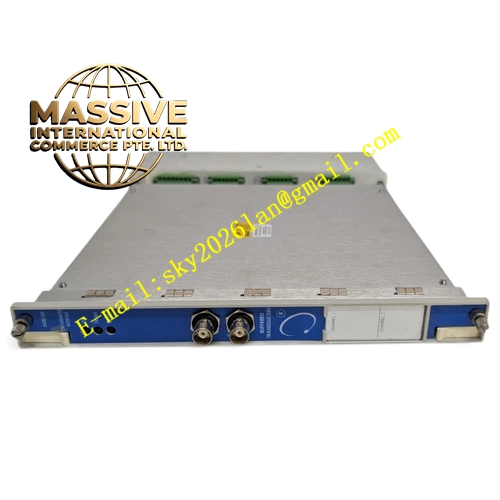
Bently Nevada 330130-070-00-05
Technical Specifications:
- Cable Length: 7.0 meters (22.9 feet)
- Cable Type: Standard non-armored cable
- Connector Type: Micro-coaxial ClickLoc gold-plated copper connectors
- Conductor Type: 75Ω triaxial coaxial structure
- Insulation Material: FEP (Fluoroethylene Propylene)
- Operating Temperature Range: -52°C to +177°C
- Minimum Bend Radius: 25.4mm (1 inch)
- Certification: CSA NRTL/C, BASEEFA/CENELEC, CSA Division 2
- Compliance Standard: API 670 (4th Edition)
Functional Features:
- Multi-agency certification supports hazardous area (Division 2) installations
- 75Ω triaxial coaxial structure ensures impedance matching and signal transmission integrity
- FEP insulation material provides excellent chemical resistance and high-temperature performance
- Multi-layer shielding design effectively resists electromagnetic interference in the field
- ClickLoc gold-plated copper connectors ensure corrosion-resistant, tool-free reliable connections
- Fully interchangeable with the 3300 XL 8mm system, no individual calibration required
- Backward compatible with non-XL 3300 series 5mm and 8mm components
Application Scenarios:
- Steam turbine shaft vibration monitoring in hazardous areas
- Compressor axial displacement measurement in classified zones
- Generator bearing vibration monitoring in Division 2 locations
- Petrochemical plant monitoring requiring multi-agency certification
- International projects requiring CSA, ATEX, and IECEx certifications
- Applications requiring longer cable runs in hazardous environments
Performance Parameters:
- Cable Capacitance: 69.9 pF/m (21.3 pF/ft)
- Output Impedance: 50Ω
- Sensitivity Stability: Output changes less than 2mV per 1 volt change in input voltage
- Frequency Response: 0 to 10kHz
- Core Resistance (RCORE): 1.54Ω ± 0.23Ω (for 7.0m length)
- Jacket Resistance (RJACKET): 0.46Ω ± 0.09Ω (for 7.0m length)
Material Composition:
- Conductor: Copper core with braided shielding layer
- Insulation Layer: FEP (Fluoroethylene Propylene)
- Connector: ClickLoc gold-plated copper
- Outer Jacket: Standard industrial-grade polymer
Structural Characteristics: Flexible coaxial cable with a triaxial structure. The cable is equipped with ClickLoc gold-plated copper connectors. The standard non-armored structure is suitable for indoor or conduit installations. The multi-agency certification makes this cable suitable for hazardous area installations. The 7.0-meter length provides sufficient wiring margin for standard 9-meter system configurations.
Working Principle: Same as the standard extension cable. The probe high-frequency signal is transmitted through the triaxial coaxial structure to the Proximitor for signal processing.
Installation Requirements:
- Ensure the total length of the probe cable plus the extension cable strictly equals 5.0 meters or 9.0 meters
- Cable routing must maintain at least 30cm clearance from high-voltage power cables
- Maintain a minimum bend radius of 25.4mm; prohibit excessive bending
- ClickLoc connectors are hand-tightened; do not use tools
- The shielding layer must be grounded at a single point on the Proximitor end
- Hazardous area installations must comply with applicable explosion-proof regulations
Usage Notes:
- The “00” code indicates a standard non-armored cable, suitable for clean environments
- The “05” code indicates multi-agency certification; verify that the specific certifications meet site requirements before installation
- Inspect connector condition at each maintenance interval
- Never cut or splice the extension cable; any modification will destroy impedance matching
- Hazardous area installations must comply with applicable explosion-proof regulations
- When replacing the cable, select a specification that exactly matches the original model