


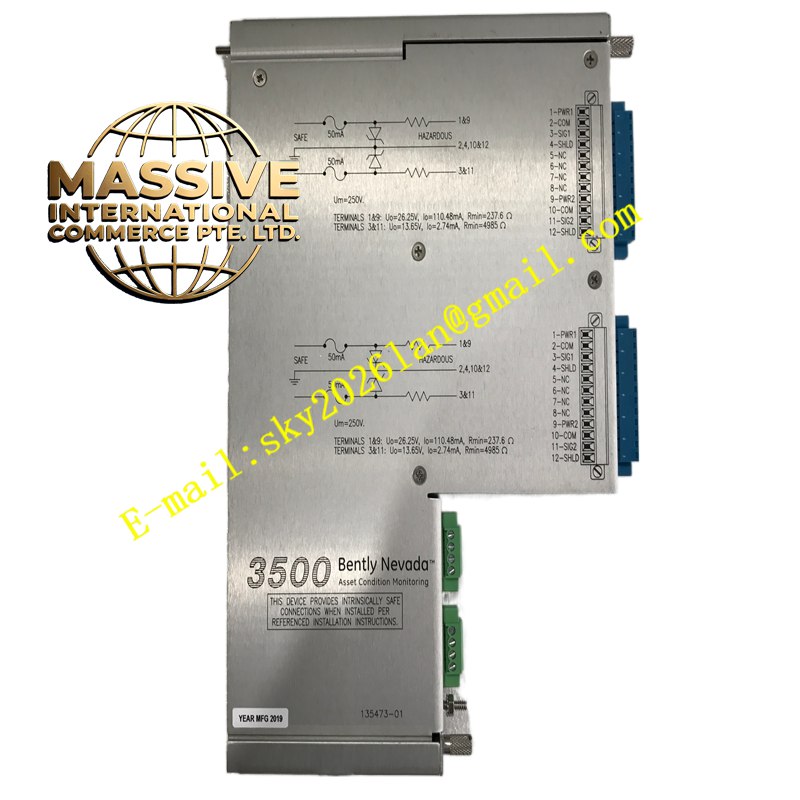
Description
Bently Nevada 330130-070-01-00
Technical Specifications:
- Cable Length: 7.0 meters (23.0 feet)
- Cable Type: Armored with connector protector
- Connector Type: ClickLoc miniature coaxial connectors (both ends)
- Conductor Type: 75 Ω triaxial
- Insulation Material: FEP (fluoroethylene propylene)
- Operating Temperature: -52°C to +177°C
- Minimum Bend Radius: 25.4 mm (1 inch)
- Certification: -00 suffix indicates no specific certification requirement
- Compliance: API 670 standard
Functional Features:
- Armored construction provides superior mechanical protection against crushing, abrasion, and impact
- Connector protector adds an extra layer of environmental sealing for the ClickLoc connections
- Low-loss signal transmission for high-frequency eddy current signals
- 75 Ω triaxial construction provides excellent EMI/RFI shielding
- ClickLoc connectors ensure secure, corrosion-resistant connections
- FEP insulation provides chemical resistance and high-temperature performance
- Fully interchangeable within the 3300 XL 8mm system
Application Scenarios:
- Turbine installations where cables are exposed to mechanical hazards and moisture
- Compressor and pump monitoring in petrochemical plants with oily environments
- Outdoor installations exposed to weather and physical damage
- Areas with heavy foot traffic or equipment movement near cable routes
- General industrial machinery in harsh environments requiring both mechanical and environmental protection
- Applications requiring longer cable runs (7.0m) with armored protection
Performance Parameters:
- Cable Capacitance: 69.9 pF/m (21.3 pF/ft)
- Output Resistance: 50 Ω
- Sensitivity Stability: Less than 2 mV change per volt change in input voltage
- Armored Tensile Strength: Enhanced resistance to pulling forces
Material Composition:
- Conductor: Copper with braided shield
- Armor: Stainless steel braided armor
- Insulation: FEP (fluoroethylene propylene)
- Connectors: ClickLoc gold-plated copper
- Connector Protector: Environmental sealing cap
- Outer Jacket: Heavy-duty industrial-grade polymer
Structural Features: Armored coaxial cable with triaxial construction. The stainless steel braid armor provides mechanical protection while maintaining flexibility. ClickLoc connectors at both ends are covered by connector protectors for additional moisture and contamination resistance.
Working Principle: Identical to the standard extension cable. The armored construction and connector protector do not affect the electrical performance but provide additional mechanical and environmental protection for the signal-carrying conductors and connection points.
Installation Requirements:
- Ensure the total system cable length (probe cable + extension cable) equals 5.0 m or 9.0 m
- Route cables at least 30 cm away from high-voltage power cables
- Maintain minimum bend radius of 25.4 mm
- Hand-tighten ClickLoc connectors; do not use tools
- Single-point shield grounding at the Proximitor end
- The armored cable is heavier and less flexible than standard cable; plan routing accordingly
- Install connector protectors after final connection to ensure proper sealing
Usage Notes:
- The -01 code indicates armored construction with connector protector; use in environments with both mechanical hazards and moisture exposure
- The -00 suffix indicates no specific certification requirement; verify local certification requirements before installation
- Inspect armor integrity and connector protector condition during each maintenance interval
- Do not use standard cable in areas where armored cable with connector protector is specified
- Verify connector tightness after installation in high-vibration areas