


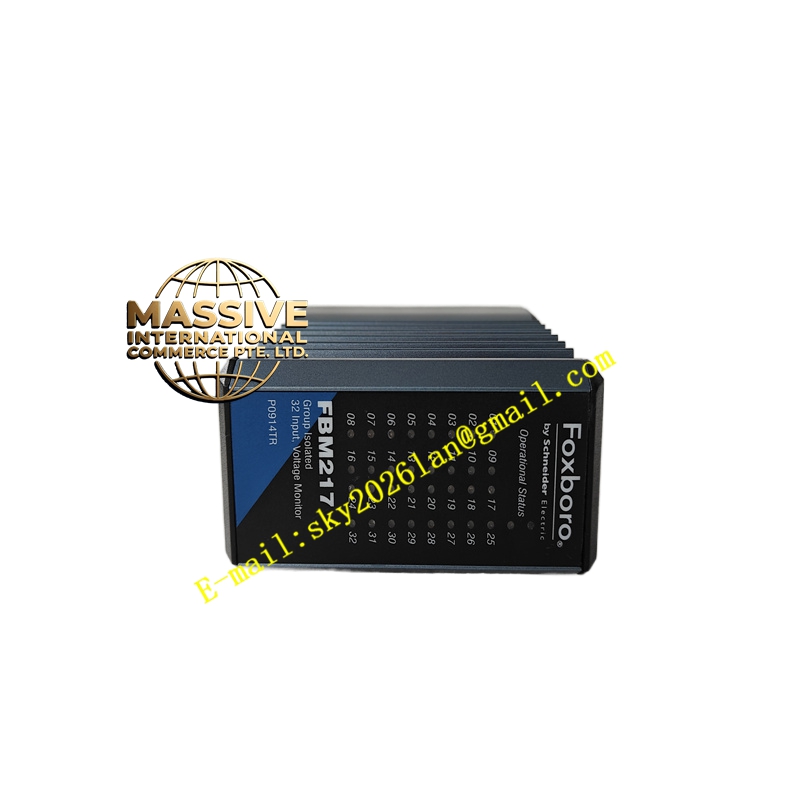
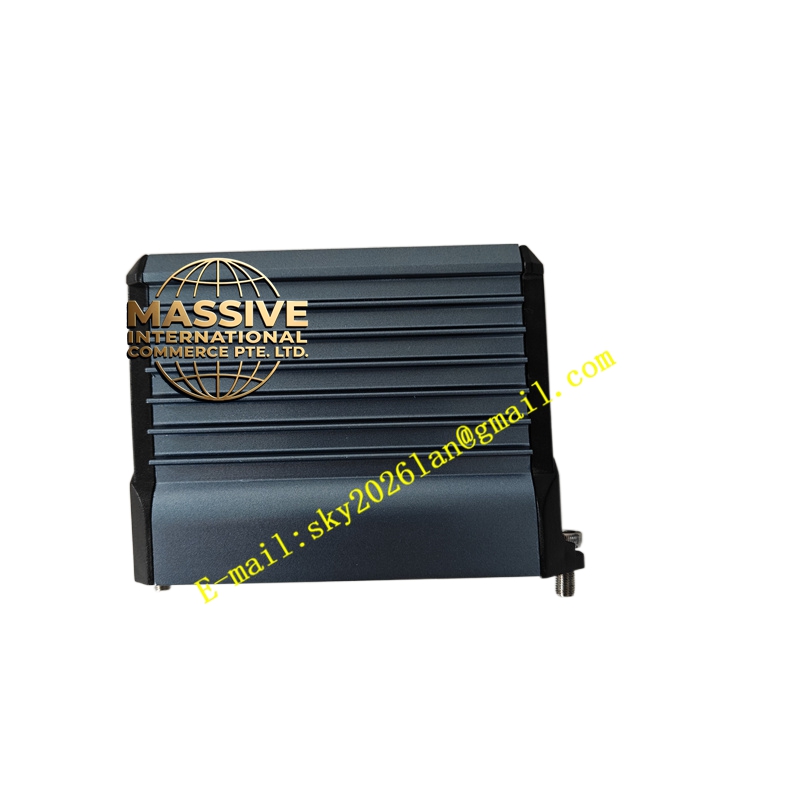
Description
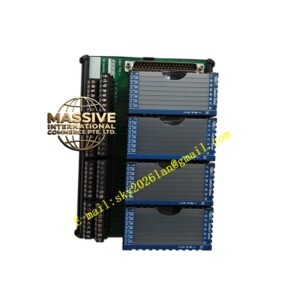
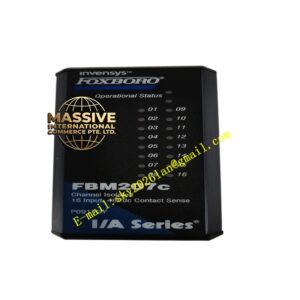
Foxboro FBM217 P0914TR Technical Specifications:
- Module Type: Discrete Input (DI).
- Terminal Base: P0914TR.
- Channels: Typically 16 or 32 channels depending on configuration.
- Input Voltage: Dry contact or wet contact (voltage level depends on terminal base).
Functional Features:
- Status Monitoring: Accurately reads open/closed states of field devices.
- Debounce Filtering: Programmable input filtering to prevent false triggering.
- High Density: Maximizes I/O point count per module.
- Diagnostic LEDs: Visual indication of channel status and module health.
Application Scenarios:
- Monitoring pump run/stop, valve open/close, and alarm contacts.
- Reading safety interlock and permissive signals.
- General plant status indication.
Performance Parameters:
- Scan Rate: Fast discrete scanning for real-time interlock response.
- Input Impedance: Optimized for minimal field loop loading.
- Isolation: Channel-to-backplane isolation.
Material Composition & Structural Characteristics:
- Circuitry: Optocoupler-based input isolation.
- Housing: Standard I/A Series module.
- Terminals: Compatible with P0914TR terminal base.
Working Principle: Field voltage or dry contact closure energizes an internal optocoupler. The optocoupler isolates the field circuit and provides a logic-level signal to the module’s microcontroller, which updates the status map on the I/O bus.
Installation Requirements:
- Mate the module with the P0914TR terminal base.
- Wire field contacts according to the terminal base diagram.
- Configure input filtering and alarm limits in software.
Usage Precautions:
- Verify the voltage rating of the P0914TR terminal base before connecting wet contacts.
- Do not exceed the maximum current rating of discrete inputs.
- Use shielded cables for long discrete runs in noisy environments.