


Description
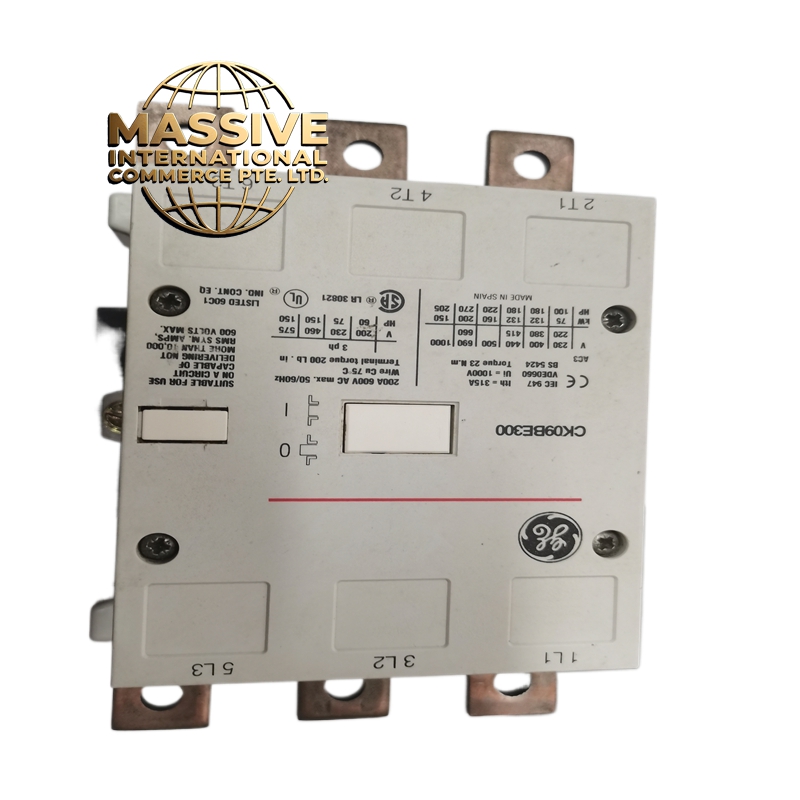
GE CK09BE311J
Technical Specifications:
- Coil Voltage: 24V DC (BE variant)
- Coil Power Consumption: 0.7W (typical at 24V DC)
- Contact Configuration: 3 Changeover (CO) + 1 Normally Open (NO) = 10 poles total
- Contact Type: Form C (1 CO = 1 NO + 1 NC) for the 3 changeover contacts
- Contact Rating (AC-15): 6A at 250V AC
- Contact Rating (DC-13): 6A at 30V DC
- Contact Rating (Resistive): 10A at 250V AC
- Mechanical Life: 10 million operations
- Electrical Life: 500,000 operations (at rated load, AC-15)
- Operating Time: Less than 10ms (energize), less than 5ms (de-energize)
- Release Time: Less than 5ms
- Insulation Resistance: Greater than 100MΩ at 500V DC
- Dielectric Strength: 2500V AC for 1 minute (coil to contacts)
- Operating Temperature: -25°C to +70°C
- Storage Temperature: -40°C to +85°C
- Humidity: 5% to 95% non-condensing
- Dimensions: 90mm x 9mm x 65mm (H x W x D, including socket base)
- Weight: Approximately 35g (relay only), 55g (with socket)
- Mounting: DIN rail (35mm) with socket base
- Standards: IEC 61810, EN 60947-5-1, UL 508, CSA C22.2 No. 14
Functional Features:
- Slim 9mm profile saves panel space (compared to standard 16mm relays)
- LED status indicator on front shows coil energized state (green LED)
- Manual test button on front for contact verification without energizing coil
- Transparent protective cover allows visual inspection of contact status
- Socket base (PYF09A-E compatible) enables quick relay replacement without rewiring
- Front-clip terminal connections for fast wiring (no screwdriver required)
- Contact status mirror for quick visual confirmation of contact state
Application Scenarios:
- PLC output expansion in machine control cabinets
- Interlocking circuits for motor starters (forward/reverse interlock)
- Signal routing in building automation (HVAC damper control)
- Conveyor belt sequencing in material handling systems
- Pump station automatic/manual switching
- Safety circuit monitoring (emergency stop logic)
- Lighting control panels (day/night switching)
Performance Parameters:
- Coil Voltage Tolerance: +10% / -15% of nominal (21.6V to 26.4V DC)
- Must-Operate Voltage: 80% of nominal (19.2V DC)
- Must-Release Voltage: Less than 20% of nominal (less than 4.8V DC)
- Contact Bounce Time: Less than 2ms
- Vibration Resistance: 5g at 10Hz to 150Hz (IEC 60068-2-6)
- Shock Resistance: 15g for 11ms (IEC 60068-2-27)
Material Composition:
- Housing: Flame-retardant polybutylene terephthalate (PBT, UL94 V-0)
- Contact Material: Silver-nickel alloy (AgNi 10) for low contact resistance
- Coil Winding: Copper wire with Class H insulation (180°C rating)
- Terminals: Phosphor bronze with tin plating
- Socket Base: Polyamide 6.6 (PA66) with glass fiber reinforcement
Structure Features:
- Ultra-slim 9mm width fits in high-density DIN rail panels
- Socket base with spring-loaded contacts for tool-free relay insertion/removal
- Clear label window on front for circuit identification
- Terminal covers protect against accidental short circuits during wiring
- Clip-on end caps for DIN rail retention
Working Principle: When 24V DC is applied to the coil terminals (A1 and A2), the electromagnetic field pulls the armature, causing the 3 changeover contacts to switch from NC to NO position, and the 1 NO contact to close. When the coil is de-energized, a spring returns the armature to its resting position. The LED on the front illuminates when the coil is energized, providing visual confirmation. Installation Requirements:
- Mount socket base on DIN rail first
- Connect coil wiring to terminals A1 (+) and A2 (-) using 0.5mm² to 1.5mm² wire
- Connect load wiring to the contact terminals (11, 12, 14 for CO contacts; 13, 14 for NO contact)
- Ensure coil voltage matches the control supply (24V DC for BE variant)
- Leave 10mm clearance above and below the relay for ventilation
Usage Notes:
- Do not exceed the contact rating (6A at 250V AC) or contacts will weld
- Use a flyback diode (1N4007) across the coil if switching inductive loads to suppress voltage spikes
- For DC coil operation, observe polarity (A1 = positive, A2 = negative)
- Replace the relay using the socket base without de-energizing the control circuit