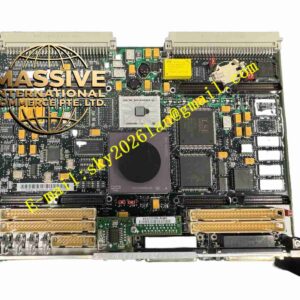





Description
Motorola MVME162-020A
Technical Specifications
- Microprocessor: 25 MHz MC68040 with FPU and MMU.
- Memory: 4MB DRAM, 512KB battery-backed SRAM.
- Non-Volatile Storage: 8KB NVRAM with real-time clock (RTC) and watchdog.
- Expansion: Four IndustryPack ports with dedicated DMA channels.
Functional Features
- Integrated 162Bug monitor/debugger for system diagnostics.
- Supports VMEbus D64 block transfers for optimized throughput.
- Provides seven-level interrupt handling and four-level requestor.
- Features Global Control and Status Registers (GCSR) for multiprocessor communication.
Application Scenarios
Ideal for military ground systems, aerospace test stands, railway signaling, and heavy industrial machinery control.
Ideal for military ground systems, aerospace test stands, railway signaling, and heavy industrial machinery control.
Performance Parameters
- DMA Support: High-performance DMA for VMEbus D64 and local bus memory burst cycles.
- Serial I/O: Dual asynchronous channels supporting EIA-232/422 protocols.
- Storage Temperature: -40°C to +85°C.
Material Composition
High-Tg printed circuit board with gold-plated VME edge connectors and industrial-grade capacitors.
High-Tg printed circuit board with gold-plated VME edge connectors and industrial-grade capacitors.
Structural Characteristics
Double-high 6U VME board with front panel status LEDs (RUN, FAIL, STAT) and manual reset/abort buttons.
Double-high 6U VME board with front panel status LEDs (RUN, FAIL, STAT) and manual reset/abort buttons.
Working Principle
Executes boot firmware from Flash, initializes hardware, and loads the real-time operating system (RTOS). The CPU coordinates with the VMEChip2 to manage bus arbitration and data routing.
Executes boot firmware from Flash, initializes hardware, and loads the real-time operating system (RTOS). The CPU coordinates with the VMEChip2 to manage bus arbitration and data routing.
Installation Requirements
- Verify system controller jumper settings (J1) if used as the VME arbiter.
- Ensure adequate clearance for IndustryPack modules if installed.
- Connect chassis ground properly to minimize EMI.
Usage Precautions
- Keep SCSI ribbon cables within specified lengths if the SCSI option is utilized.
- Route serial communication lines away from high-noise power cables.
- Perform routine inspection of backplane contacts for oxidation.