


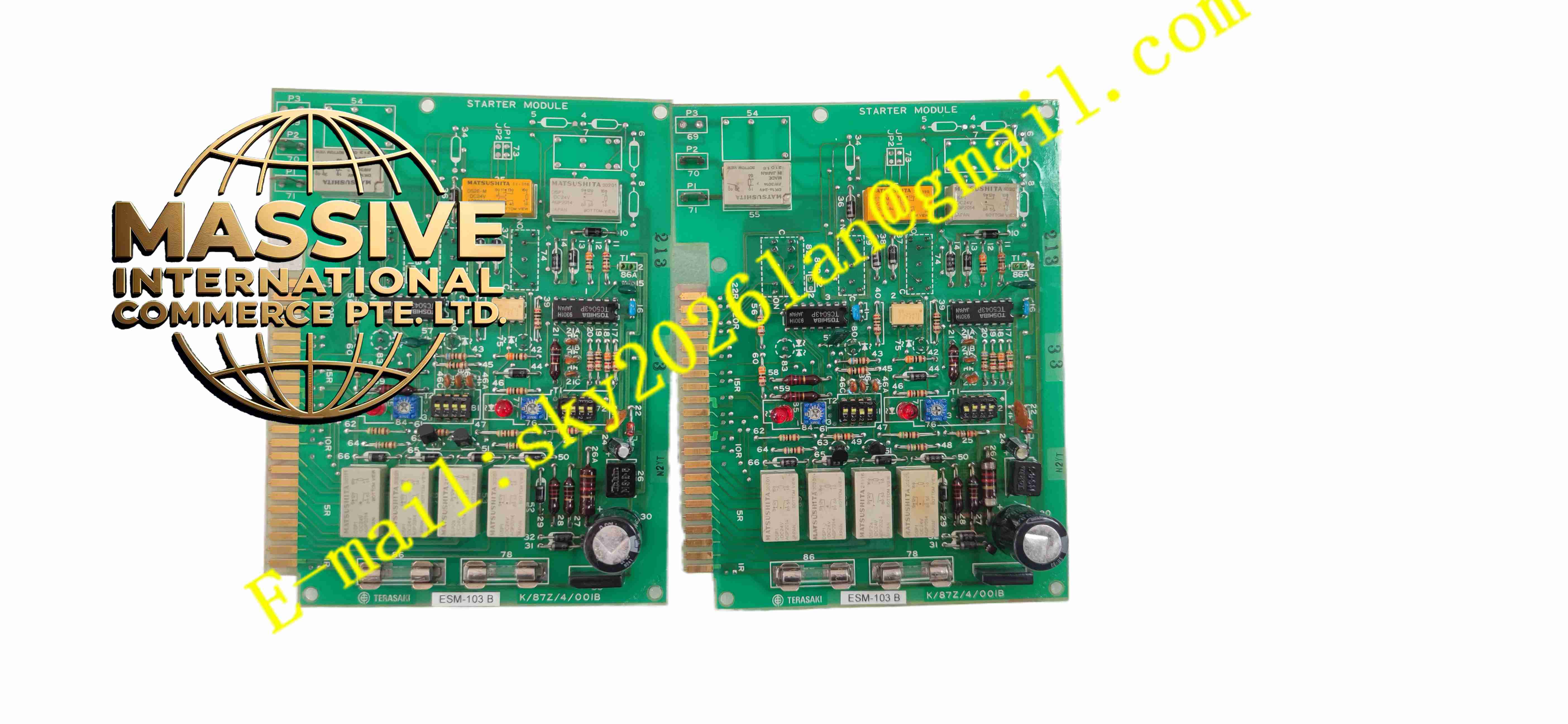
Description
TERASAKI ESM-103B Control Board Module
Technical Specifications
- Brand: TERASAKI
- Model: ESM-103B
- Product Type: Control board module
- Application Area: Industrial automation, power distribution control, marine electrical systems
- Processing Function: Signal acquisition, logic control, and command output
- I/O Capability: Supports digital and analog signal interfaces depending on system configuration
- Communication Support: May support Modbus, Profibus, Ethernet/IP, or other industrial protocols depending on version
- Mounting Type: Modular plug-in board for TERASAKI control or protection racks
- Power Supply: Low-voltage DC supply from the parent system
Functional Features
- Modular Design: Allows flexible integration into TERASAKI control assemblies.
- Signal Processing: Acquires and processes sensor, relay, and switch signals.
- Logic Control: Executes control logic for protection, interlock, and automation functions.
- I/O Expansion: Connects to sensors, actuators, relays, and display devices.
- Communication Interface: Supports integration with higher-level control systems where equipped.
- Protection Support: Assists in motor protection, breaker control, and alarm management.
- Diagnostic Capability: Provides status feedback and fault indication for maintenance.
- High Reliability: Designed for continuous operation in industrial and marine environments.
Application Scenarios
- Marine switchboard control systems
- Industrial motor protection panels
- Power distribution automation
- Generator control and monitoring
- Substation auxiliary control
- Process plant interlock systems
- Alarm and status monitoring panels
Performance Parameters
- Processing Speed: Supports real-time monitoring and control of electrical and process signals.
- I/O Flexibility: Handles digital inputs, digital outputs, and analog signals as configured.
- Communication Compatibility: Supports common industrial communication standards depending on version.
- Control Accuracy: Provides stable logic execution for protection and automation tasks.
- Environmental Suitability: Designed for indoor industrial and marine control rooms.
- Service Life: Built for long-term operation in protection and automation systems.
Material Composition
- PCB: High-quality industrial printed circuit board.
- Processor: Microcontroller or DSP for control logic and signal processing.
- I/O Circuits: Optocouplers, drivers, and interface components for signal isolation.
- Communication Interface: Ethernet, serial, or fieldbus interface circuits depending on version.
- Power Circuit: DC power regulation and protection components.
- Connectors: Board-to-board or front-panel connectors for system integration.
- Protective Components: Fuses, TVS devices, and filtering components for electrical protection.
Structural Features
- Plug-In Module Design: Installs directly into TERASAKI control or protection racks.
- Compact PCB Layout: Optimized for dense electrical control assemblies.
- Front or Rear Connectors: Allows connection to system backplane or external terminals.
- Status LEDs: Indicates power, communication, I/O status, and fault conditions.
- Robust Construction: Designed to withstand vibration and temperature variations in industrial panels.
- Replaceable Module: Supports maintenance without replacing the entire control unit.
Working Principle
The ESM-103B receives input signals from sensors, switches, protection relays, or external controllers. The onboard processor evaluates these signals according to configured logic, protection rules, or communication commands. It then generates output signals to control relays, breakers, alarms, or other devices. If communication interfaces are present, the module can exchange status data, setpoints, and fault information with上位机 systems, PLCs, or protection management units. When abnormal conditions are detected, the module triggers alarms, trips, or interlock actions to maintain system safety.
Installation Requirements
- Confirm compatibility with the TERASAKI system before installation.
- Power down the control rack before inserting or removing the module.
- Handle the board by its edges to avoid damaging components.
- Ensure connectors are clean and fully seated.
- Verify system firmware and configuration compatibility.
- Check indicator status after power-up.
- Perform functional testing before placing the system into service.
Precautions for Use
- Do not insert or remove the module while the system is energized unless permitted by the manual.
- Avoid static discharge when handling the board.
- Do not expose the module to moisture, dust, or corrosive gases.
- Verify communication settings before connecting to external systems.
- Do not modify firmware or parameters without authorization.
- Keep a backup of configuration data before maintenance.
- Replace faulty boards with the same model and version.
- Only qualified engineers should configure or troubleshoot the module.
- Refer to the official TERASAKI documentation for exact I/O definitions, communication protocols, and electrical ratings.