


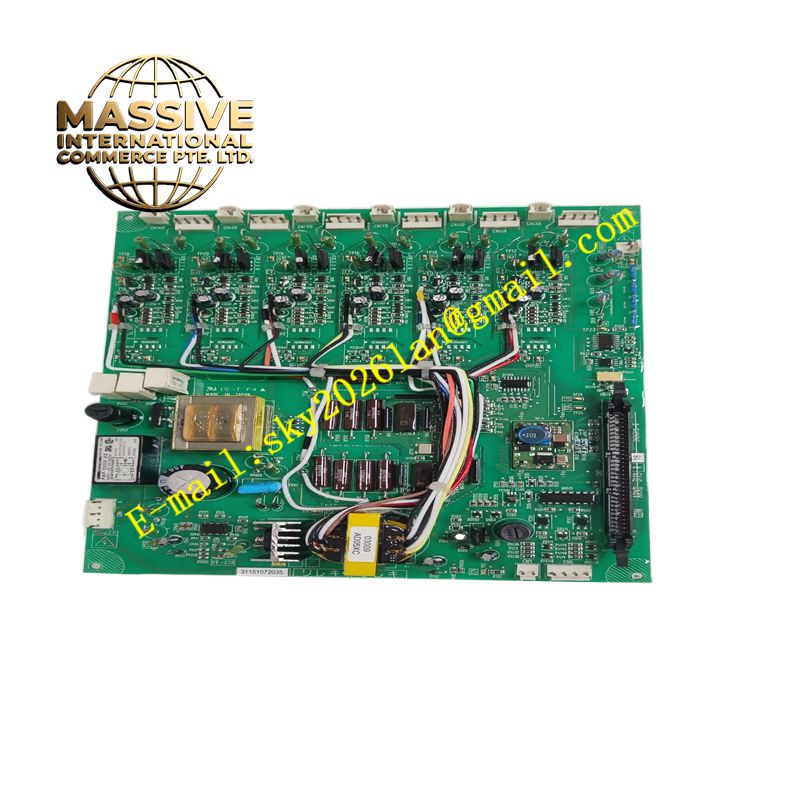
Description
TMEIC ARND-3115A18
Technical Specifications
- Brand: TMEIC (Toshiba Mitsubishi-Electric Industrial Systems Corporation)
- Model: ARND-3110
- Product Type: Industrial Control/Interface Module
- Product Family: TMEIC Industrial Control System Platform
- Application Domain: Industrial Automation, Process Control, Drive Systems
- Supply Voltage: 24V DC (typical industrial control voltage)
- Communication Interfaces: Fiber optic, Ethernet, or proprietary TMEIC communication protocols
- Processing Capability: Real-time control execution with deterministic response times
- Operating Temperature: 0°C to 55°C (industrial grade)
- Storage Temperature: -20°C to 70°C
- Humidity Range: 5% to 95% non-condensing
- Protection Rating: IP20 (panel-mounted)
- Vibration Resistance: IEC 60068-2-6 compliant
- Shock Resistance: IEC 60068-2-27 compliant
- EMC Compliance: IEC 61000-4 series industrial immunity standards
- Dimensions: Module-specific form factor (typically 1U or 2U rack-mount compatible)
- Weight: Approximately 1-2 kg (module dependent)
Functional Features
- High-reliability industrial control processing for real-time automation applications
- Integration with TMEIC’s distributed control system architecture
- Multiple communication interface options including fiber optic and Ethernet connectivity
- Deterministic response times ensuring precise synchronization in multi-axis systems
- Hot-swappable module design enabling maintenance without system shutdown
- Comprehensive self-diagnostics and health monitoring capabilities
- Event logging and fault recording for maintenance and troubleshooting
- Redundant architecture support for critical process applications
- Field-upgradeable firmware enabling feature enhancements and bug fixes
- Seamless integration with TMEIC drive systems and automation platforms
- Configurable I/O mapping for flexible system integration
- Remote monitoring and diagnostics capability via industrial communication networks
- Comprehensive electromagnetic compatibility (EMC) hardening for industrial environments
Application Scenarios
- Steel and Metal Processing: Rolling mill control, reheating furnace automation, and finishing line control
- Power Generation: Turbine control, generator excitation systems, and balance-of-plant automation
- Oil and Gas: Pipeline compression control, refinery process automation, and offshore platform systems
- Chemical Processing: Batch process control, continuous process automation, and safety instrumented systems
- Mining and Minerals: Conveyor control, crusher automation, and grinding mill control
- Pulp and Paper: Paper machine drive control, reel automation, and process control systems
- Water and Wastewater: Pump station control, treatment process automation, and distribution systems
- Cement Production: Kiln control, mill automation, and material handling systems
- Automotive Manufacturing: Paint shop automation, assembly line control, and testing systems
- Marine and Offshore: Ship propulsion control, power management systems, and cargo handling
Performance Parameters
- Control Loop Execution: Millisecond-level deterministic control loop update rates
- Communication Latency: Microsecond-level inter-module communication via fiber optic links
- I/O Response Time: Sub-millisecond digital and analog I/O response for critical control functions
- System Availability: >99.9% availability with redundant configuration options
- Mean Time Between Failures (MTBF): Designed for >100,000 hours in industrial service
- Operating Temperature Range: 0°C to 55°C continuous operation
- Electromagnetic Compatibility: IEC 61000-4 series compliant for industrial immunity levels
- Vibration Resistance: IEC 60068-2-6 compliant for industrial vibration environments
- Shock Resistance: IEC 60068-2-27 compliant for industrial shock conditions
- Humidity Tolerance: 5% to 95% non-condensing per industrial standards
Material Composition
- Processing Unit: Industrial-grade microprocessor or FPGA for real-time control execution
- Memory: ECC-protected RAM and non-volatile flash memory for program and data storage
- Communication Interfaces: Fiber optic transceivers or Ethernet PHY chips with industrial-grade magnetics
- Power Supply Circuitry: DC-DC converters with input filtering and reverse polarity protection
- I/O Circuitry: Optically isolated digital I/O and precision analog I/O with signal conditioning
- Heat Sink: Aluminum heat sink with optimized fin geometry for conduction and convection cooling
- Housing: Ruggedized metal enclosure with EMI shielding gaskets and mounting flanges
- PCB Substrate: High-Tg FR-4 printed circuit board with conformal coating for environmental protection
- Connectors: Industrial-grade circular or backplane connectors with locking mechanisms
- Internal Wiring: High-temperature insulated wiring with proper strain relief and routing
Structural Features
- Modular form factor designed for rack-mount or backplane installation
- Front-accessible status LEDs and communication port indicators
- Hot-swappable design with guide rails and locking mechanisms for safe module extraction
- Integrated heat sink with thermal interface to enclosure for efficient heat dissipation
- Ruggedized connector interfaces preventing vibration-induced disconnection
- Clear labeling with model number, serial number, and connection diagrams
- Mounting holes and guide pins ensuring proper alignment during installation
- Environmental sealing gaskets around all enclosure interfaces
- Vibration-isolated internal mounting for sensitive electronic components
- Diagnostic push-buttons or switches for local testing and configuration
Working Principle
The TMEIC ARND-3110 operates as a distributed control module within TMEIC’s industrial automation architecture. The module receives power from the system’s 24V DC supply, which is internally regulated to the various voltage levels required by the digital logic, communication interfaces, and I/O circuitry. The processing unit executes control algorithms and communication protocols in real-time, processing input data from sensors, other control modules, and operator interfaces.
For communication-intensive applications, the module utilizes fiber optic or Ethernet interfaces to exchange data with other modules in the distributed control system. Fiber optic communication provides electrical isolation and immunity to electromagnetic interference, making it ideal for harsh industrial environments with high-voltage equipment and variable frequency drives. The module processes incoming commands and setpoints, executes control algorithms (such as PID control, logic sequencing, or motion control), and generates output signals to actuators, drives, and other field devices.
The integrated self-diagnostics system continuously monitors the module’s health including processor operation, memory integrity, communication link status, power supply voltages, and temperature. If any abnormal condition is detected, the module initiates appropriate protective actions such as fault signaling, safe state output, or graceful shutdown. The event logging function records operational events, fault conditions, and configuration changes for maintenance and troubleshooting purposes. In redundant configurations, the module synchronizes its state with a partner module, enabling seamless switchover in the event of a primary module failure.