


Description
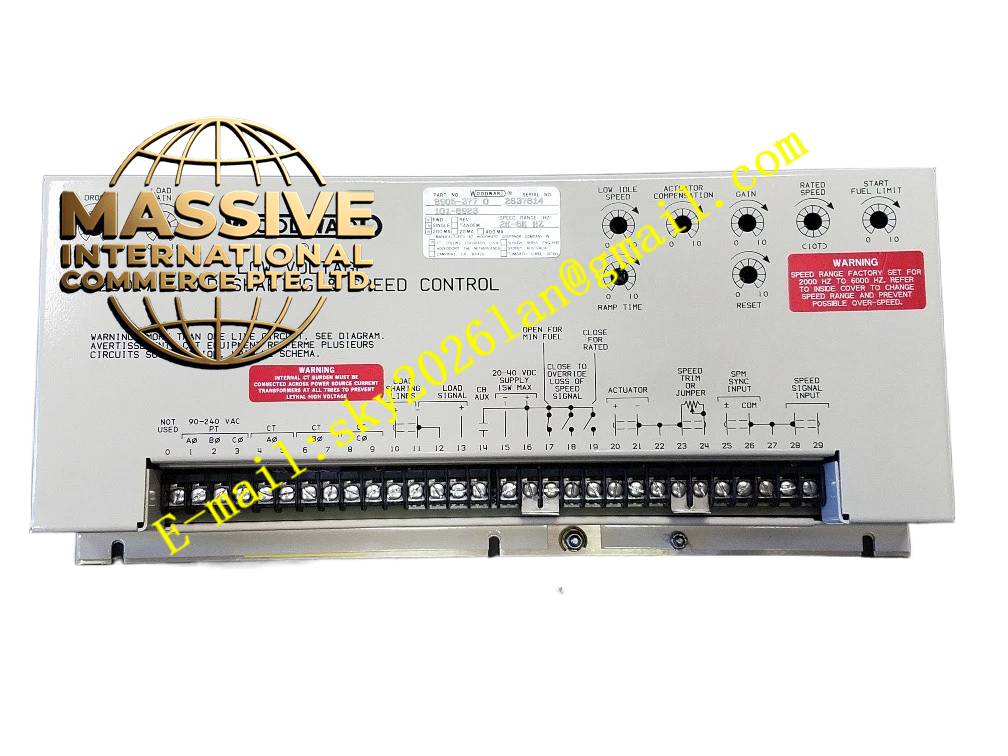
Woodward 9905-377
Technical Specifications
- Type: Variable Reluctance (Passive) Magnetic Pickup.
- Output: AC sine wave voltage proportional to speed and air gap.
- Thread Size: Standard industrial thread (e.g., 5/8-18 UNF).
- Frequency Range: Wide range covering cranking to maximum overspeed.
Functional Features
- High Sensitivity: Generates sufficient voltage at low cranking speeds for reliable starting.
- Rugged Construction: Hermetically sealed to withstand oil, moisture, and vibration.
- Wide Air Gap Tolerance: Accommodates shaft runout and mechanical tolerances.
- EMI Shielding: Integral shielding to prevent false triggering.
Application Scenarios
Primary speed sensing for turbine governors, engine control units, and overspeed protection systems.
Performance Parameters
- Output Level: Typically >1.5 Vrms at 1000 Hz.
- DC Resistance: Low resistance coil for long cable runs.
Material Composition
Alnico or rare-earth magnet core. High-temperature copper wire winding. Stainless steel threaded housing.
Structural Characteristics
Cylindrical probe with a threaded body and hexagonal head. Terminates in a shielded two-wire cable or military-style connector.
Working Principle
As gear teeth pass the sensor tip, they disturb the magnetic field, inducing an AC voltage in the coil. The frequency of this voltage is directly proportional to the shaft RPM.
Installation Requirements
Screw into the tapped hole until it contacts the gear, then back off to the specified air gap (typically 0.010″ – 0.030″). Lock with a jam nut. Route cable away from high-voltage VFD cables.
Usage Precautions
- Never hammer the sensor into place.
- Check gear teeth for damage; missing teeth cause signal dropouts.
- Measure resistance periodically to detect coil degradation.