


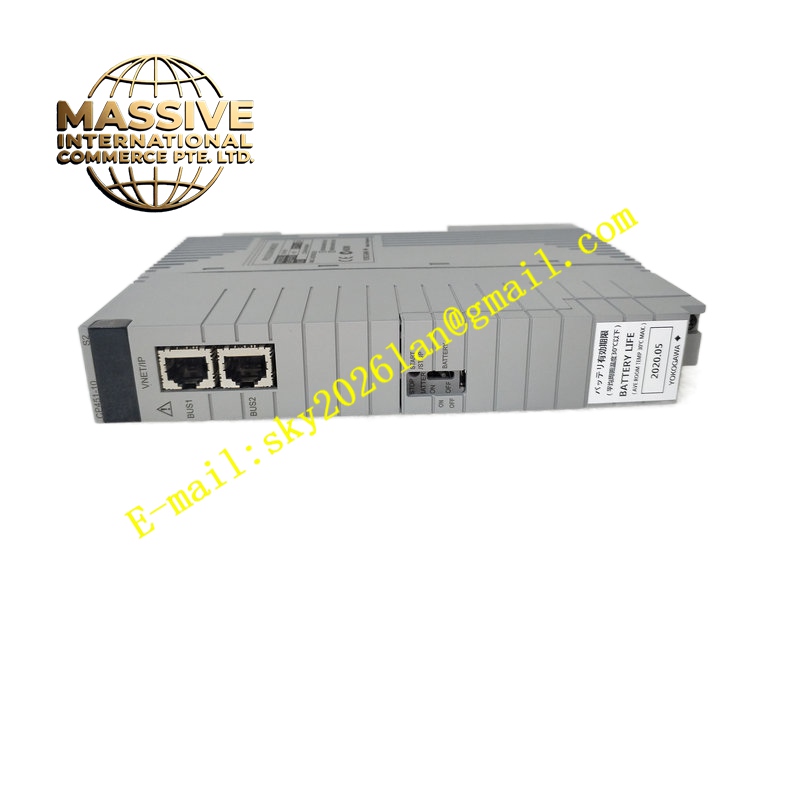
Description
Yokogawa CP451-51
Technical Specifications
Brand: Yokogawa
Product Model: CP451-51
Product Type: Processor Module / CPU Module
Processor: 32-bit RISC processor
Clock Speed: 400 MHz
Memory: 128 MB RAM, 256 MB Flash storage
I/O Capacity: Up to 256 input points and 256 output points
Communication Interfaces: RS-232C, RS-422/485, Ethernet, Foundation Fieldbus
Power Supply: AC 100-240V 50/60Hz or 24V DC
Power Consumption: Less than 20W
Operating Temperature: 0°C to 55°C (indoor), -20°C to 60°C (outdoor)
Storage Temperature: -40°C to 85°C
Protection Rating: IP65
Dimensions: 260 mm x 160 mm x 80 mm
Weight: 2.0 kg
Certification Standards: CE, UL, RoHS compliant
Functional Features
High-Speed Processing: 400 MHz RISC processor handles complex algorithms and large I/O counts efficiently
Extensive I/O Support: Manages up to 256 inputs and 256 outputs for large-scale applications
Multi-Protocol Communication: RS-232C, RS-485, Ethernet, and Foundation Fieldbus for versatile integration
Redundancy Support: Dual-processor configuration for high availability and fault tolerance
Modular Design: Supports expansion modules for flexible system configuration
Industrial-Grade Reliability: Excellent anti-interference performance and stability in harsh environments
User-Friendly Configuration: Intuitive software tools simplify programming and parameter setup
Real-Time Control: Deterministic execution ensures timely response to process changes
Self-Diagnostic: Continuous monitoring of processor health, memory, and communication links
Hot-Swap Capability: Supports module replacement without system shutdown in redundant configurations
Application Scenarios
Chemical Industry: Reactor control, distillation, polymerization process automation
Petroleum and Natural Gas: Refinery unit control, pipeline monitoring, LNG plant automation
Power Generation: Boiler and turbine control, balance of plant systems
Pharmaceutical Manufacturing: Batch processing, clean-in-place systems, environmental control
Steel and Metals: Reheating furnaces, rolling mills, continuous casting automation
Pulp and Paper: Stock preparation, paper machine control, chemical recovery
Food and Beverage: Process control for brewing, dairy, and packaged food production
Water and Wastewater: Large-scale treatment plant automation and monitoring
Performance Parameters
Processor Speed: 400 MHz 32-bit RISC
RAM: 128 MB for program execution and data handling
Flash Storage: 256 MB for program and configuration storage
Control Scan Time: Millisecond-level for critical loops
I/O Update Rate: Synchronized with control execution cycle
Communication Speed: Ethernet 10/100 Mbps, serial ports at standard baud rates
Redundancy Switchover: Sub-second automatic failover
Program Languages: Function block diagram, ladder logic, structured text
Task Management: Priority-based multitasking for real-time performance
Material Composition
Aluminum alloy housing for durability and heat dissipation, industrial-grade PCB with surface-mounted components, precision timing circuits, ECC memory for data integrity, metal shielding for EMI protection, gold-plated connectors for reliable contact, flame-retardant materials compliant with UL94 standards
Structural Features
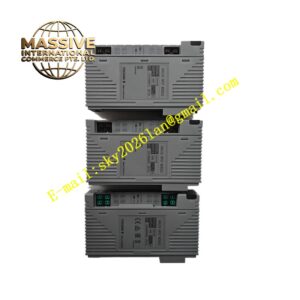
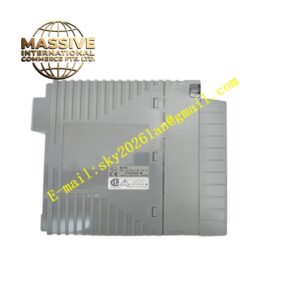
Compact rectangular module design, aluminum alloy enclosure for robustness and thermal management, front-panel status LEDs for power, run, fault, and redundancy indication, standardized connectors for communication and I/O expansion, mounting brackets for secure rack installation, ventilation slots for passive cooling, keyed connectors to prevent incorrect installation, modular form factor for easy maintenance and replacement
Working Principle
The CP451-51 receives digital and analog signals from field devices through connected I/O modules. The 400 MHz RISC processor executes the control program, performing calculations such as PID regulation, logic operations, and mathematical transformations. The processed results are sent as output commands to field actuators like control valves, motor drives, and relays. The module communicates with operator stations, engineering workstations, and other DCS nodes via Ethernet, V-Net, or Foundation Fieldbus, exchanging real-time process data, alarms, and configuration information. In redundant setups, a paired CP451-51 runs in hot-standby mode, continuously synchronized with the active processor. Upon detecting a failure in the active unit, the standby processor assumes control within milliseconds, ensuring uninterrupted process operation. The module also performs continuous self-diagnostics, monitoring CPU load, memory integrity, communication health, and power status, reporting any anomalies to the system.
Installation Requirements
Mount the module securely in a compatible Yokogawa DCS rack or enclosure
Ensure proper grounding of the rack and module to prevent electrical noise
Connect power supply (AC 100-240V or 24V DC) according to wiring diagrams
Wire communication interfaces (Ethernet, RS-485, Foundation Fieldbus) using shielded cables
Configure I/O module addresses and communication parameters before commissioning
Load the control program from the engineering workstation
Verify redundancy settings if using dual-processor configuration
Ensure adequate ventilation around the module for heat dissipation
Follow Yokogawa installation manuals for cable routing, grounding, and system checkout
Usage Precautions
Do not remove the module during operation unless hot-swap is supported and procedures are followed
Back up the control program and configuration before making changes
Monitor redundancy status to ensure both processors are properly synchronized
Replace the backup battery (if equipped) according to Yokogawa’s maintenance schedule
Operate within the specified temperature and humidity ranges
Verify firmware and software version compatibility with the DCS system
Use only genuine Yokogawa spare parts for replacement
Refer to Yokogawa technical documentation for programming, troubleshooting, and alarm interpretation
Avoid electrostatic discharge when handling the module
Keep detailed records of firmware versions, configuration changes, and maintenance activities