


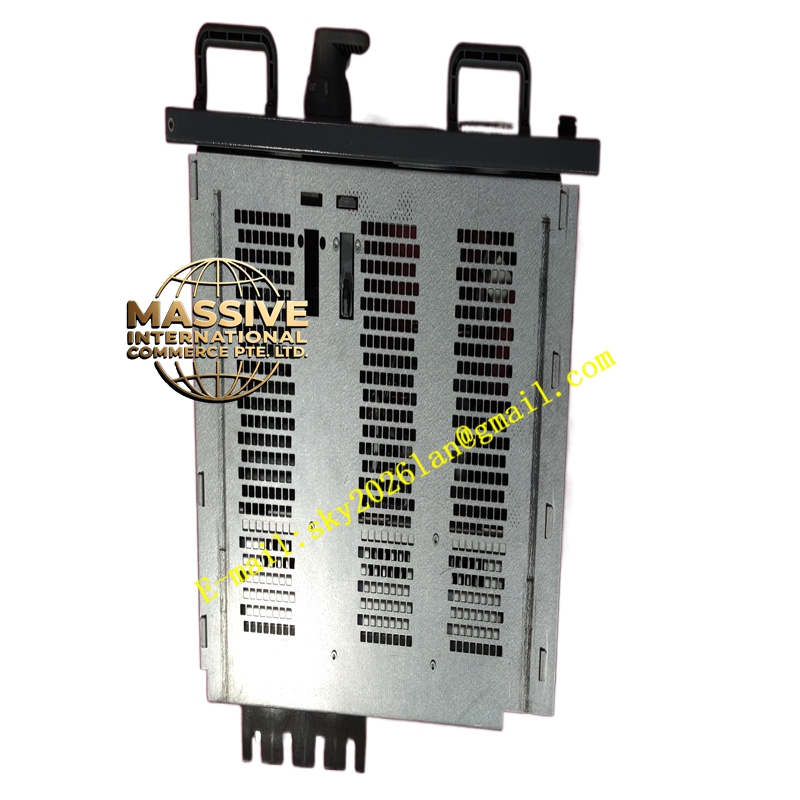
Description
ABB 1TGE106170M4200
Technical Specifications:
- Measurement Principle: Bidirectional calorimetric measurement technology.
- Response Time: Ultra-fast response time of ≤ 20 ms.
- Accuracy: High precision up to 2% of full scale (f.s.).
- Repeatability: Excellent repeatability of 0.2%.
- Flow Range Versions: Available in three specific flow ranges: +/- 50 sccm, +/- 200 sccm, and +/- 1000 sccm.
- Output Interfaces: Supports both analog output and digital I2C output.
- Addressing: Equipped with two address pins for flexible digital bus configuration.
- Dimensions: Highly compact footprint of 50 x 40 x 20 mm.
Functional Features:
- Bidirectional Sensing: Capable of measuring gas flow in both forward and reverse directions accurately.
- Factory Linearization: Pre-calibrated and linearized at the factory to ensure out-of-the-box accuracy and minimal setup time.
- Dual Communication: Offers versatile integration options through both standard analog signals and digital I2C protocols.
- Space-Saving Design: The miniature size allows for seamless integration into space-constrained measurement devices and medical equipment.
Application Scenarios:
- Medical equipment integration (e.g., ventilators, gas analyzers).
- Gas supply and quantitative dosing systems.
- Environmental technology, including gas analysis and continuous emission monitoring systems (CEMS).
- Precision process control under modified atmospheric conditions.
Performance Parameters:
- Signal Processing: Continuous and rapid flow monitoring with minimal latency.
- Integration Flexibility: I2C digital output supports multi-device networks on a single bus using the dual address pins.
- Reliability: Factory linearization guarantees consistent performance across the specified flow ranges.
Material Composition & Structural Characteristics:
- Housing: Compact, robust industrial-grade enclosure measuring exactly 50 x 40 x 20 mm.
- Internal Sensors: Precision micro-machined calorimetric sensor elements.
- Electrical Interfaces: Standardized analog pins and I2C digital communication terminals.
- Mounting: Designed for direct PCB mounting or secure integration into custom manifolds.
Working Principle:
The module utilizes bidirectional calorimetric measurement technology. It detects the heat transfer caused by the movement of gas molecules across a heated sensing element. By analyzing the thermal differential, the module calculates the mass flow rate with high precision. The integrated microprocessor linearizes the raw thermal data and outputs the calibrated flow value via analog voltage/current or I2C digital signals.
Installation Requirements:
- Space Allocation: Ensure a minimum clearance of 50 x 40 x 20 mm within the device enclosure for proper fitment.
- Gas Connections: Connect to the gas manifold or analyzer using appropriate low-dead-volume tubing to maintain response time.
- Electrical Wiring: Properly terminate the analog or I2C connections. Configure the two address pins according to the system’s I2C bus topology if using digital output.
- Orientation: Follow manufacturer guidelines for sensor orientation to prevent particulate accumulation on the sensing element.
Usage Precautions:
- Gas Compatibility: Verify that the gas being measured is compatible with the internal calorimetric sensor materials to prevent corrosion or degradation.
- Cleanliness: Ensure the gas supply is properly filtered to prevent dust or moisture from contaminating the sensitive thermal sensing element.
- Thermal Stability: Avoid sudden ambient temperature fluctuations that could affect the calorimetric baseline.
- Handling: Handle the module with care during installation to avoid mechanical shock to the internal micro-sensors.