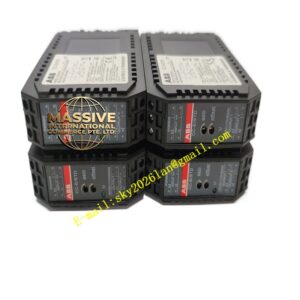





Description
ABB 3BHE044249R0003 GDC806C0003
Technical Specifications:
- Network Type: DCS Information/Control Network
- Communication Protocols: Token-passing, polling, and store-and-forward
- Topology Support: Bus, Ring, and Star configurations
- Redundancy: Dual redundant network interfaces for high availability
- Data Rate: High-speed industrial Ethernet or proprietary fieldbus speeds
Functional Features:
- Deterministic Communication: Guarantees data delivery within strict time limits for real-time control.
- Traffic Management: Efficiently manages network traffic using token-passing or master-slave polling.
- Fault Tolerance: Automatic failover to redundant network paths upon cable or node failure.
- Diagnostics: Comprehensive network health monitoring and error reporting.
Application Scenarios:
- Core communication backbone in large-scale DCS installations.
- Plant-wide data integration and SCADA networks.
- Redundant control networks in critical infrastructure.
Performance Parameters:
- Latency: Microsecond-level network propagation delay.
- Throughput: High-bandwidth data transfer for thousands of I/O points.
- MTBF: Extremely high reliability for continuous 24/7 operation.
Material Composition & Structural Characteristics:
- Enclosure: Shielded metal housing for EMI protection.
- Connectors: Dual RJ45 or fiber optic ports for redundant connections.
- PCB: High-speed digital board with impedance-controlled traces.
Working Principle:
The controller manages the network protocol, granting transmission rights to nodes via token-passing or responding to polling requests. It routes data packets between nodes, performs error checking, and automatically switches to the redundant network if a fault is detected on the primary path.
Installation Requirements:
- Cabling: Use certified, shielded DCS network cable with proper impedance.
- Termination: Install termination resistors at both ends of bus networks.
- Redundancy: Connect both primary and secondary network ports to separate physical paths.
Usage Precautions:
- Network Integrity: Never disconnect both redundant cables simultaneously.
- Configuration: Strictly adhere to network design guidelines to prevent broadcast storms.
- Firmware: Ensure all communication controllers on the network run compatible firmware.