



Description
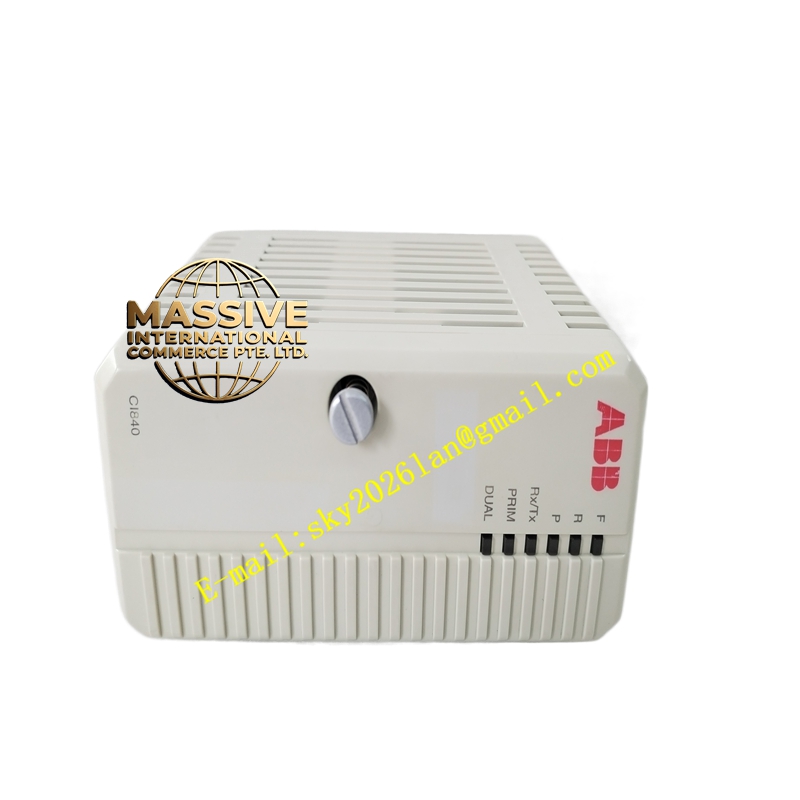
ABB CI840
Technical Specifications:
- Network Type: Industrial Ethernet (Redundant).
- System: ABB S800 I/O and AC 800M.
- Protocols: MODBUS/TCP, ABB Redundant Protocol.
- Physical Interface: Dual RJ45 Ethernet ports.
Functional Features:
- Redundant Ethernet: Dual ports for network redundancy and seamless failover.
- High-Speed Data Transfer: Gigabit-capable Ethernet for high-bandwidth applications.
- Protocol Flexibility: Supports multiple industrial Ethernet protocols.
Application Scenarios:
- High-bandwidth I/O stations requiring fast data exchange.
- Integration of S800 I/O into plant-wide Ethernet networks.
- Redundant control system architectures.
Performance Parameters:
- Fast Failover: Sub-millisecond switchover in redundant Ethernet configurations.
- High Throughput: Supports large data volumes for advanced I/O modules.
Material Composition & Structural Characteristics:
- Enclosure: Standard S800 I/O module.
- Connectors: Dual RJ45 Ethernet ports with link/activity LEDs.
Working Principle:
The CI840 manages the S800 I/O bus and provides a redundant Ethernet link to the AC 800M controller or higher-level systems. It continuously monitors both Ethernet links and automatically switches to the backup link if a failure is detected, ensuring uninterrupted communication.
Installation Requirements:
- Network Cabling: Use CAT5e or higher shielded Ethernet cables.
- Redundant Configuration: Connect both RJ45 ports to separate network switches for true redundancy.
- IP Configuration: Assign unique IP addresses and configure redundancy parameters in Control Builder.
Usage Precautions:
- Network Topology: Ensure the network topology supports the configured redundancy protocol.
- Switch Configuration: Configure network switches to support the required Ethernet protocols and redundancy features.