


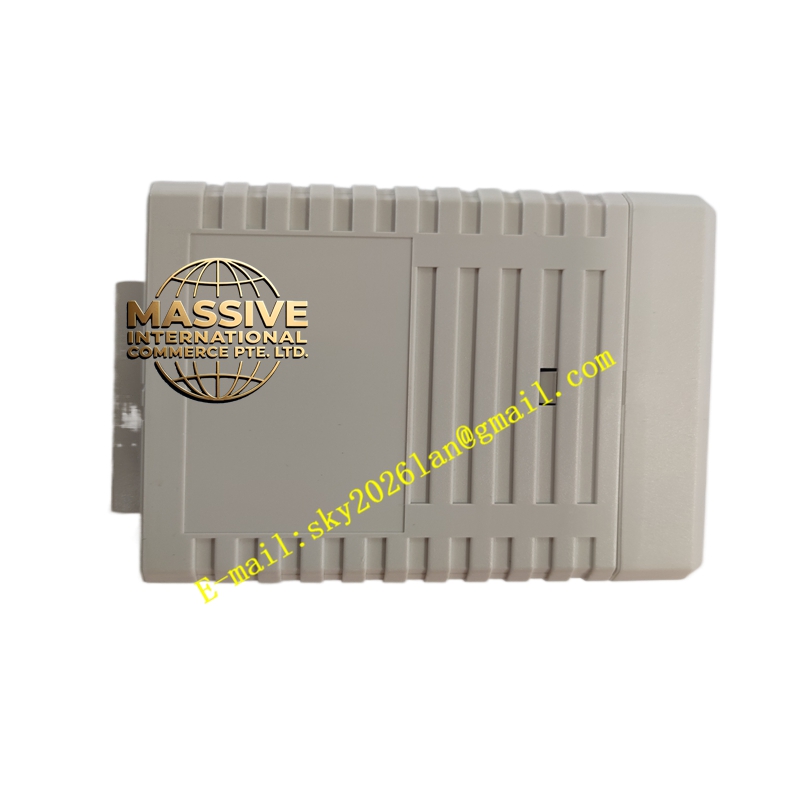
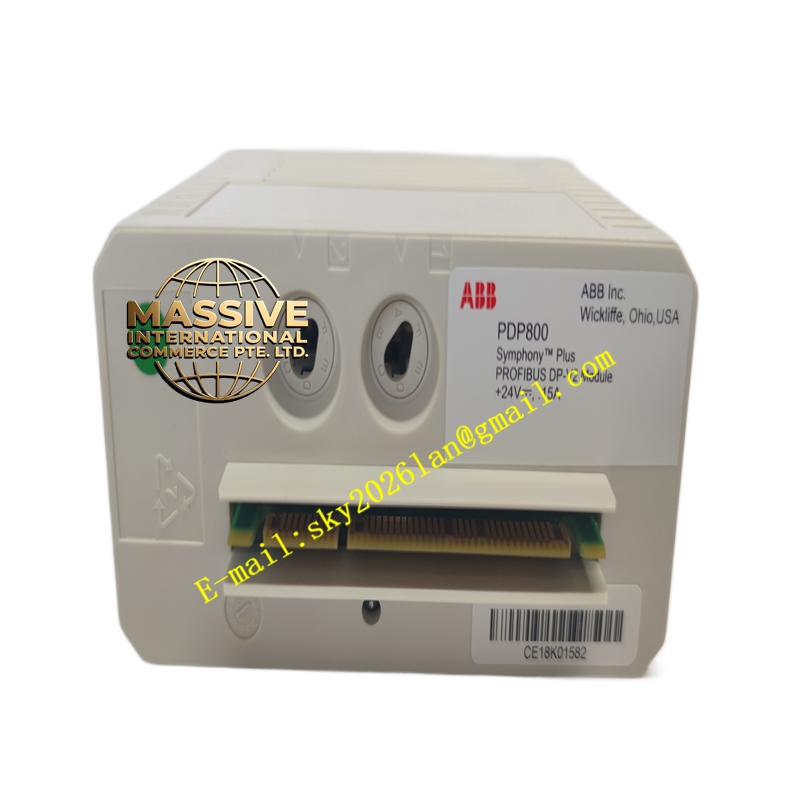
Description
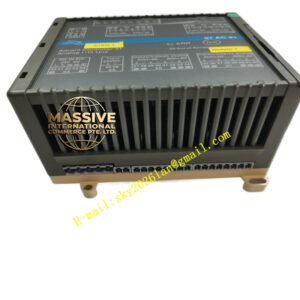
ABB PDP800
Technical Specifications:
- Supported Protocols: PROFIBUS DP V0, V1, and V2.
- Communication Rate: Supports transmission speeds up to 12 Mbps.
- Node Capacity: Capable of connecting up to 125 slave stations.
- Transmission Media: Supports both electrical and optical fiber media.
- Transmission Distance: Up to 15 kilometers when utilizing optical fiber.
- Power Requirements: 24 VDC ±10%, with a typical power consumption of 3.6W.
- Environmental Rating: Operating temperature range from 0°C to +55°C.
Functional Features:
- Intelligent Device Integration: Seamlessly integrates smart transmitters, actuators, and Intelligent Electronic Devices (IEDs) into the control strategy.
- High-Precision Timestamping: Supports PROFIBUS DP V2 protocol to provide 1-millisecond event timestamps, crucial for Sequence of Events (SOE) recording.
- Comprehensive Redundancy: Features full redundancy at the module, power supply, and PROFIBUS DP link levels to guarantee maximum system availability.
- Remote I/O Connectivity: Connects Symphony Plus controllers to S800 I/O modules, supporting all signal types including analog, digital, and pulse counters.
Application Scenarios:
- Power Generation: Integration of turbine control systems, including valve positioning (VP800) and automatic synchronization (AS800).
- Petrochemical Industry: Long-distance pipeline monitoring and large-scale refinery process control.
- Water Treatment: Integration of pump stations and valve controls for optimized flow regulation and energy efficiency.
Performance Parameters:
- System Availability: Achieves up to 99.999% availability through redundant configurations.
- Fault Tolerance: Independent redundant options ensure that a single point of failure does not disrupt critical process control.
- Event Resolution: 1-millisecond precision for accurate fault diagnosis and system synchronization.
Material Composition & Structural Characteristics:
- Form Factor: Compact module designed for standard 35mm DIN rail installation.
- Dimensions: Product net depth/length of 243.84 mm, height of 73.66 mm, and width of 170.18 mm.
- Construction: Ruggedized industrial-grade housing designed to withstand harsh electromagnetic interference and mechanical vibrations.
Working Principle:
The PDP800 module acts as a PROFIBUS DP master. It translates control logic and data requests from the Symphony Plus controller into PROFIBUS DP telegrams. These telegrams are transmitted over the electrical or fiber-optic bus to intelligent field slaves. The module continuously polls the slaves for cyclic process data and asynchronously receives alarm or diagnostic data, passing it back to the controller for real-time processing.
Installation Requirements:
- Mounting: Securely mount the module on a standard 35mm DIN rail within a climate-controlled control cabinet.
- Wiring: Use properly shielded twisted-pair cables for electrical connections and ensure correct termination resistors are applied.
- Grounding: Implement strict single-point grounding for communication shields to prevent ground loops and electromagnetic interference.
- Configuration: Utilize the S+ Engineering tool suite for graphical network configuration and device mapping.
Usage Precautions:
- Shield Integrity: Ensure cable shields are properly grounded at both ends (or as specified by PROFIBUS guidelines) to maintain signal integrity at high speeds.
- Redundancy Testing: Regularly test redundant power and communication paths during scheduled maintenance windows.
- Firmware Compatibility: Verify that the module firmware is compatible with the Symphony Plus controller and S+ Engineering software versions.
- Environmental Limits: Do not exceed the specified operating temperature range to prevent premature component degradation.