


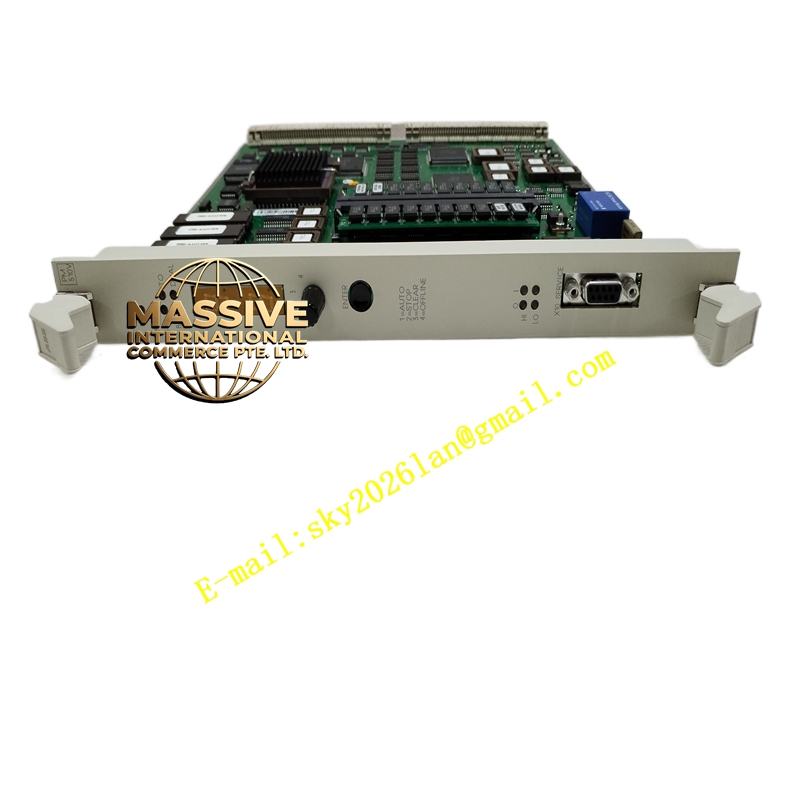
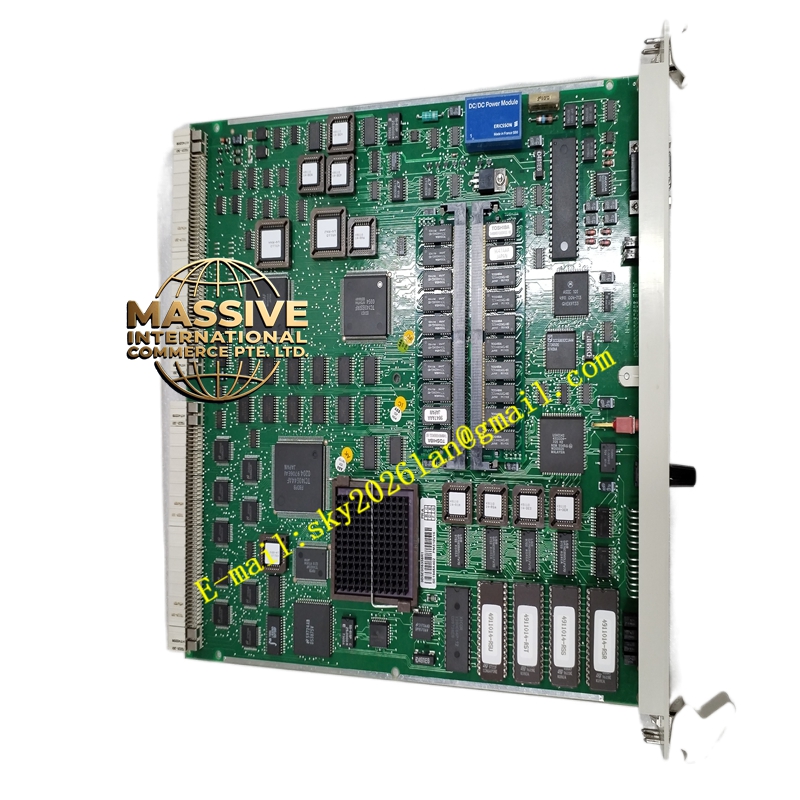
Description
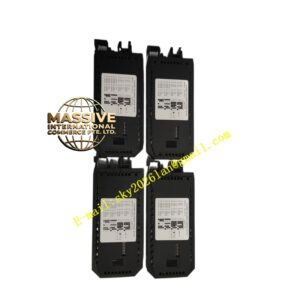
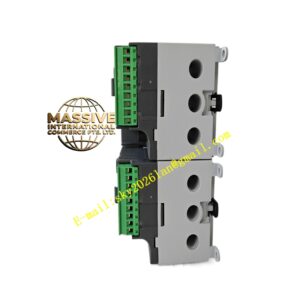
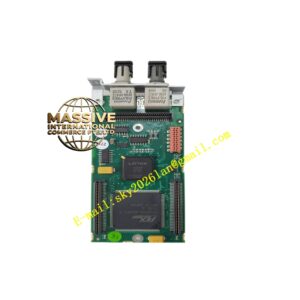
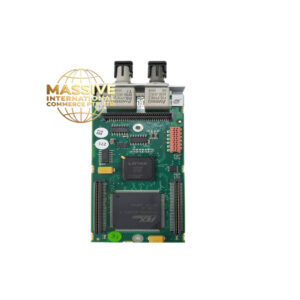
ABB PM510V16
technical Specifications / Performance Parameters
| Parameter | Value / Description |
|---|---|
| CPU Type | 32‑bit RISC processor, deterministic scan |
| Application Memory (RAM) | 16 MB (user program + process data; retentive variables battery‑backed) |
| Flash Memory | 32 MB (stores OS, project archive, event log, diagnostics) |
| Retentive Memory Backup | Supercap + coin‑cell battery on baseplate; ≥5 years data retention with 24 V DC off |
| Typical Scan Cycle | Configurable 50 ms – 2000 ms (continuous task); fast task min ≈10–20 ms depending on program size |
| Max I/O Capacity | Up to 256 S800 I/O modules (local + remote); practical limit set by scan time & comm load (typically several thousand I/O points) |
| Communication Interfaces | • 2 × 10/100 Mbps Ethernet RJ45 (Plant LAN / Engineering / Modbus TCP / IEC 61850‑8‑1 optional) • 1 × RS‑232/485 D‑sub 9‑pin (service port / Modbus RTU) • 1 × CEX‑Bus slot (for CI854 / CI840 / CI871 / CI867 etc.) • 1 × ModuleBus (direct to TB807/TB820 local I/O baseplate – up to 12 modules) |
| Redundancy Support | Yes – 1:1 hot‑standby with primary/backup sync link; automatic switchover < one scan on failure |
| Power Requirement | Supplied from AC 800M baseplate (24 V DC ±20 %); typical 12–18 W max |
| Indicators (LEDs) | Run (green), Error (red), Sync (green – on standby when synced), Com Active, Battery Low, Eth Link/Act (per port) |
| Operating Temperature | 0 °C … +60 °C (storage –40 °C … +70 °C) |
| Humidity | 5–95 % RH non‑condensing |
| Mounting | Into AC 800M CPU baseplate (BC810 / BC820) – leftmost slot of controller unit |
| Dimensions (module only) | ≈ 40 × 125 × 135 mm (W × H × D) |
| Certifications | CE, UL 61010‑1, cULus, ATEX / IECEx Zone 2 (with system certification), SIL2 capable when used with S800 SIL I/O & proper engineering |
| Firmware / Engineering | Compatible with Control Builder M (version must match FW – e.g. CB M 5.x for FW 5.x); IEC 61131‑3 compliant |
Functional Features
- IEC 61131‑3 Programming: Function Block Diagram (FBD), Ladder (LD), Structured Text (ST), Instruction List (IL), Sequential Function Chart (SFC).
- Online Changes: Qualified minor modifications can be downloaded without stopping the process (online download); major changes require cold restart – clearly identified in Control Builder.
- Redundancy: Two PM510V16 CPUs in one BC820 baseplate with sync cable provide bumpless takeover on HW/SW fault.
- Integrated Diagnostics: CPU health, I/O error rates, communication statistics, event buffer with time stamp (1 ms resol. when time‑synced) uploaded to 800xA / OIS.
- Retentive Variables & Recipes: Hold setpoints, accumulated totals, batch phase-step across power cycles.
- Time Synchronization: NTP/SNTP client or server; IRIG‑B input supported via system time source.
- Connectivity: Native Ethernet for 800xA Plant Network; CEX‑bus for fieldbus cards; ModuleBus for local S800 I/O; RS‑232/485 for local service or legacy Modbus RTU devices.
- Alarm & Trend: Integrated alarm processing per ISA‑18.2; real‑time & historical trend via 800xA Aspects.
Application Scenarios
- Process Unit Control in System 800xA DCS: Boiler/BOP (Balance of Plant), reactor temperature & level control, distillation column reflux & reboiler control.
- Retrofit / Migration: Replaces Advant Controller 450 / S100 with minimal re‑engineering – application logic converted to AC 800M function blocks.
- Hybrid Batch + Continuous: Pharmaceutical / F&B skid control with S88 phase logic and continuous utility monitoring.
- Water / Wastewater Treatment: Master controller talking Profibus DP (CI854) to remote S800 I/O racks at pump stations & clarifiers.
- Machine / Skid Integration: Small‑to‑mid process skid with local S800 I/O + Ethernet to plant DCS.
Material Composition & Structural Characteristics
- Housing: Aluminum alloy EMI‑shielded chassis with flame‑retardant ABS/PC front bezel & status window.
- PCB: Industrial‑grade FR4 with G3 conformal coat (ISA‑S71.04) on process‑grade versions.
- Connectors:
- 2 × RJ45 (Ethernet 10/100)
- 1 × D‑sub 9‑pin (RS‑232/485)
- 1 × 50‑pin CEX‑bus card edge (for option cards)
- 1 × 30‑pin ModuleBus gold‑finger (to TB807/TB820)
- Battery: Lithium coin cell (CR2032 or equivalent) located on baseplate – backs up retentive RAM & RTC when 24 V absent.
- Heat Dissipation: Convection via chassis slots in cabinet; no fan on CPU itself.
Working Principle
- Power‑Up / Boot: On 24 V DC application the boot loader initializes hardware, checks battery/RTC, loads firmware & application from Flash into RAM, runs POST, and synchronizes time via NTP or IRIG‑B if configured.
- Cyclic Execution:
- Read inputs from I/O image table (updated via ModuleBus / CEX‑bus cyclic exchange).
- Execute configured tasks (continuous task + optional fast/event tasks) → compute outputs.
- Write outputs to I/O image.
- Handle communication (Ethernet CIP/MMS/Modbus TCP, CEX‑bus acyclic services).
- Update diagnostics & watchdog.
- Redundant Operation: Standby CPU mirrors primary’s image via high‑speed sync link; on primary watchdog failure the standby assumes control within ≤1 scan – outputs freeze only briefly (<10 ms) during switchover then resume from last state.
- Time Sync & Alarms: Time tags events/SOE; alarms evaluated per block attributes and forwarded to 800xA Alarm & Event server.