


Description
Bently 330930‑045‑01‑00
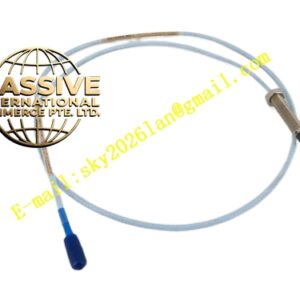
Technical Specifications: ‑ Cable Overall Length: 4.5 m ‑ Nominal Characteristic Impedance: 75 Ω coaxial ‑ Uniform Capacitance: 69.9 pF/m ‑ Insulation Material: FEP fluoropolymer ‑ Continuous Operating Temperature: ‑52 °C ~ +177 °C ‑ Minimum Static Bend Radius: 38.1 mm ‑ Connector Type: ClickLoc miniature self‑locking coaxial connector ‑ Armor Material: AISI 302 stainless‑steel spiral armor ‑ Net Weight: 0.43 kg ‑ Agency Approval: General industrial grade, no hazardous‑area certification ‑ Signal Bandwidth: 0 Hz‑10 kHz
Functional Features: ‑ Stainless‑steel spiral armor resists mechanical impact, squeezing and surface abrasion during installation and long‑term running ‑ Coaxial shielding structure suppresses industrial EMI and RFI signal interference ‑ Pure passive transmission design, no internal electronic consuming components ‑ Fully interchangeable with certified 3300 XL NSv probes and Proximitor sensor units ‑ ClickLoc anti‑loose locking connector adapts to sustained machine vibration environment ‑ Consistent electrical parameters over full rated working temperature range
Application Scenarios: Applied for compact centrifugal compressors, turbo‑expanders, high‑speed process pumps and blowers at general industrial sites. Deployed in petrochemical workshops and thermal power plants, matches Bently 3500 rack for machinery protection, suitable for cable routes subject to mechanical collision and wear risks.
Performance Parameters: ‑ Full‑range scale factor deviation: Less than ±1% ‑ Humidity resistance: Stable under 100% non‑condensing relative humidity ‑ Storage Temperature: ‑52 °C ~ +177 °C ‑ DC core‑to‑core resistance: 0.81 Ω nominal ‑ Armor bears rated radial crush load without permanent deformation
Material Composition: ‑ Inner conductor: tinned copper ‑ Intermediate insulation: FEP fluoropolymer ‑ Single‑layer shielding: copper braided mesh ‑ Outer jacket: FEP fluoropolymer ‑ Armor: AISI 302 stainless‑steel spiral strip ‑ Connector shell and contact: gold‑plated brass ‑ Sealing ring: fluororubber
Structural Features: Concentric coaxial inner core wrapped with continuous spiral stainless‑steel armor. ClickLoc miniature self‑locking coaxial connectors are installed on both cable ends. Armor terminates at short transition section near connectors. FluidLoc sealing assembly is not fitted for this model.
Working Principle: Passive signal transmission part for NSv eddy‑current transducer system. Armor delivers mechanical protection only without modifying electrical properties. It maintains 75‑ohm measuring‑loop impedance matching. Gap‑proportional DC voltage signal from proximity probe transmits to NSv Proximitor sensor, keeps linear gap‑voltage measurement response.
Installation Requirements: ‑ Comply with armored‑cable minimum static bend radius 38.1 mm, sharp bending is strictly forbidden ‑ Keep minimum 150 mm clearance from high‑voltage power cables ‑ Tensile force shall only act on connector housing, armor and cable core cannot bear pulling load ‑ Connector tightening torque maximum 0.565 N·m ‑ Install external connector protector for exposed joints ‑ Sum of probe built‑in cable length and extension cable length must conform to NSv Proximitor total‑length configuration
Usage Notes: ‑ Field cutting or splicing of armored cable assembly is strictly prohibited ‑ Prevent armor surface from scratch by sharp metal edges ‑ Check armor integrity and connector locking state during routine shutdown maintenance ‑ Avoid long‑time direct contact with strong corrosive medium ‑ Perform continuity and insulation resistance test before system startup