


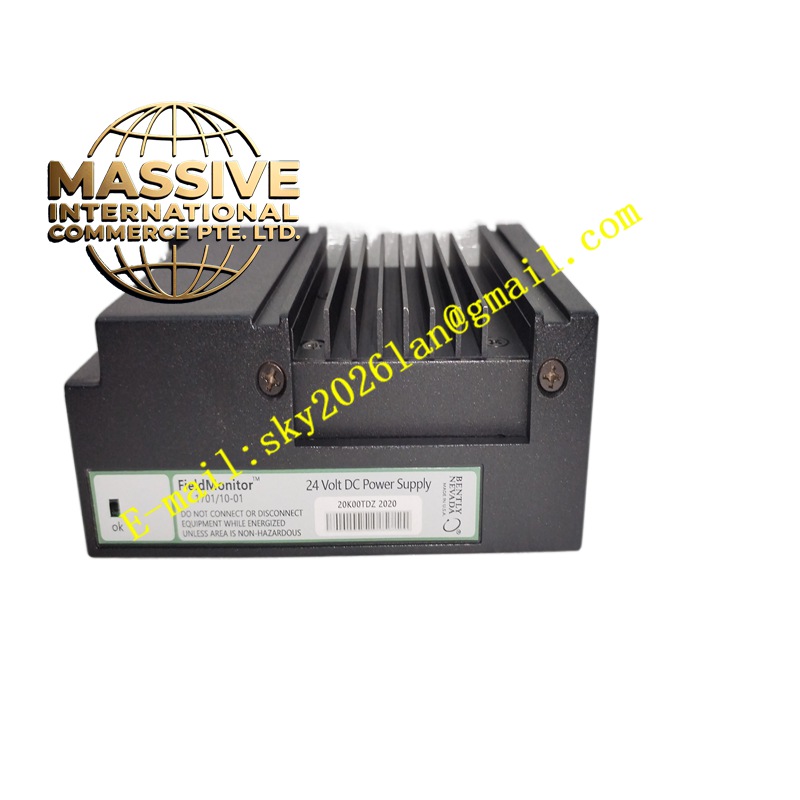
Description
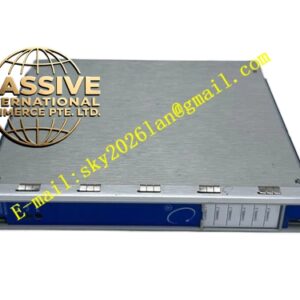
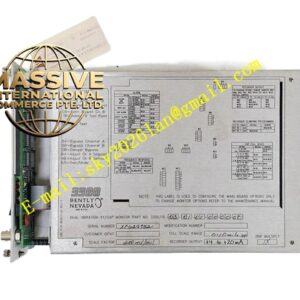
Bently 3500-22M
Technical Specifications
- Module Type: Transient Data Interface (TDI)
- Data Channels: Supports up to 22 channels of dynamic and static data
- Sampling Rate: High-resolution sampling up to 102.4 kHz
- Communication Protocols: BN Master Computer Protocol, BN TDI Protocol, TCP/IP via Ethernet
- Power Consumption: Typical power draw of 7.2 to 7.7 Watts
Functional Features
- Transient Data Capture: Capable of capturing high-resolution waveform data during machinery startup, shutdown, and alarm events, storing pre-alarm and post-alarm data for comprehensive fault analysis.
- Steady-State Monitoring: Continuously collects and transmits static values, including amplitude and phase for multiple harmonics, to host systems.
- Integrated Communication: Features built-in Ethernet ports (10Base-T/100Base-TX) and RS232 front-panel interfaces for seamless network integration.
- Non-Critical Path Design: Operates independently of the core machinery protection logic, ensuring that data acquisition failures do not compromise automatic machine tripping or protection functions.
Application Scenarios
Extensively deployed in power generation, petrochemical processing, and metallurgical facilities to provide advanced diagnostic capabilities for steam turbines, gas compressors, and large industrial motors. It is essential for root-cause analysis following unexpected machinery trips.
Performance Parameters
- Speed Input Support: Supports keyphasor signals and speed inputs up to 20 kHz per revolution.
- Data Buffering: Transient event collection capacity is limited only by the module’s available internal memory.
- Operating Temperature Range: -30°C to +65°C (-22°F to +149°F)
Material Composition
The module is constructed with a high-strength metallic front panel and a robust internal printed circuit board (PCB) featuring premium electronic components, all housed within a standard 19-inch rack-compatible chassis.
Structural Characteristics
Designed as a single-width module that strictly occupies Slot 1 in the 3500 rack, positioned immediately adjacent to the Power Supply Module. It features front-panel status LEDs for diagnostic monitoring and secure rear I/O connectors for network cabling.
Working Principle
The TDI module interfaces directly with the M-series monitors in the rack via the backplane. It continuously polls the monitors for static data and triggers high-speed analog-to-digital conversion to capture transient waveforms when programmable speed or alarm thresholds are met, subsequently packaging and transmitting this data over the Ethernet link.
Installation Requirements
Must be installed in Slot 1 of the 3500 rack. The module includes a 2-pin connector for Signal Common, which must be connected to the single-point instrument ground. When utilizing this connection, the selector switch on the adjacent Power Input Module (PIM) must be slid toward the “HP” arrow to isolate the signal common from the chassis ground.
Usage Precautions
Always ensure proper grounding to prevent signal noise and ground loops. Do not remove or insert the module while the rack is energized. Regularly verify the Ethernet link status and ensure the host software configuration matches the physical module setup.