


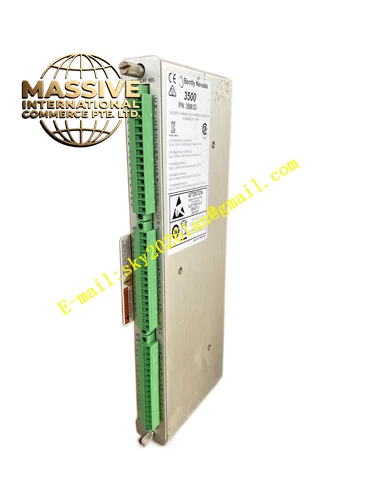
Description
Bently 9200‑06‑06‑02‑00
Technical Specifications:
- Sensing Principle: Moving‑coil self‑generating
- Mounting Angle: 0‑degree vertical installation
- Nominal Sensitivity: 500 mV/in/s (20 mV/mm/s), tolerance ±5% at 100 Hz
- Frequency Response: 10 Hz ~ 1000 Hz (-3 dB)
- Output Interface: Two‑wire terminal connection
- Operating Temperature: ‑50 °C ~ +120 °C
- Storage Temperature: ‑55 °C ~ +130 °C
- Insulation Resistance: ≥100 MΩ @500 VDC
- Housing Rating: IP65
- Weight: 0.41 kg
- Shock Resistance: 50 g peak
- Continuous Vibration Rating: 10 g (10‑2000 Hz) Functional Features:
- Passive self‑generating structure without external power input, supports both online permanent monitoring and temporary field measurement.
- Zero‑degree vertical mounting design optimizes vertical vibration signal collection of bearing housings.
- Robust stainless‑steel housing delivers strong corrosion resistance for oily and humid plant environments.
- Terminal‑style output simplifies junction‑box wiring in field installation.
- Low susceptibility to pulse impact compared with piezoelectric sensors, stable output for continuous running equipment.
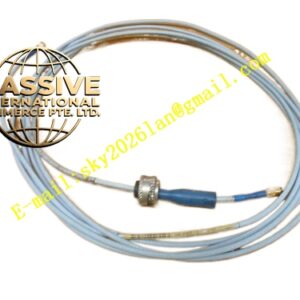
- Fully sealed internal assembly, no maintenance requirement for sensor body during service cycle. Application Scenarios: Vertical direction casing vibration monitoring for compressors, fans, pumps and turbine bearing housings; high‑speed rotating machinery condition monitoring; field vibration test work; machinery retrofitting projects. Performance Parameters: Amplitude linearity error ≤ ±3% FS; phase distortion ≤10° within working frequency band; low output noise level; excellent temperature stability. Material Composition: 316 stainless‑steel housing; high‑energy permanent magnet; copper moving‑coil winding; non‑magnetic internal framework; epoxy insulation parts; terminal block assembly; fluorosilicone sealing gaskets. Structural Characteristics: Cylindrical sealed housing; bottom threaded mounting stud; external wire‑lead terminals; fully encapsulated internal moving‑coil magnet assembly; housing surface printed with part number and serial number. Working Principle: Equipment casing vibration drives relative motion between suspended moving coil and built‑in permanent magnet. Electromagnetic induction produces AC voltage signal. Output voltage amplitude directly corresponds to casing vibration velocity. Back‑end monitoring devices convert AC signal into vibration velocity and displacement engineering values. Installation Requirements:
- Polish mounting surface, eliminate paint and rust to achieve rigid mechanical contact.
- Fasten mounting stud with correct torque, prevent sensor loosening caused by equipment operating vibration.
- Maintain 0‑degree vertical installation orientation. Deviation will degrade measurement accuracy.
- Separate sensor signal wiring from high‑current power cables to reduce electromagnetic noise coupling.
- Protect terminal wiring from oil immersion and moisture ingress. Seal junction box properly. Usage Notes:
- Avoid dropping and heavy mechanical impact, impact can deform internal coil suspension structure.
- Do not cut or re‑solder sensor internal lead wires. Factory calibration will be invalidated.
- Do not apply high‑voltage megger test across sensor terminals. High voltage damages coil insulation.
- Check mounting bolt tightness during each equipment overhaul. Loose mounting creates unreliable measurement result.