


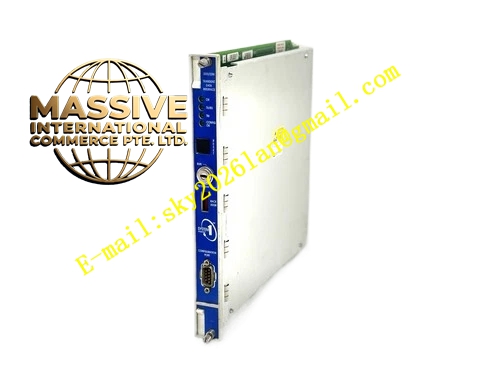
Description
Bently Nevada 330101-00-48-10-02-05
Technical Specifications:
- Product Series: 3300 XL 8mm Eddy Current Sensor System
- Probe Diameter: 8mm
- Thread Specification: 3/8-24 UNF Imperial Thread
- Unthreaded Length: 48 (corresponding to specific inch value)
- Overall Case Length: 10 (corresponding to specific inch value)
- Total Cable Length: 2 (corresponding to specific meter value)
- Connector Type: 02 = Miniature coaxial ClickLoc connector, standard cable
- Agency Approval: 05 = Multiple certifications
Functional Features:
- Non-contact measurement eliminates interference with the target object’s motion
- Supports both static (displacement) and dynamic (vibration) dual measurement
- TipLoc molding technology ensures a robust connection between the probe tip and probe body
- CableLoc design guarantees the probe cable-to-housing connection withstands 330N (75 lbs) pull force
- Probes, extension cables, and proximitor modules are fully interchangeable without individual matching or bench calibration
- Backward compatible with non-XL 3300 series 5mm and 8mm sensor system components
Application Scenarios:
- Steam turbine and gas turbine shaft vibration monitoring
- Centrifugal and axial compressor shaft position monitoring
- Generator and motor shaft vibration monitoring
- Large pump and fan bearing vibration monitoring
- Keyphasor and speed measurement
Performance Parameters:
- Sensitivity: 7.87 V/mm (200 mV/mil) ±4% (when system calibrated)
- Linear Range: 2mm (80 mils), from 0.25mm to 2.3mm from target face
- Recommended Gap Setting: 1.27mm (50 mils)
- Frequency Response: 0 to 10 kHz
- Supply Voltage: -17.5 VDC to -26 VDC, maximum current 12mA
- Recommended Minimum Shaft Diameter: 76.2mm (3 inches)
Material Composition:
- Probe Tip: PPS (Polyphenylene Sulfide) high-performance plastic
- Probe Housing: Stainless steel
- Cable: Standard coaxial cable
Structural Features:
- Cylindrical probe body with 8mm sensing face at the front end
- 3/8-24 UNF thread for mounting fixation
- Integrated rear cable connected to extension cable via ClickLoc miniature coaxial connector
- Non-armored design suitable for general industrial environments
Working Principle: When high-frequency current flows through the internal coil of the probe, an alternating magnetic field is generated around the probe tip. When a conductive metal surface (such as a rotating shaft) enters this magnetic field, eddy currents are induced on the metal surface. These eddy currents generate a reverse magnetic field that alters the impedance of the probe coil. The proximitor detects this impedance change and converts it into a DC voltage signal proportional to the gap distance. The smaller the gap, the more negative the output voltage; the larger the gap, the closer the output voltage approaches zero.
Installation Requirements:
- The total length of probe cable plus extension cable must match the nominal system length of the proximitor (5-meter or 9-meter system)
- The mounting threaded hole must be pre-machined to ensure smooth thread engagement
- The probe mounting bracket must have sufficient rigidity; flexible connections are strictly prohibited
- The target shaft surface must be smooth, scratch-free, and free of plating, with surface roughness better than 1.6μm
- Gap voltage must be set to -10.0 VDC ± 0.2V under static (cold) conditions
Usage Precautions:
- Never insert or remove probe connectors while energized
- Coaxial cables must not be bent at right angles; the minimum bending radius must be maintained, otherwise the cable capacitance value changes causing measurement deviation
- Extension cable shielding must be grounded at a single point only; multi-point grounding creating ground loops is strictly prohibited
- Signal cables must be kept away from high-voltage power cables with a minimum separation of 30cm
- Regularly verify probe linearity using a TK-3E calibration instrument
- Recommended installation torque is 1.7 to 2.3 N·m; overtightening damages the internal coil