


Description
Bently Nevada 330604-00-13-10-02-00
Technical Specifications
| Parameter | Specification |
|---|---|
| Part Number | 330604-00-13-10-02-00 |
| Unthreaded Length | 0.0 inch |
| Overall Case Length | 1.3 inch |
| Total Cable Length | 1.0 meter (3.3 feet) |
| Connector Type | Miniature coaxial ClickLoc connector, standard cable |
| Agency Approval | Not required |
| Probe Tip Diameter | 11 mm |
| Sensitivity | 3.94 V/mm (100 mV/mil) ±10% |
| Linear Range | 4.0 mm (160 mils) |
| Extended Linear Range | 5.0 mm (200 mils) |
| Frequency Response | 0 to 8 kHz |
| Output Resistance | 50 Ω |
| Power Requirements | -17.5 Vdc to -26 Vdc |
| Recommended Gap | 2.5 mm (100 mils) |
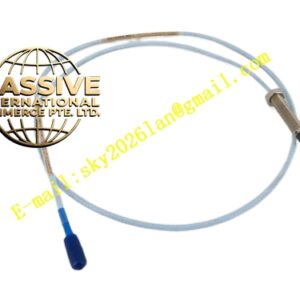
Functional Features The probe delivers a 3.94 V/mm output for non-contacting vibration and displacement measurements on fluid film bearing machines. The large tip diameter enables a longer linear range compared to 8 mm systems. The patented TipLoc molding method provides a robust bond between the probe tip and the probe body. The CableLoc design ensures 330 N (75 lbf) pull strength between the probe case and probe lead.
Application Scenarios Axial position measurement, differential expansion monitoring on steam turbines, rod position and rod drop measurement on reciprocating compressors, tachometer and zero speed measurements, phase reference Keyphasor signals, radial vibration monitoring on large rotating equipment.
Performance Parameters Incremental Scale Factor remains within ±25% of 3.94 V/mm over a probe temperature range of -35°C to +120°C. Deviation from best fit straight line is less than ±0.10 mm over the standard 4.0 mm linear range and less than ±0.15 mm over the extended 5.0 mm range.
Material Composition Probe tip is manufactured from polyphenylene sulfide (PPS). The probe case is constructed from AISI 304 stainless steel. The cable is 75 Ω triaxial with fluoroethylene propylene (FEP) insulation.
Structural Characteristics The probe features a standard mount configuration with imperial thread dimensions. The overall case length of 1.3 inches provides a compact installation profile. The probe cable is securely attached to the probe tip utilizing the patented CableLoc design.
Working Principle The probe operates on the eddy current principle. A high-frequency RF signal from the Proximitor Sensor is applied to the probe tip. When the probe is placed near a conductive target, eddy currents are induced in the target surface. The resulting energy loss is detected and converted into a DC voltage proportional to the gap distance between the probe tip and the target surface.
Installation Requirements The probe must be mounted through a threaded hole or bracket with proper torque application. The recommended mounting torque for standard forward-mounted probes is 11.2 N·m (100 in·lbf) with a maximum rated torque of 33.9 N·m (300 in·lbf). The minimum bend radius for the cable is 25.4 mm (1.0 in). The probe must be used with a matching electrical length extension cable and Proximitor Sensor.
Usage Precautions Exposing the probe to temperatures below -34°C (-30°F) causes premature failure of the pressure seal. The probe is designed to seal differential pressure between the probe tip and case using a Viton O-ring, but probes are not pressure tested prior to shipment. Connector protectors are recommended for all installations to provide increased environmental protection. The probe must not be submerged.