


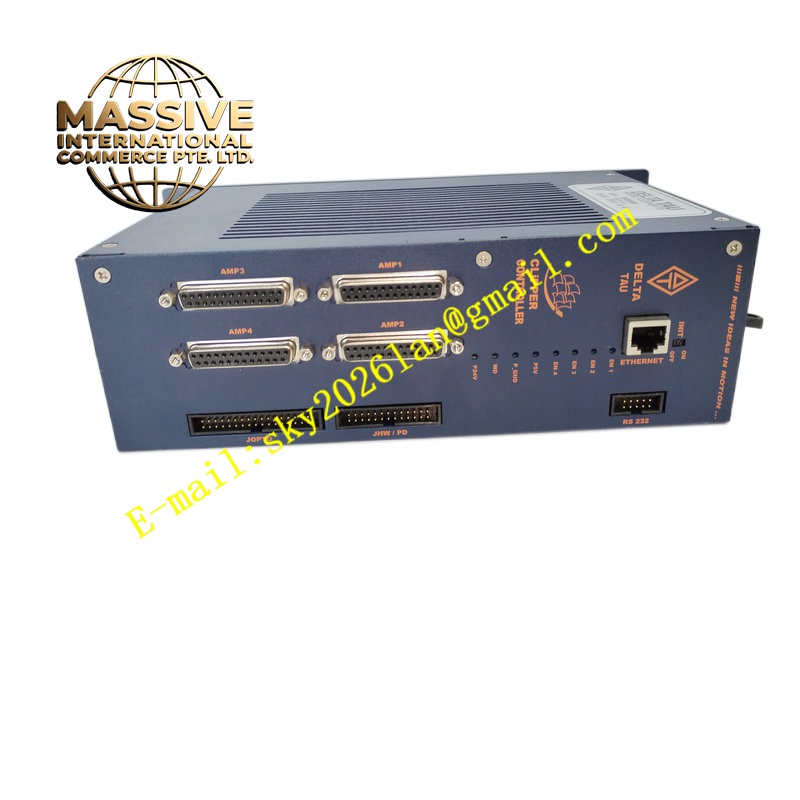
Description
Delta Tau CLIPPERT3
Technical Specifications
Brand: Delta Tau (Omron)
Product Model: CLIPPERT3 (Turbo PMAC Clipper / Turbo PMAC2 Eth-Lite)
Product Type: Compact Multi-Axis Motion Controller
Processing Core: 80 MHz DSP56303 Turbo PMAC CPU
Memory: 256k x 24 user SRAM, 1M x 8 flash memory
Communication Interfaces: 100 Mbps Ethernet, RS-232 serial interface
Axis Control: Up to 32 axes of servo or stepper control
Digital I/O: 32 general-purpose TTL-level I/O points (16-point multiplexer port + 16-point opto port)
Axis Interface: 4 channels per board, expandable with additional boards
Analog Output: 12-bit +10V per axis channel
Digital Output: Pulse-and-direction per axis channel
Encoder Input: 3-channel differential/single-ended per axis channel
Hall Inputs: UVW TTL-level per axis channel
Handwheel Port: 2 quadrature encoder inputs, 2 pulse (PFM or PWM) output pairs
Power Supply: 5V, +/-12V, GND (+/-12V required only for analog I/O)
Warranty: 1 year from date of shipment
Functional Features
Full Turbo PMAC2 Functionality: Complete feature set of the Turbo PMAC2 platform in a compact, cost-optimized package
Compact Design: Small footprint ideal for space-constrained OEM installations
Ethernet Connectivity: Built-in 100 Mbps Ethernet for fast communication and integration
Multi-Axis Support: Controls up to 32 axes with synchronized interpolation
Integrated I/O: 32 digital I/O points compatible with Delta Tau accessories and Opto-22 modules
Advanced Motion Control: Supports linear, circular, spline, and PVT interpolation with S-curve acceleration
Servo Algorithms: PID, notch filter, and feedforward for precise closed-loop control
Handwheel Interface: Dedicated port for manual jog and teach pendant operation
Flash Memory: Firmware and user program storage with upgrade capability
Cost-Effective: Designed for price-sensitive applications without sacrificing core PMAC performance
Application Scenarios
OEM Machinery: Custom-built automation equipment requiring integrated motion control
Robotics: Small to medium-sized industrial robots, educational robots, and collaborative robots
CNC Equipment: Compact CNC routers, plasma cutters, and engraving machines
Packaging and Labeling: High-speed packaging lines, label applicators, and case packers
Electronics Manufacturing: PCB assembly, component placement, and testing equipment
Medical Devices: Diagnostic equipment, laboratory automation, and rehabilitation devices
Material Handling: Sorting systems, conveyor control, and automated guided vehicles (AGVs)
Research and Education: University labs, robotics competitions, and motion control training platforms
Performance Parameters
CPU Speed: 80 MHz DSP56303
SRAM: 256k x 24
Flash: 1M x 8
Servo Cycle Time: Microsecond-level update rate (varies with axis count and algorithm complexity)
Interpolator: Linear, circular, cubic spline, Hermite spline (PVT) with S-curve acceleration/deceleration
Communication: 100 Mbps Ethernet, RS-232 (up to 115.2 kbps or higher)
I/O Response: Fast TTL-level switching
Axis Resolution: High-resolution encoder processing (up to 36-bit position counting in PMAC architecture)
Expansion: Multiple Clipper boards can be combined for additional axes
Material Composition
Industrial-grade PCB, surface-mounted DSP and memory ICs, metal shielding components, standardized IDC and Molex connectors, compliant with CE, UL, and RoHS environmental standards
Structural Features
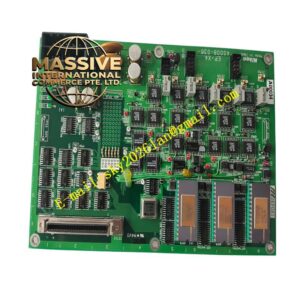
Compact single-board design, 50-pin IDC connector for axis interfaces, 34-pin IDC connector for flag/I/O interface, 4-pin Molex power connector, handwheel port connector, status LEDs, mounting holes for secure installation, optimized component layout for thermal management, modular form factor for easy integration
Working Principle
The CLIPPERT3 operates as a standalone motion controller or as a slave to a host PC. Motion programs and parameters are downloaded via Ethernet or RS-232. The 80 MHz DSP executes real-time trajectory planning, generating coordinated multi-axis motion profiles. Encoder feedback is processed for each axis, and servo algorithms (PID, notch, feedforward) compute control outputs sent as analog voltages or pulse/direction signals to motor amplifiers. Digital I/O handles discrete events like limit switches, tool changes, and safety interlocks. The handwheel port enables manual operation for setup and teaching. The controller continuously monitors system status, reporting errors or faults to the host via the communication interface. Multiple Clipper boards can be networked for systems requiring more than 4 axes per board.
Installation Requirements
Securely mount the CLIPPERT3 board in an enclosure or equipment chassis with adequate airflow
Connect 5V power (and +/-12V if analog I/O is used) via the Molex connector, ensuring correct polarity
Wire motor amplifiers, encoders, and hall sensors to the 50-pin IDC header per Delta Tau wiring diagrams
Connect digital I/O signals (limits, home switches, general-purpose I/O) to the 34-pin IDC header
Use shielded cables for all analog and encoder signals, with shields grounded at one end
Establish Ethernet or RS-232 connection to the host computer for programming and monitoring
Install Delta Tau software tools (PMAC Executive, PEWIN32) on the host for configuration and调试
Verify all connections before applying power to prevent short circuits or miswiring
Usage Precautions
Double-check power supply polarity and voltage levels before powering on
Use high-quality shielded cables and proper grounding to minimize electrical noise on encoder and analog signals
Avoid connecting or disconnecting axis cables while the system is energized
Tune servo parameters methodically; improper gains can cause oscillation or instability
Implement hardware limit switches and software travel limits for axis protection
Regularly back up motion programs and parameter sets
Consult Delta Tau CLIPPER documentation for programming syntax, alarm codes, and troubleshooting procedures
Ensure the controller operates within specified temperature and humidity ranges
Do not modify the board hardware; contact Delta Tau or authorized service providers for repairs
For multi-board systems, ensure proper addressing and communication configuration to avoid conflicts