


Description
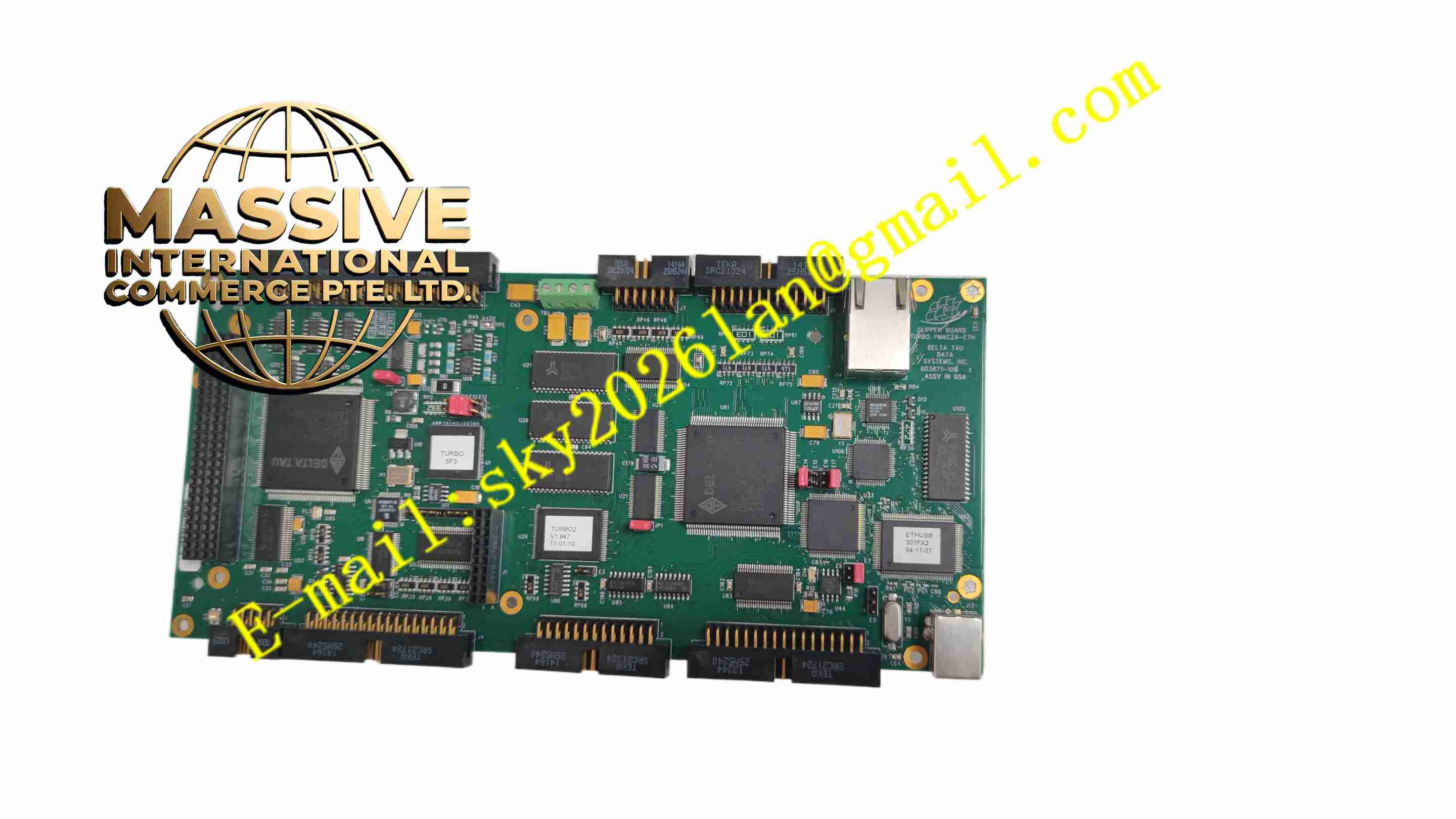
Delta Tau TURBO PMAC2 CPU 160MHZ
Technical Specifications Core clock frequency 160MHz; Supports up to 32 axes synchronized motion control; Built-in dedicated motion calculation co-processor; Onboard memory includes program RAM, variable RAM and non-volatile flash memory; Multiple communication interfaces including Ethernet, RS232, RS485; Encoder input channels for differential quadrature signals; Digital input and output ports for limit, home and enable signals; Operating temperature range 0°C to +55°C; Powered by 5V DC supply.
Functional Features High-speed real-time trajectory interpolation for linear, circular and spline motion profiles; Built-in soft PLC for discrete logic control; Electronic cam function enables phase-locked axis synchronization; Electronic gearing for master-slave axis following; Position, speed and torque closed-loop control modes; Onboard fault capture and position capture function; Multi-tasking operation supports independent execution of multiple motion programs; Built-in watchdog timer triggers safe state upon CPU abnormality; Supports online program modification without full system stop.
Application Scenarios CNC machine tool multi-axis control; High-speed packaging machinery; Laser cutting and engraving equipment; Semiconductor wafer handling mechanism; Robotics joint motion control; Printed web converting machinery; Precision pick-and-place automation systems.
Performance Parameters Servo loop update cycle reaches microsecond level; Interpolation calculation maintains high precision under multi-axis synchronous operation; Encoder position sampling resolution stays stable; Program execution speed matches 160MHz core frequency; Watchdog response latency is fixed.
Material Composition Multi-layer glass fiber printed circuit board; High-speed microprocessor chip; Flash memory and SDRAM memory chips; Differential line receiver ICs; Surface mount signal conditioning components; Gold-plated edge connectors; Aluminum shielding cover for high-speed signal circuits; Screw terminal connectors for digital signals.
Structural Features Rack plug-in board form factor; Edge connector for backplane bus connection; Front panel with status LED indicators and communication ports; Internal metal electromagnetic shielding structure separating analog and digital circuits; Layout isolates high-speed motion signal traces from power traces; Mounting holes for fixed installation inside industrial control chassis.
Working Principle After power supply stabilization, the CPU loads firmware and user motion programs from flash memory into operating RAM. It receives motion commands from host computer or local program. The dedicated motion co-processor computes target position points for each axis in real time. Command position signals are sent to servo drives. Encoder feedback signals return to the CPU for closed-loop position comparison. The CPU adjusts output command to reduce position error. Digital I/O handles limit switch, home sensor and safety interlock signals. It continuously monitors system state and activates safety shutdown once fault condition is detected.
Installation Requirements Install the board into compatible Delta Tau chassis and secure mounting screws; Use shielded differential cables for encoder wiring; Separate high-speed signal cables from AC power cables; Chassis protective earth connection must be implemented; Maintain proper airflow around the board for heat dissipation.
Precautions for Use Cut off chassis power before plugging or unplugging the CPU board; Handle the board with anti-static wristband to prevent electrostatic damage; Do not exceed maximum input voltage for digital I/O channels; Keep ventilation channels free of dust accumulation; Backup motion programs regularly to flash memory or external storage.