


Description
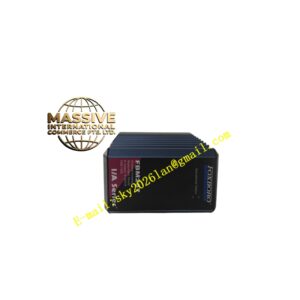
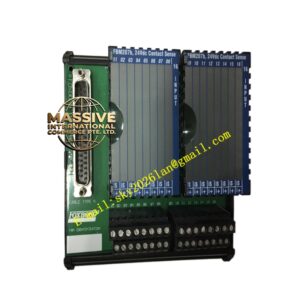
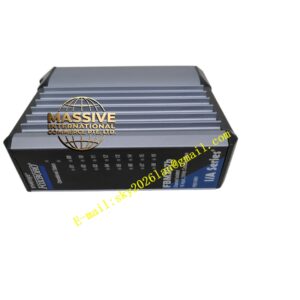
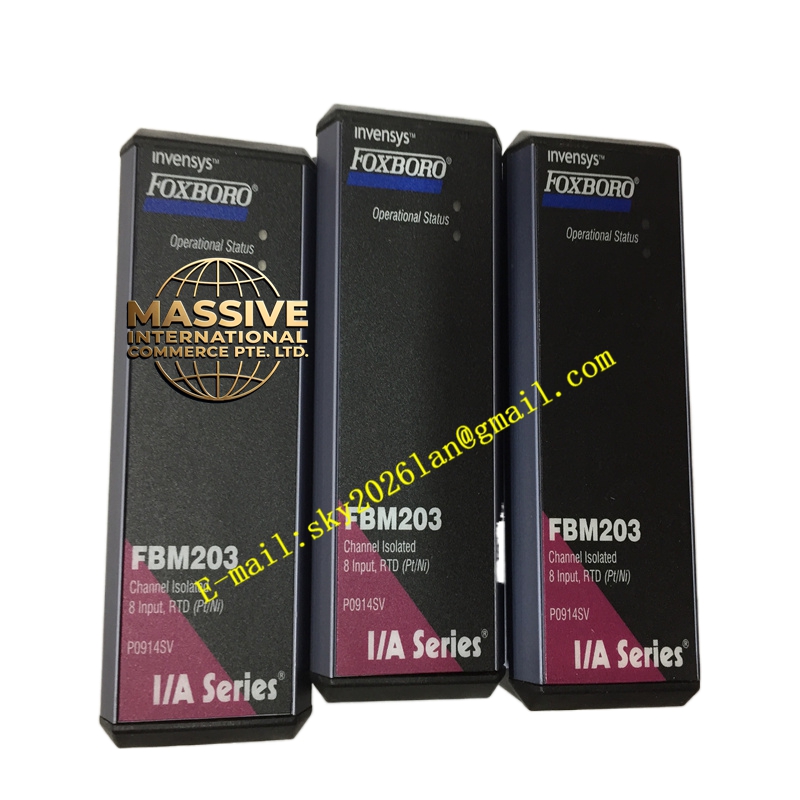
Foxboro FBM203
- Technical Specifications:
- Channels: 8 isolated independent RTD input channels
- Input Types:
- FBM203: 0–320 Ω (2-wire or 3-wire)
- FBM203b: 0–640 Ω (2-wire or 3-wire; Pt1000/high-temp platinum)
- FBM203c: 0–30 Ω (2-wire or 3-wire; Ni120/Cu10)
- FBM203d: 0–320 Ω (4-wire high-precision)
- Supported Sensors: Platinum (IEC, DIN, SAMA), nickel (SAMA), copper Cu10
- Accuracy: ±0.05% of span (typical; per datasheet)
- Sensor Excitation: 0.2 mA DC nominal (constant current)
- Lead Wire Compensation: 2-wire (no lead compensation), 3-wire, 4-wire (depending on variant)
- A/D: Per-channel Sigma-Delta; update 25 ms; configurable integration cycles (50/60 Hz rejection)
- Isolation: Channel-to-channel and channel-to-ground isolation (600 V AC per 1 minute test)
- Communication: Redundant 2 Mbps module fieldbus to FCM/FCP
- Power: 24 V DC; power dissipation < 3 W
- Environment: 20 °C to +70 °C (operating); Class G3 harsh environment
- Dimensions: Approx. 10.4 cm × 4.5 cm × 11.4 cm; weight ~0.284 kg
- Functional Features:
- High accuracy with per-channel Sigma-Delta A/D conversion
- Automatic open-circuit, short-circuit, and over-range diagnostics per channel
- Software-configurable scaling, filtering, rate-of-change limits, and units
- Hot-swappable (requires appropriate baseboard and terminal assembly)
- LED indicators for module status
- Application Scenarios:
- RTD-based temperature measurement in process vessels, pipes, and equipment
- High-precision applications in power generation (e.g., turbine bearings, windings)
- General temperature monitoring in chemical, petrochemical, and pharmaceutical processes
- Performance Parameters:
- Excellent stability and repeatability across the operating range
- High common-mode noise rejection due to isolation and filtering
- Material and Structural Characteristics:
- Housing: Stamped aluminum enclosure for robust physical protection
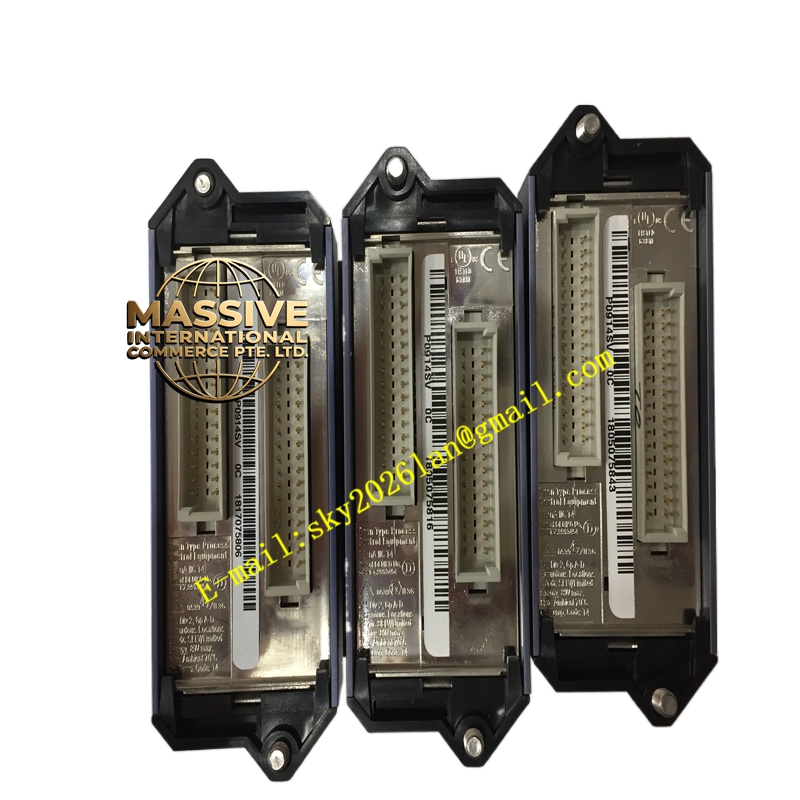
- Connectors: Industrial-grade connectors for fieldbus and terminal interfaces
- PCB: Conformal-coated to resist moisture and contaminants
- Working Principle:
- A constant current excitation passes through the; the voltage across the RTD is measured and converted to temperature using the resistance–temperature relationship. Isolation and filtering ensure noise immunity and safety.
- Installation Requirements:
- Mount on a DIN-rail or baseboard designed for 200 series FBM modules
- Connect RTD sensors via the terminal block, observing 2/3/4-wiring requirements per variant
- Configure RTD type, range, and parameters via engineering tools
- Usage Notes:
- Use RTDs matching the configured type and resistance range
- Verify correct wiring (especially for 3-wire and 4-wire configurations)
- Perform periodic verification of input accuracy
- Ensure grounding per system recommendations