




Description
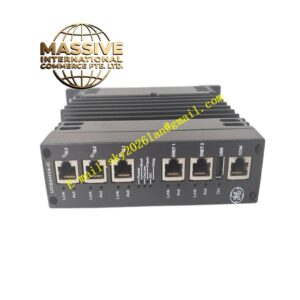
GE IC698ETM001
Technical Specifications:
- Ethernet Ports: Two 10/100Base-TX RJ45 ports with auto-negotiation, crossover detection, and dual-speed support
- Serial Station Manager Port: 9-pin D-Sub RS-232, 1200–115200 bps
- Processor: 200 MHz dedicated Ethernet processor
- Supported Protocols: SRTP, SRTP Client, Modbus TCP Server/Client, EGD, SNTP time synchronization
- LEDs: Module OK, LAN Online, Status, 100 LINK P1, 100 LINK P2
- Power: 5 VDC; current draw 1.5 A typical
- Operating Temperature: 0 °C to 60 °C
Functional Features:
- Internal two-port switch enables daisy-chain, star, and ring topologies
- Redundant IP addressing support for high-availability networks
- EGD for periodic, high-speed producer/consumer data exchange
- Flash-stored protocols upgradeable via CPU serial port
- Comprehensive diagnostics and web-based management tools
Application Scenarios:
- Controller-to-controller communication across plant networks
- Connecting HMIs and SCADA systems to RX7i controllers
- Remote I/O and distributed control architectures
- Time synchronization across control systems
Performance Parameters:
- Low-latency communication suitable for real-time data exchange
- High throughput with full-duplex operation and auto-negotiation
- Scalable to large numbers of EGD exchanges and TCP connections
Material and Structural Characteristics:
- Industrial-grade module conforming to RX7i mechanical standards
- Shielded RJ45 connectors and robust backplane interface
- Front-panel LEDs for clear status indication
Working Principle: The module handles Ethernet traffic independently of the CPU, providing protocol stacks, data buffering, and network management. It exchanges data with the CPU over the backplane and with network devices via Ethernet ports. Installation Requirements:
- Insert into any slot of an RX7i universal backplane
- Connect Ethernet cabling (CAT5 or higher) to RJ45 ports; observe proper termination
- Configure IP addresses and protocols via Station Manager or Proficy Machine Edition
Usage Notes:
- Verify IP address settings and gateway configuration before deployment
- Use STP or ring protocols where loop prevention is required
- Keep firmware up to date for security and feature support
- Avoid exposing ports to moisture or contaminants; use appropriate enclosures