


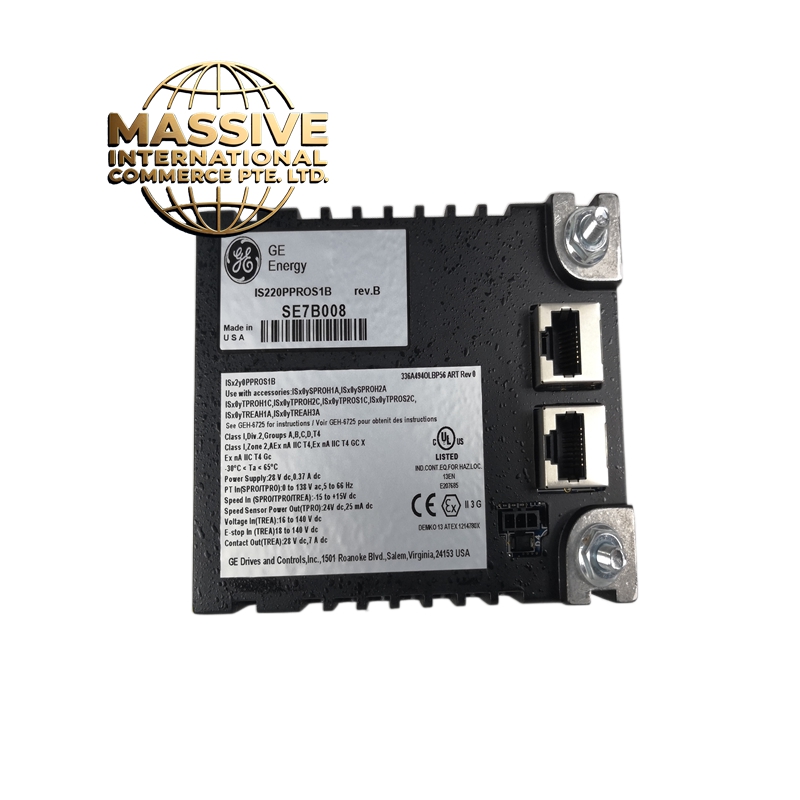
Description
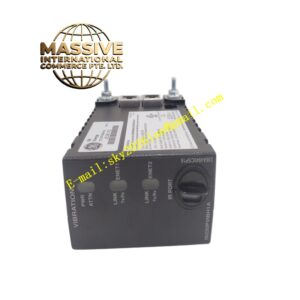
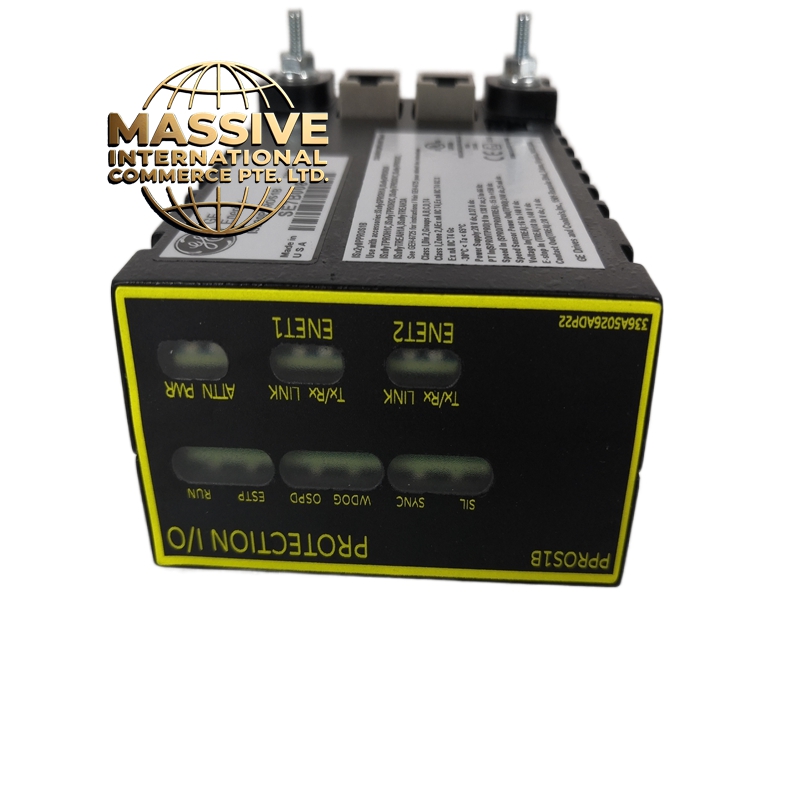
GE IS220PRTDH1A
Technical Specifications
| Parameter | Specification |
|---|---|
| Function | RTD Temperature Sensor Interface |
| System Compatibility | Mark VIe I/O Pack |
| Sensor Types | Pt100, Pt200, Pt500, Pt1000, Cu10, Ni120 |
| Connection Types | 2-wire, 3-wire, 4-wire configurations |
| Measurement Range | -200°C to +850°C (sensor dependent) |
| Accuracy | ±0.1°C or better with 4-wire connection |
| Resolution | 0.01°C |
| Excitation Current | Constant current excitation, typically 1mA |
| Lead Wire Compensation | Automatic compensation for 3-wire and 4-wire |
| Isolation | Channel-to-channel and channel-to-ground isolation |
| Update Rate | < 1 second per channel |
| Operating Temperature | -30°C to 65°C (-22°F to 149°F) |
| Storage Temperature | -40°C to 85°C (-40°F to 185°F) |
| Humidity | 5% to 95% non-condensing |
| Enclosure | IP20, DIN rail mountable |
Functional Features
-
Multi-Sensor Support: Compatible with platinum, copper, and nickel RTD types
-
Automatic Lead Compensation: Eliminates errors from lead wire resistance in 3-wire and 4-wire configurations
-
Open Circuit Detection: Identifies broken sensor wires or disconnected sensors
-
Short Circuit Detection: Detects sensor short circuits
-
Over-Range Detection: Identifies temperatures exceeding sensor capability
-
Sensor Diagnostics: Monitors sensor health and drift over time
-
Linearization: Built-in Callendar-Van Dusen equation for accurate linearization
Structural Characteristics
-
Precision resistance measurement circuitry
-
Constant current excitation source with low drift
-
High-impedance differential input amplifiers
-
Removable spring-clamp or screw terminal blocks
-
LED status indicators for channel health
-
Compact DIN rail mountable housing
Working Principle The module uses a constant current excitation method to measure RTD resistance. A precise constant current (typically 1mA) is passed through the sensor. The resulting voltage drop across the sensor is measured using high-impedance differential amplifiers. For 3-wire and 4-wire configurations, the module measures the voltage drop in the lead wires and automatically subtracts this value to eliminate lead resistance errors. The measured resistance is then converted to temperature using the Callendar-Van Dusen equation for platinum RTDs or appropriate equations for other sensor types.
Installation Requirements
-
Mount on DIN rail in control cabinet
-
Use appropriate RTD extension cable for sensor connections
-
Follow correct wiring configuration (2-wire, 3-wire, or 4-wire) as configured in software
-
Ensure all connections are tight to prevent measurement errors
-
Maintain proper separation from high-voltage power cables
Application Scenarios
-
Turbine bearing temperature monitoring
-
Generator winding temperature measurement
-
Steam temperature monitoring in boilers
-
Process vessel temperature control
-
Motor bearing and winding temperature monitoring
-
Heat exchanger performance monitoring
Usage Precautions
-
Verify correct RTD type configuration in software (Pt100, Pt1000, etc.)
-
Ensure proper wire configuration matching (2, 3, or 4-wire)
-
Avoid exposing RTD sensors to temperatures beyond rated range
-
Check for loose connections causing intermittent readings
-
Periodic verification against calibrated reference recommended
-
Protect sensor leads from mechanical damage and moisture ingress