


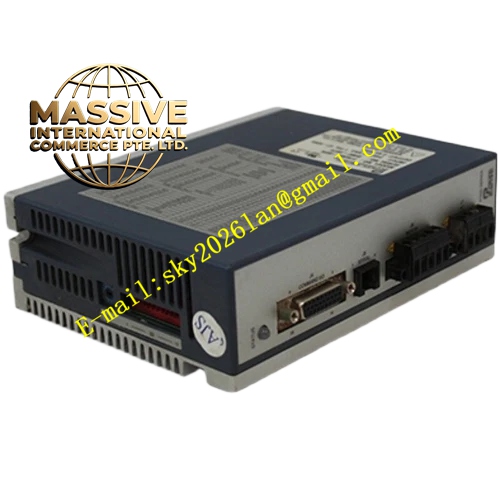
Description
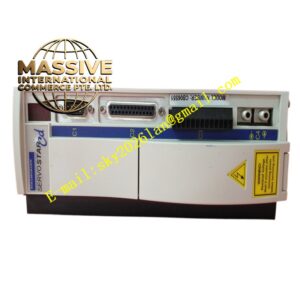
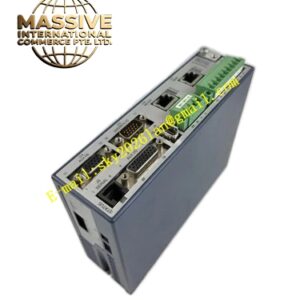
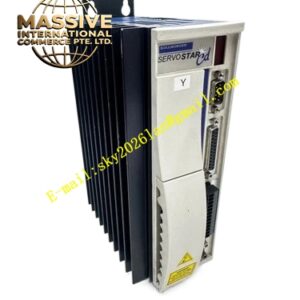
Kollmorgen P70360-PNN
Technical Specifications
- Max Output Current: 2.5 A (at 0°C to 40°C ambient)
- Bus Voltage: 20 VDC to 75 VDC (DC bus option) or 120/240 VAC (AC input option)
- Step Resolution: Configurable from 5,000 to 50,000 steps per motor revolution
- Max Step Input Frequency: 2 MHz (minimum ON/OFF time of 250 ns each)
- Direction Setup Time: 55 µs from DIR input change prior to STEP transition
- General Purpose Inputs: 9 configurable optically isolated inputs
- Communication: RS-232 via RJ12 connector; optional RS-485 multi-drop bus
- Protection Class: IP20 (panel/cold-plate mount)
- CE Compliance: EN 50178 (Low Voltage Directive), EN61800-3 (EMC)
Functional Features
- Built-In Motion Profiling: The PNN version includes Move Select inputs (MV SEL 1 through MV SEL 4) for executing pre-programmed move profiles without an external controller.
- Anti-Resonance Control: Advanced digital algorithms detect and suppress mid-range resonance that typically causes stepper motors to lose synchronism and stall.
- Dynamic Smoothing: A 2nd-order low-pass temporal filter applied to the command sequence reduces jerk, overshoot, and mechanical resonance excitation.
- Stall Detection: The drive continuously monitors shaft position versus commanded position and triggers a fault if the deviation exceeds two full steps.
- X-Smoothness Tuning: Harmonic amplitude and phase adjustment for reducing torque ripple specific to individual motor characteristics.
- P7000Tools Software: Full Windows-based configuration utility for motor file editing, motion profile generation, I/O configuration, and real-time status monitoring.
Application Scenarios
- Indexing Tables: Standalone rotary indexing with pre-programmed move profiles.
- Pick-and-Place Systems: High-speed linear and rotary positioning in automated assembly.
- CNC Auxiliary Axes: Tool changers, rotary tables, and feed mechanisms.
- Labeling and Converting: Precise web transport and registration in printing machinery.
- Medical Devices: Smooth, low-vibration motion for diagnostic and laboratory automation.
Performance Parameters
- Microstepping Resolution: Up to 50,000 steps per revolution for ultra-smooth motion.
- Resonance Suppression: Robust anti-resonance control eliminates mid-range velocity instability.
- Positioning Accuracy: Maintains closed-loop stall detection with fault output.
- Velocity Smoothness: Dynamic smoothing reduces jerk and mechanical shock during acceleration and deceleration.
Material Composition
Housed in a compact aluminum chassis with integrated heat sink fins for efficient thermal dissipation. Internal circuitry features high-reliability power MOSFETs, optically isolated I/O stages, and surface-mount digital signal processing components.
Structural Features
- Cold-Plate Mounting: Designed for mounting on a cold plate using 8×32 or M4 screws, with heat sink fins oriented to the left when viewed from the front.
- 26-Pin D-Sub Connector (J4): High-density female connector for command I/O including step, direction, enable, general purpose inputs, and fault output.
- RJ12 Serial Port (J5): RS-232 communication interface for PC-based configuration.
- Status LED: Multi-color indicator for real-time drive status (solid green = enabled, blinking green = online but disabled).
Working Principle
The P70360-PNN receives step and direction pulses from an external controller or generates internal motion profiles via its Move Select inputs. The internal DSP processes these commands through dynamic smoothing and anti-resonance filters, then generates precisely timed PWM signals to drive the two-phase stepper motor windings. The drive continuously monitors the motor’s actual shaft position against the commanded position. If a stall is detected (deviation exceeding two full steps), the drive outputs a fault signal. Configuration and tuning are performed via the RS-232 serial port using P7000Tools software.