


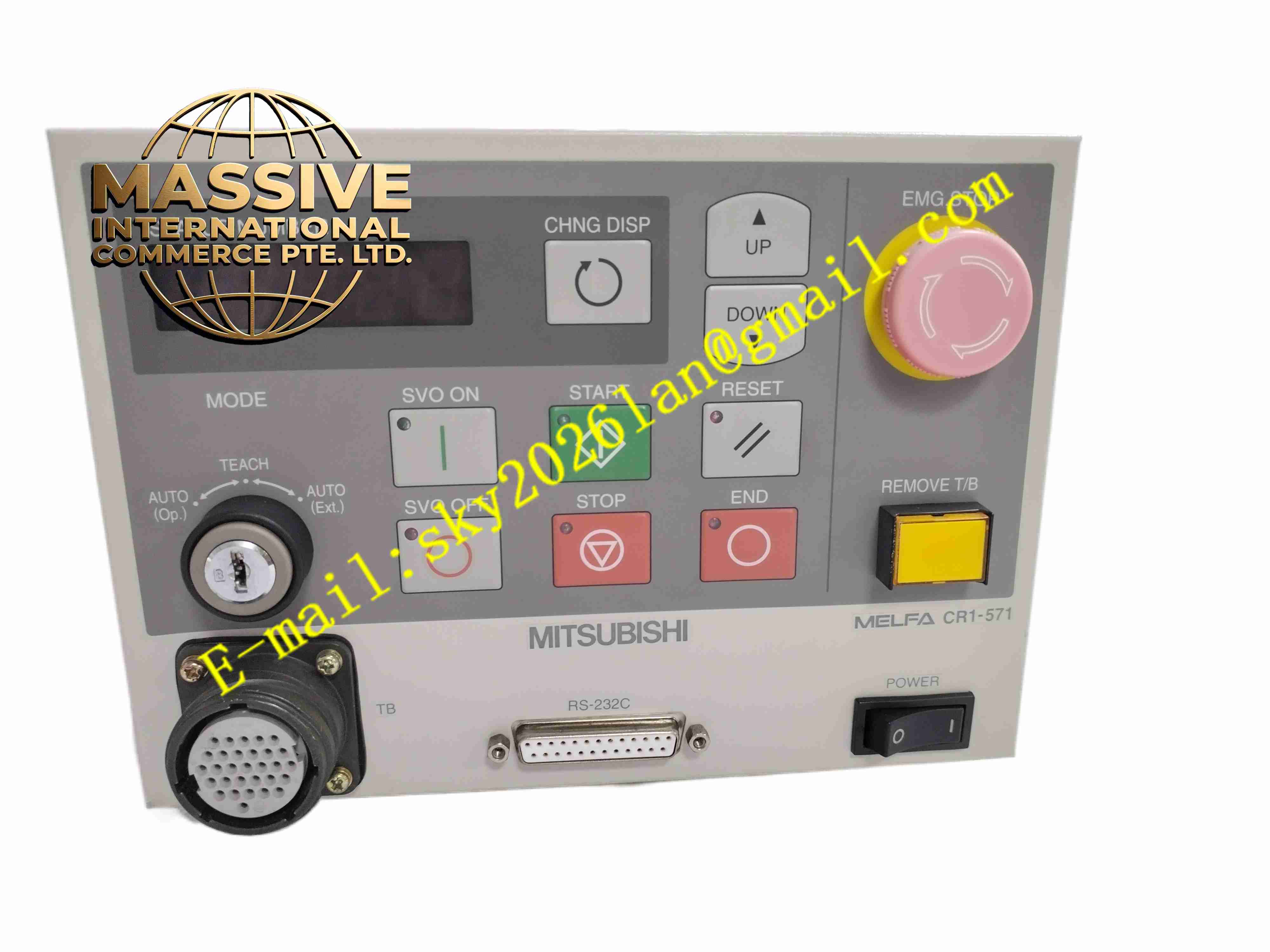
Description
Mitsubishi MELFA CR1-571
Technical Specifications
- Brand: Mitsubishi Electric
- Product Line: MELFA industrial robot controller
- Model: CR1-571
- Controller Type: Standalone robot controller for MELFA articulated robots
- Programming Language: MELFA-BASIC programming environment
- Control Method: PTP and CP motion control
- Axes Supported: Depends on the connected robot; typical small MELFA robots support up to 6 axes
- Power Supply: Selectable single-phase AC 100 V or single-phase AC 200 V for supported robot series
- Voltage Selection: Input voltage must be confirmed and set via the controller voltage setting connector before power connection
- Leakage Protection: An external leakage circuit breaker must be installed on the primary power side
- Teach Pendant: Dedicated teach pendant for programming, jogging, and maintenance
- I/O Interface: Robot-specific digital I/O and interface connectors for peripheral devices
- Communication: Serial, PLC interface, and robot network connections depending on configuration
Functional Features
- Multi-axis motion control: Controls articulated robot axes for precise positioning.
- Program storage: Stores robot programs, position data, and system parameters.
- Teach pendant operation: Allows manual jogging, program editing, and status monitoring.
- PTP and CP control: Supports point-to-point movement and continuous-path trajectory control.
- Peripheral I/O: Provides digital inputs and outputs for grippers, sensors, conveyors, and safety devices.
- PLC integration: Interfaces with Mitsubishi PLCs and external automation equipment.
- Safety functions: Includes emergency stop, enable switch, brake control, and protective monitoring.
Application Scenarios
- Small parts pick-and-place
- Electronic component handling
- Assembly line automation
- Machine tending
- Packaging and sorting
- Laboratory and testing automation
- Education and training cells using small articulated robots
Performance Parameters
- Motion Control: PTP and CP control modes
- Axis Count: Determined by the connected robot model
- Programming: MELFA-BASIC language
- Power Input: Single-phase AC 100 V or 200 V, depending on model and setting
- I/O Capacity: Depends on installed interface options and robot configuration
- Teaching Method: Teach pendant and manual data input
Material Composition
- Controller Enclosure: Metal cabinet with internal power supply, drive, and control boards
- Internal Drives: Servo amplifiers and motion control circuitry
- Power Section: Transformer, rectifier, filter, and protection circuits
- Interface Boards: I/O, communication, and robot interface modules
- Connectors: Robot cable connector, teach pendant connector, power connector, and I/O terminals
Structural Features
- Standalone cabinet design: Houses power supply, controllers, and drive units.
- Dedicated robot interface: Connects to the robot arm through a multi-core robot cable.
- Teach pendant port: Provides a safe interface for programming and manual operation.
- Voltage selection connector: Allows configuration for supported AC input voltages.
- Modular I/O options: Supports additional interface boards depending on system needs.
- Compact footprint: Suitable for small robot cells and benchtop automation systems.
Working Principle
The CR1-571 controller receives motion commands from stored robot programs or from the teach pendant. It calculates joint trajectories and sends drive signals to the robot servo amplifiers. Encoder feedback from each axis is returned to the controller for closed-loop position and speed control. Digital I/O signals coordinate grippers, sensors, conveyors, and safety devices. The controller monitors faults, limits, and safety circuits to stop motion when required.
Installation Requirements
- Install the controller in a clean, dry, and ventilated indoor environment.
- Confirm the input voltage setting connector matches the available AC supply before powering on.
- Install the supplied leakage circuit breaker on the primary power side.
- Connect the robot cable securely and verify pin alignment.
- Ground the controller and robot according to Mitsubishi installation requirements.
- Keep the teach pendant cable away from moving robot parts.
- Verify emergency stop circuits before starting automatic operation.