


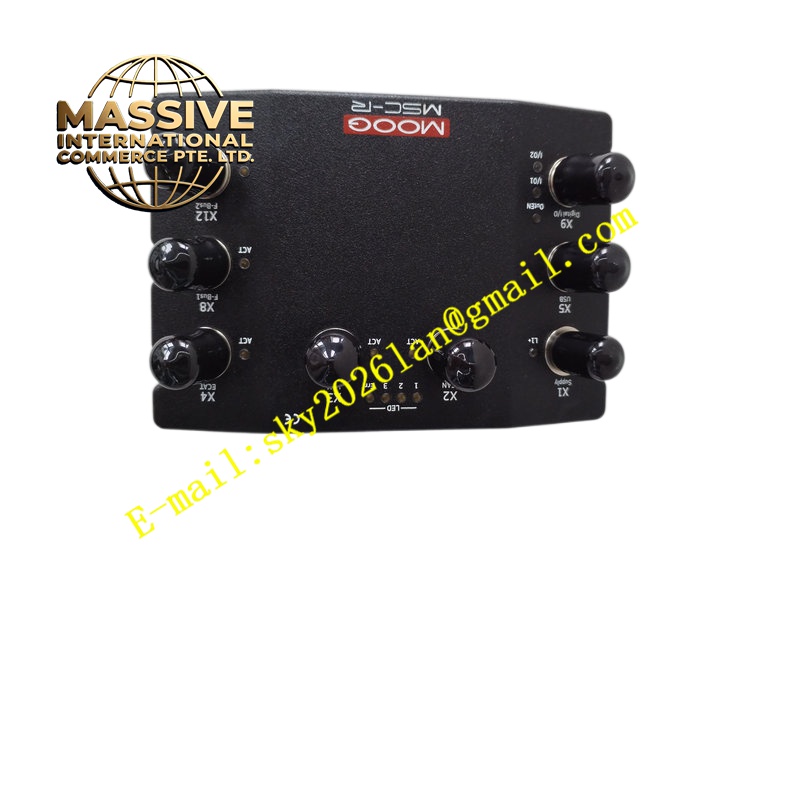
Description
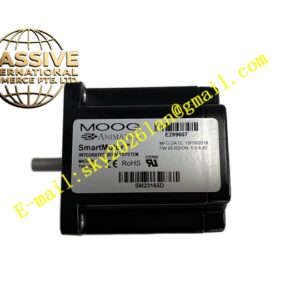
MOOG D136-003-001
Technical Specifications
Brand: MOOG
Product Model: D136-003-001
Product Series: MSC-R Servo Controller
Power Supply Input: 24 V DC or 48 V DC
Output Voltage: 0 to 10 V DC
Rated Power: Approximately 750 W
Rated Current: 3.4 A
Overload Capacity: 150% for 1 minute duration
Rated Torque (dual-axis): 2.8 N·m
Peak Torque (dual-axis): 4.2 N·m
Maximum Rotational Speed: 4500 rpm
Response Time: Less than 1 ms
Communication Interfaces: EtherCAT, CANopen
Protection Rating: IP20
Dimensions: 100 mm × 50 mm × 25 mm
Installation Method: Wall-mounted or rack-mounted
Cooling Method: Natural cooling (convection)
Certification Standards: CE, UL, RoHS compliant
Functional Features
Multi-Mode Control: Supports position control, speed control, and torque control modes to accommodate diverse application requirements
High-Precision Current Amplifier: Built-in high-precision current amplifier with overload capacity of ±80 mA for accurate motor drive
Fast Response: Sub-millisecond response time enables rapid tracking of command signals and quick adaptation to load changes
Dual-Axis Capability: Capable of controlling two servo axes simultaneously with independent or synchronized operation
Modern Communication Support: Compatible with EtherCAT and CANopen protocols for integration into contemporary industrial networks
Compact Form Factor: Small dimensions (100 mm × 50 mm × 25 mm) save space in control cabinets and machine installations
Natural Cooling: Convection-based cooling eliminates the need for additional fans, reducing maintenance requirements and noise
Flexible Mounting: Can be installed on walls or in racks to suit different installation environments
Overload Protection: 150% overload capacity for 1 minute allows the controller to handle temporary peak loads without tripping
Application Scenarios
Industrial Robotics: Joint control for robotic arms requiring precise position and torque control
CNC Machine Tools: Axis control for milling machines, lathes, and grinding machines
Packaging Machinery: Servo-driven packaging lines for food, beverage, and pharmaceutical industries
Textile Machinery: Precise tension and speed control in weaving and knitting machines
Printing Presses: Registration control and web tension management
Material Handling: Conveyor systems, automated guided vehicles (AGVs), and sorting systems
Test Equipment: Material testing machines and fatigue testing rigs requiring precise force control
Semiconductor Manufacturing: Wafer handling robots and precision positioning stages
Performance Parameters
Rated Power Output: 750 W
Rated Current: 3.4 A
Overload Capacity: 150% (1 minute)
Rated Torque: 2.8 N·m (dual-axis)
Peak Torque: 4.2 N·m (dual-axis)
Maximum Speed: 4500 rpm
Control Response Time: Less than 1 ms
Current Amplifier Overload: ±80 mA
Communication Speed: EtherCAT and CANopen standard rates
Protection Level: IP20
Material Composition
Industrial-grade printed circuit board with surface-mounted power electronics components, precision current sensing resistors, high-performance MOSFET or IGBT power transistors for motor drive, digital signal processor for control algorithm execution, aluminum heat sink for passive cooling, reinforced polymer or metal housing, flame-retardant materials compliant with UL94 standards, gold-plated connector contacts
Structural Features
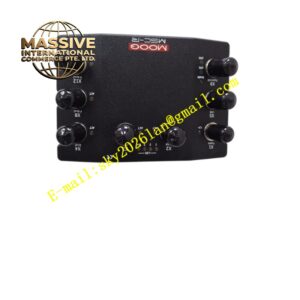
Ultra-compact modular design (100 mm × 50 mm × 25 mm) for space-efficient installation, integrated aluminum heat sink fins for natural convection cooling, front-panel connectors for power, communication, and motor connections, status LEDs for power, communication, and fault indication, mounting holes for wall or rack installation, ventilation slots for airflow, clearly labeled terminal markings, IP20 protection against solid objects larger than 12.5 mm
Working Principle
The D136-003-001 receives command signals from a higher-level controller via EtherCAT or CANopen fieldbus interfaces. The onboard digital signal processor interprets the command and executes the selected control algorithm (position, speed, or torque). For position control, the controller compares the commanded position with feedback from the motor encoder and generates a speed command. For speed control, it compares commanded and actual speed to produce a torque command. For torque control, it directly regulates the motor current. The power stage converts the control signal into the appropriate voltage and current to drive the servo motor. The built-in current amplifier precisely regulates the motor current, while the overload protection circuitry monitors temperature and current levels to prevent damage. Communication with the host system provides real-time status updates, diagnostic information, and parameter adjustments.
Installation Requirements
Mount the controller securely on a wall or in a rack using the provided mounting holes, ensuring adequate clearance for ventilation
Ensure the installation environment is within the specified temperature and humidity ranges
Connect the DC power supply (24 V or 48 V) using properly sized wiring with appropriate fusing
Connect the servo motor cables, ensuring correct phase sequence and encoder wiring
Connect the fieldbus communication cable (EtherCAT or CANopen) using shielded twisted-pair cable with proper termination
Configure controller parameters (control mode, gains, limits) using the appropriate MOOG configuration software
Verify all connections are secure before applying power
Ensure the controller is installed in a location protected from direct exposure to water, oil, and conductive dust (IP20 rating)
Usage Precautions
Verify the power supply voltage matches the controller’s rated input (24 V or 48 V DC) before powering on
Do not exceed the rated current of 3.4 A for continuous operation; the 150% overload is limited to 1-minute duration
Ensure adequate ventilation around the controller for effective natural cooling; do not obstruct the heat sink fins
Keep the controller clean and free of dust accumulation that could impair heat dissipation
Use properly shielded cables for all connections to minimize electromagnetic interference
Do not operate the controller in environments exceeding the IP20 protection rating without additional enclosure protection
Back up configuration parameters before making changes to controller settings
Monitor status LEDs and diagnostic messages for early fault detection
Handle the controller with care to avoid electrostatic discharge damage to sensitive electronic components
Refer to MOOG documentation for specific parameter settings and troubleshooting procedures