


Description
Motorola MVME162P-252SE
Technical Specifications
- Microprocessor: 33 MHz MC68040 enhanced 32-bit microprocessor (includes 8KB cache, MMU, and FPU).
- Main Memory: 16MB SDRAM with hardware ECC protection.
- Integrated Interfaces: Onboard Ethernet and optional SCSI interface.
- Storage Resources: 512KB battery-backed SRAM, 1MB Flash, and 8K NVRAM.
Functional Features
- Floating-Point Unit: Integrated FPU enables complex mathematical computations and advanced motion control algorithms.
- ECC Memory: Hardware-level error detection and correction ensures extreme data reliability.
- High-Speed I/O: Integrated Ethernet and SCSI both utilize DMA for rapid data transfers.
- Petra ASIC: Delivers highly efficient memory management and VMEbus interface control.
Application Scenarios
Designed for advanced motion control, radar signal processing, precision instrumentation, nuclear power monitoring, and defense/military applications.
Performance Parameters
- VME Bus: Supports D64 BLT and MBLT transfers.
- Serial Interfaces: Dual EIA-232-D/EIA-422 ports.
- Timers: Six 32-bit timers and one hardware watchdog.
Material Composition
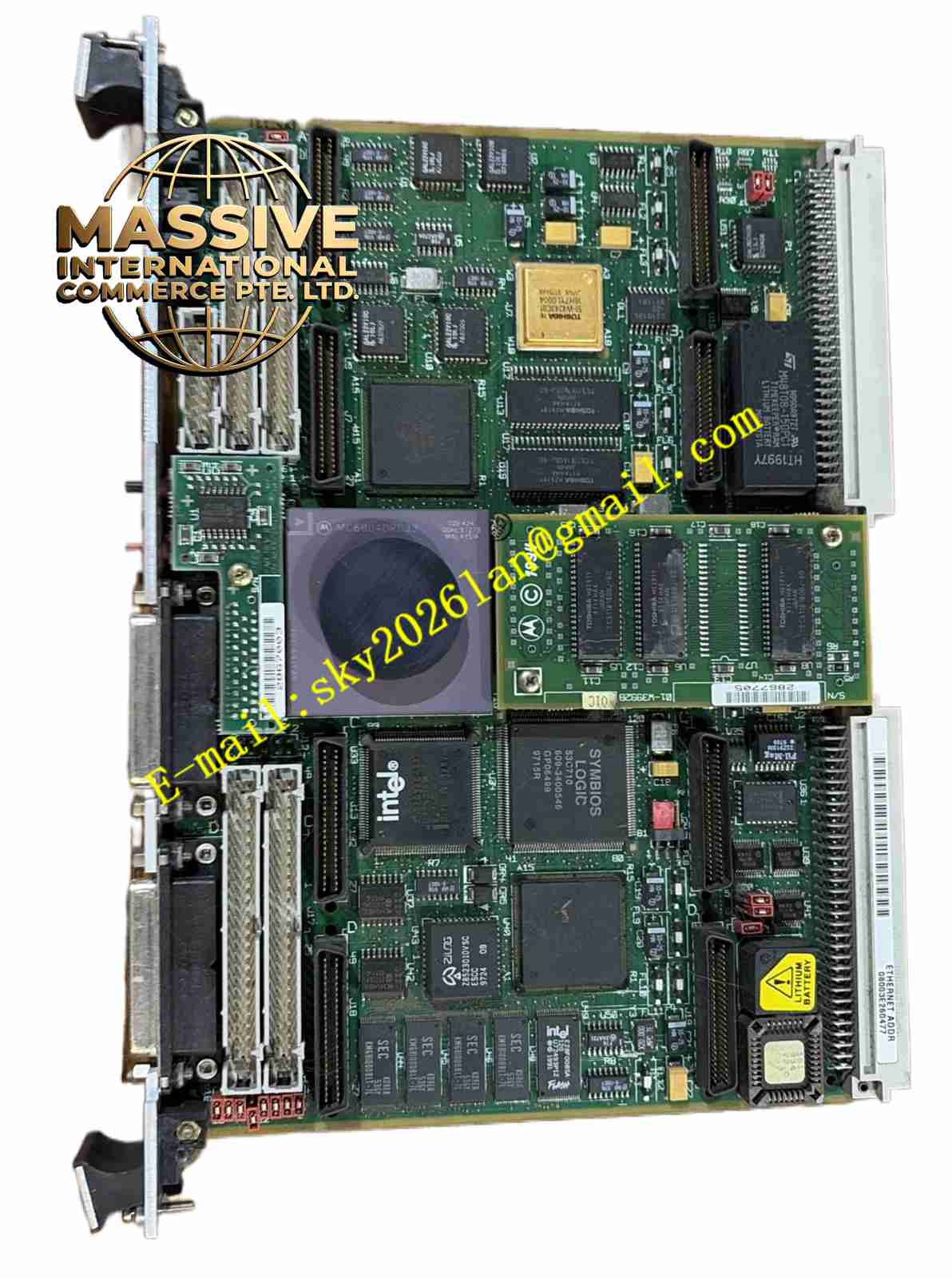
High-density multi-layer PCB populated with the MC68040RC33 processor, ECC SDRAM modules, Ethernet PHY, SCSI controller, and the Petra ASIC.
Structural Characteristics
Standard 6U VME form factor with comprehensive front-panel status indicators and hardware configuration switches.
Working Principle
The MC68040 processor communicates via the local bus with the Petra ASIC, which manages the ECC SDRAM and peripherals. Internal DMA controllers handle high-speed data transfers for Ethernet, SCSI, and VMEbus transactions.
Installation Requirements
- Ensure the VME chassis power supply can meet the peak current demands of the high-performance processor.
- Configure memory and processor switches accurately.
- If using SCSI, ensure proper termination resistors are configured on the SCSI bus.
Usage Precautions
- Never hot-swap the board; always power down the chassis before installation.
- Avoid operating in environments with excessive vibration or strong EMI.
- Monitor ECC error logs via system diagnostics to maintain system health.