


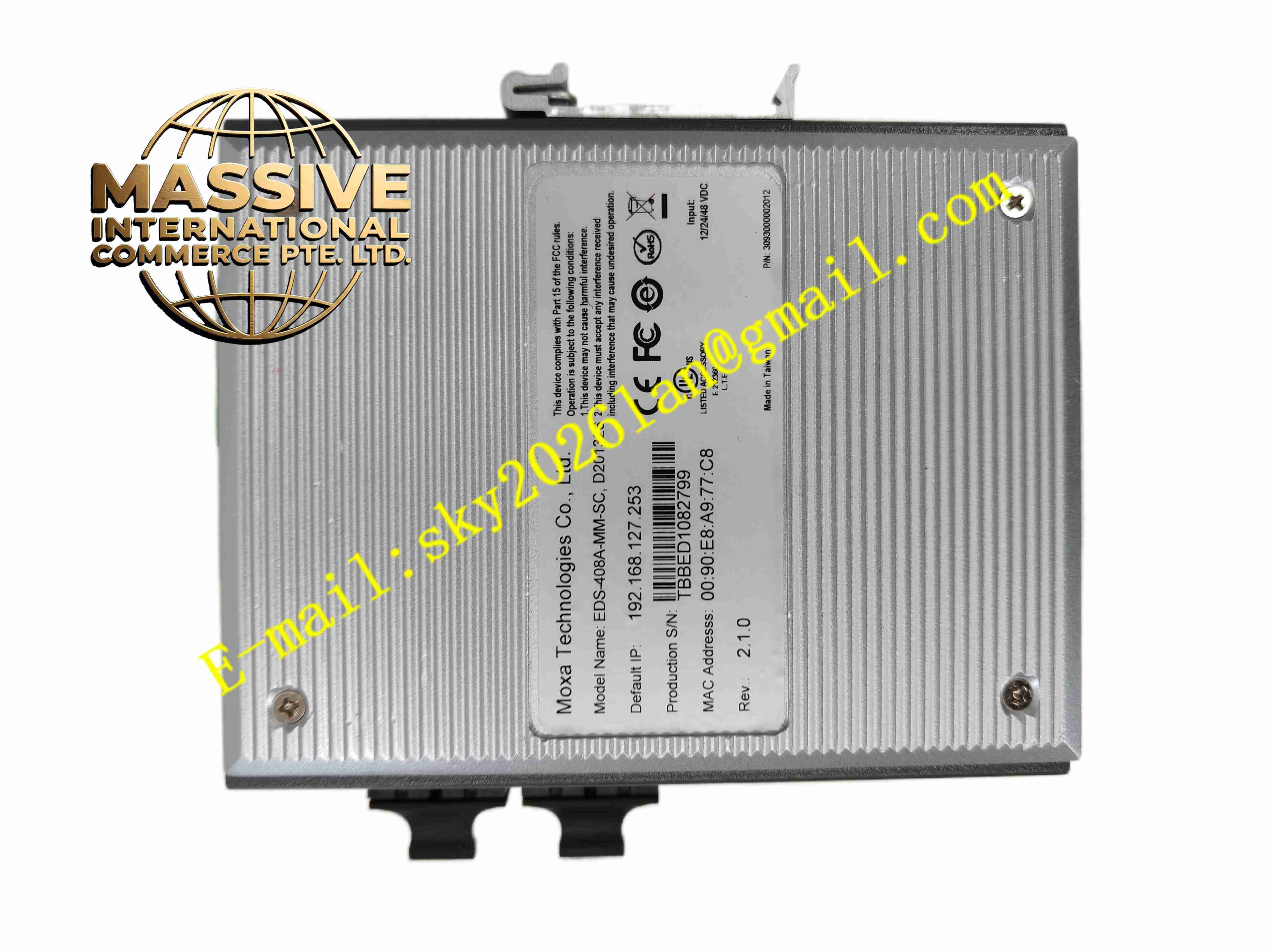
Description
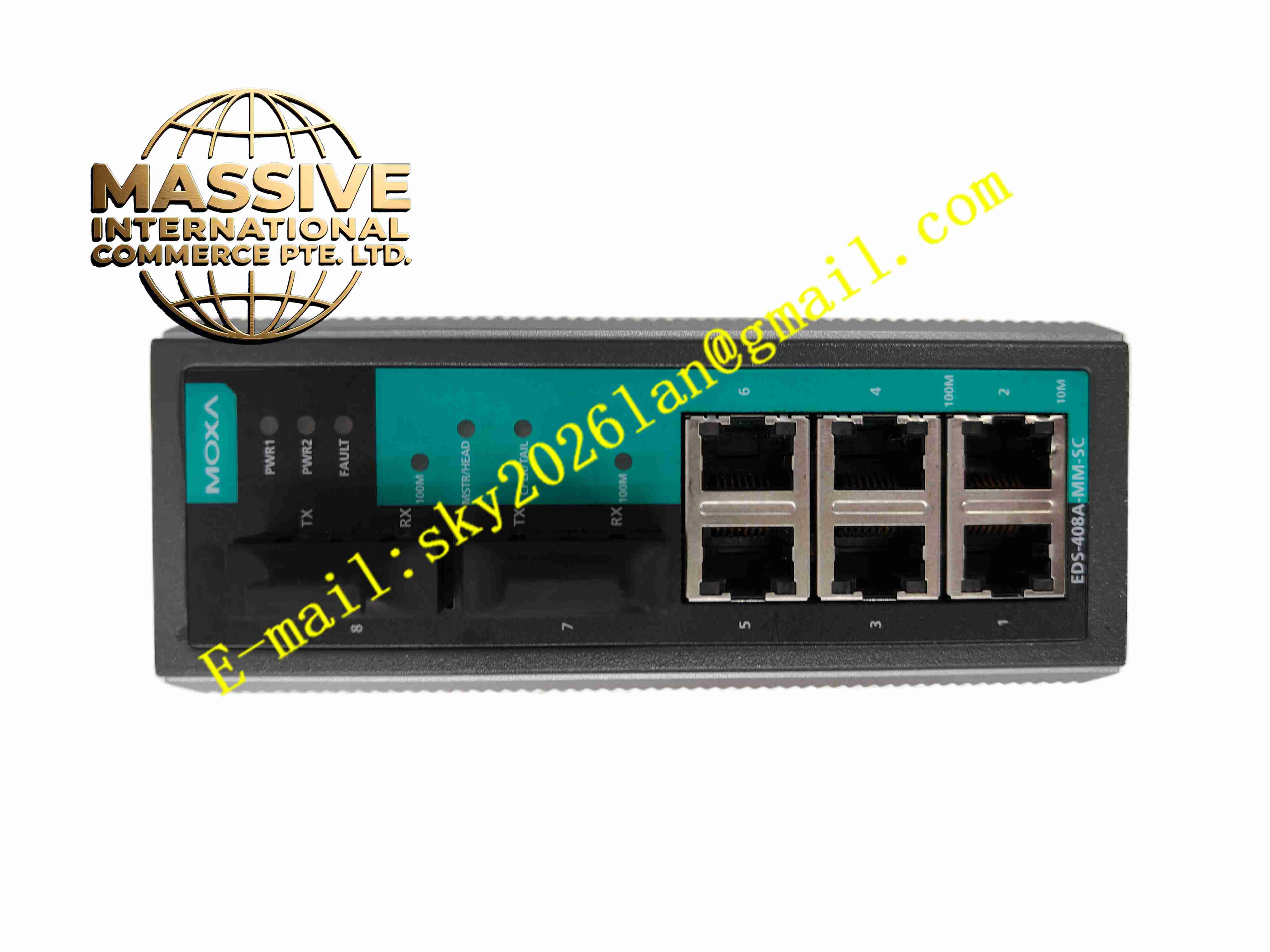
MOXA EDS-408A-MM-SC (D201326)
Technical Specifications
Brand: MOXA
Product Series: EDS-400A Series
Product Model: EDS-408A-MM-SC
Product Type: Layer 2 Managed Industrial Ethernet Switch
Copper Ports: 6 × 10/100BaseT(X) RJ45, auto MDI/MDI-X, auto-negotiation
Fiber Ports: 2 × 100BaseFX multi-mode SC connector
Standards: IEEE 802.3, IEEE 802.3u, IEEE 802.3x, IEEE 802.1D-2004, IEEE 802.1p, IEEE 802.1Q, IEEE 802.1w
Switching Method: Store-and-forward
Flow Control: IEEE 802.3x full duplex, backpressure flow control
MAC Address Table: 8K entries
Packet Buffer: 1 Mbit
Input Voltage: 24 VDC (12–45 VDC), dual redundant inputs
Power Connector: 2 × removable 6-pin terminal blocks
Alarm Output: 2 × relay outputs, 1 A @ 24 VDC
Digital Input: 2 × digital inputs (State 1: +13 to +30 V; State 0: -30 to +3 V; max 8 mA)
Protection Rating: IP30
Dimensions: 53.6 × 135 × 105 mm (W × H × D)
Weight: Approximately 650 g
Operating Temperature: -10°C to 60°C (standard model); -40°C to 75°C (wide-temperature variant)
Storage Temperature: -40°C to 75°C
Relative Humidity: 5% to 95% (non-condensing)
Certifications: UL 508, UL 60950-1, CSA C22.2 No. 60950-1, CE
Functional Features
Turbo Ring v1/v2: Proprietary ring redundancy protocol with recovery time under 20 ms for up to 250 switches
Turbo Chain: Chain-type redundancy for linear topologies with fast failover
RSTP/STP: IEEE 802.1w Rapid Spanning Tree Protocol and IEEE 802.1D Spanning Tree Protocol for loop prevention
VLAN Support: IEEE 802.1Q VLAN tagging, port-based VLAN, and GVRP for dynamic VLAN registration
QoS: IEEE 802.1p/1Q priority queuing and TOS/DiffServ for traffic prioritization
IGMP Snooping: IGMP v1/v2 snooping and GMRP for efficient multicast traffic filtering
RMON: Remote Network Monitoring (Groups 1, 2, 3, 9) for proactive network monitoring
Port Mirroring: Mirrors traffic from one port to another for troubleshooting and analysis
Bandwidth Management: Rate limiting on individual ports to prevent network congestion
SNMP Management: SNMPv1/v2c/v3 support for network monitoring and management
Security Features: IEEE 802.1X port authentication, HTTPS, SSH, TACACS+, SNMPv3 for secure access
DHCP Features: DHCP server/client, DHCP Option 66/67/82 for automated IP assignment
LLDP: Link Layer Discovery Protocol for network topology discovery
Email Alerts: Automatic email notifications for network events and faults
ABC-01 Support: Automatic Backup Configuration tool for quick device replacement
Web Management: Browser-based graphical user interface for configuration and monitoring
CLI: Command-line interface via console port or Telnet/SSH for advanced configuration
Application Scenarios
Industrial Automation: Managed network backbone for PLC, HMI, and drive communication in manufacturing facilities
Process Industries: Reliable Ethernet infrastructure for oil and gas, chemical, and pharmaceutical plants
Power Utilities: Substation automation networks compliant with IEC 61850-3 requirements
Transportation: Traffic management systems, tunnel monitoring, and railway signaling networks
Water and Wastewater: SCADA networks for pump stations, treatment plants, and distribution systems
Building Management: Large-scale HVAC, lighting, and security system integration
Machine Building: Network backbone for complex packaging, printing, and assembly machines
Performance Parameters
Switching Capacity: 1.6 Gbps non-blocking switching fabric
Forwarding Rate: Approximately 1.19 Mpps at wire speed
Latency: Less than 10 microseconds for store-and-forward switching
MAC Address Table: 8,000 entries for large network support
VLAN Capacity: Up to 4,094 VLAN IDs (VID 1–4094)
Priority Queues: 4 priority levels for QoS traffic classification
IGMP Groups: Up to 256 multicast groups
Ring Recovery Time: Under 20 ms for Turbo Ring with up to 250 switches
Fiber Link Budget: Approximately 12 dB for multi-mode fiber at 1300 nm
Fiber Distance: Up to 5 km with 50/125 µm fiber; up to 4 km with 62.5/125 µm fiber
Material Composition
IP30-rated metal enclosure with aluminum construction for heat dissipation and EMI shielding, industrial-grade printed circuit board with managed switching ASIC, Ethernet PHY transceivers for copper ports, fiber optic transceivers for SC ports, redundant power supply circuitry with reverse polarity and overcurrent protection, relay output and digital input circuitry, LED indicator components, removable terminal block connectors, console port interface components
Structural Features
Compact metal housing with IP30 protection and ribbed design for passive cooling, DIN-rail mounting clips on the rear panel, 6 RJ45 ports on the front panel for copper connections, 2 SC fiber ports on the front panel for fiber connections, RS-232 console port (RJ45 type) for local configuration, LED indicators for PWR1, PWR2, FAULT, MASTER, COUPLER, and port link/activity status, DIP switches for Turbo Ring mode selection (Master, Coupler, Reserve), 2 × removable 6-pin terminal blocks for dual power input, relay outputs, and digital inputs, ventilation slots for passive thermal management, clearly labeled ports, LEDs, and DIP switch functions
Working Principle
The EDS-408A-MM-SC operates as a Layer 2 managed switch that learns MAC addresses from incoming frames and builds a forwarding table to direct traffic efficiently. It supports multiple redundancy protocols including Turbo Ring, Turbo Chain, and RSTP/STP to provide fast network failover in case of link or switch failure. VLAN functionality segments the network into logical groups for improved security and traffic management. QoS mechanisms prioritize critical industrial traffic such as real-time control data over less time-sensitive traffic. IGMP snooping reduces multicast traffic flooding by forwarding multicast frames only to ports with interested receivers. The switch can be managed locally via the console port or remotely via web browser, SNMP, or CLI. Event-driven alerts are sent via email or relay output when faults such as link failure, power loss, or unauthorized access are detected.
Installation Requirements
Mount the switch on a standard DIN rail in a control cabinet or enclosure
Ensure adequate ventilation around the switch for passive cooling
Connect the 24 VDC power supply to both 6-pin terminal blocks for redundancy
Connect copper devices using standard RJ45 Ethernet cables (Cat5e or higher recommended)
Connect fiber devices using multi-mode SC fiber optic cables
Connect the console cable to the RS-232 port for initial configuration if needed
Set the DIP switches to the appropriate Turbo Ring mode (Master, Coupler, or Reserve) if using ring topology
Configure the switch IP address, VLANs, and redundancy settings via web browser or CLI
Verify LED indicators show normal power, link, and ring status after configuration
Ground the control cabinet and follow electrical safety standards
Usage Precautions
Do not exceed the rated input voltage range of 12–45 VDC
Use both power inputs for redundancy in critical applications
Configure Turbo Ring settings carefully to avoid network loops during setup
Ensure fiber connectors are clean and properly seated to maintain signal integrity
Monitor the switch via SNMP or web interface for proactive fault detection
Keep the operating temperature within the specified range
Back up the switch configuration using ABC-01 or TFTP for quick recovery
Refer to the official MOXA EDS-400A series user manual for detailed configuration procedures
Contact MOXA technical support for network design and troubleshooting assistance