


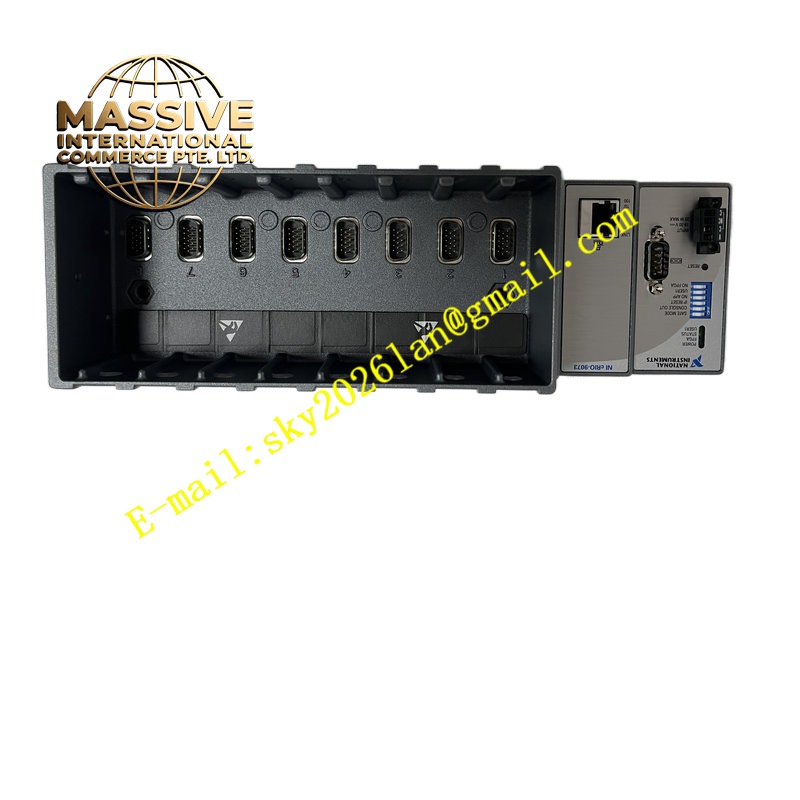
Description
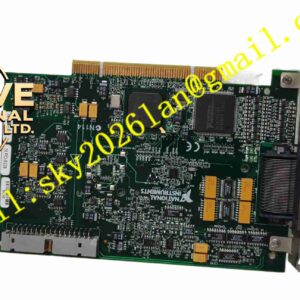
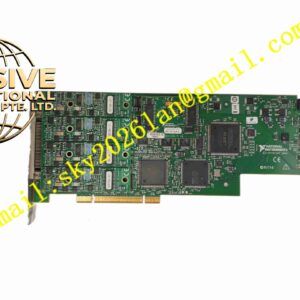
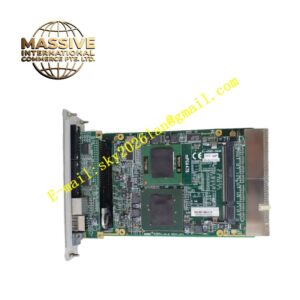
NI CRI0-9073
Technical Specifications
Brand: National Instruments (NI)
Product Model: CRI0-9073
Product Type: CompactRIO Controller / Embedded Controller
Processor: Industrial-grade real-time processor (specific model depends on configuration)
FPGA: Reconfigurable Xilinx FPGA for custom timing and signal processing
Memory: RAM and non-volatile storage for real-time operating system and user applications
I/O Compatibility: Compatible with NI C Series I/O modules for flexible I/O expansion
Communication Interfaces: Ethernet, serial (RS-232/RS-485), USB, and optional fieldbus interfaces
Operating Temperature: Industrial temperature range suitable for harsh environments
Power Supply: 9-30V DC wide-range input
Protection Rating: Rugged design for industrial environments
Certification Standards: CE, UL, RoHS compliant
Functional Features
Deterministic Real-Time Control: Executes control algorithms with precise timing for critical applications
Reconfigurable FPGA: Allows custom hardware-level timing, triggering, and signal processing
Hot-Swappable I/O: Supports C Series I/O modules that can be replaced without powering down the system
Wide I/O Compatibility: Works with over 50 types of C Series modules for analog, digital, counter, and communication functions
Rugged Design: Built to withstand vibration, shock, and wide temperature ranges
Flexible Programming: Supports LabVIEW, LabWindows/CVI, and text-based languages for application development
Remote Monitoring: Ethernet connectivity enables remote programming, monitoring, and data logging
Integrated Development Environment: NI software tools simplify configuration, programming, and debugging
Scalable Architecture: Multiple CompactRIO systems can be networked for larger applications
Built-In Diagnostics: Self-monitoring capabilities for system health and fault detection
Application Scenarios
Aerospace and Defense: Avionics testing, flight data acquisition, hardware-in-the-loop simulation
Automotive: Engine testing, vehicle diagnostics, production line monitoring
Energy and Power: Turbine control, substation monitoring, renewable energy system management
Industrial Automation: Machine control, process monitoring, predictive maintenance systems
Semiconductor Manufacturing: Test equipment, wafer handling automation, environmental monitoring
Transportation: Railway signaling, traffic control systems, vehicle telematics
Academic Research: Laboratory automation, data acquisition systems, prototype development
Oil and Gas: Wellhead monitoring, pipeline inspection, offshore platform automation
Performance Parameters
Processor Speed: Sufficient for real-time control and data processing tasks
FPGA Logic Cells: Thousands of logic cells for custom hardware implementation
I/O Update Rate: Microsecond-level I/O scanning for high-speed control
Communication Speed: Ethernet 10/100/1000 Mbps for fast data transfer
Determinism: Sub-millisecond jitter for precise timing control
Data Throughput: High-bandwidth FPGA-to-processor communication
Storage Capacity: Adequate non-volatile memory for application and data logging
Boot Time: Fast boot for quick system startup after power cycle
Material Composition
Industrial-grade PCB with surface-mounted components, Xilinx FPGA chip for reconfigurable logic, precision timing circuits, industrial-grade connectors, metal shielding for EMI protection, aluminum or reinforced plastic housing for durability, flame-retardant materials compliant with UL94 standards
Structural Features
Compact modular form factor for DIN rail or panel mounting, integrated heat sink for passive cooling, status LEDs for power, processor status, FPGA status, and I/O activity, hot-swappable C Series I/O module slots, industrial-grade Ethernet and serial connectors, removable terminal blocks for field wiring, rugged enclosure rated for industrial environments, keyed connectors to prevent incorrect installation
Working Principle
The NI CRI0-9073 operates as the central controller in a CompactRIO system. The real-time processor runs a deterministic operating system (such as NI Linux Real-Time) and executes the user’s control application, handling tasks such as data logging, communication, and high-level decision-making. Simultaneously, the reconfigurable FPGA implements custom hardware-level logic for precise timing, triggering, and signal processing. The FPGA directly interfaces with C Series I/O modules, performing high-speed acquisition and generation with microsecond-level determinism. Processed data is transferred between the FPGA and the real-time processor via a high-speed internal bus. The system communicates with host computers, HMIs, or other controllers via Ethernet, serial, or fieldbus interfaces. Users develop applications using NI LabVIEW or other supported programming environments, deploying the real-time code to the processor and the FPGA bitstream to the FPGA. The hot-swappable I/O architecture allows modules to be added, removed, or replaced without powering down the controller, minimizing system downtime.
Installation Requirements
Mount the controller securely on a DIN rail or panel using the provided mounting hardware
Ensure adequate ventilation around the controller for heat dissipation
Connect the power supply (9-30V DC) using proper gauge wiring and secure terminals
Insert compatible C Series I/O modules into the available slots, ensuring proper seating
Connect Ethernet and serial communication cables using shielded industrial-grade cables
Configure the controller’s network settings (IP address, subnet) for communication with host systems
Install NI software (LabVIEW, CompactRIO drivers) on the development computer
Deploy the application code and FPGA bitstream from the development environment to the controller
Verify I/O module recognition and configuration in the NI MAX software
Usage Precautions
Ensure the power supply voltage is within the 9-30V DC range to prevent damage
Do not remove I/O modules while the system is actively acquiring or generating signals unless hot-swap procedures are followed
Monitor the controller’s operating temperature and ensure adequate ventilation
Back up application code and FPGA configurations regularly
Verify firmware and driver version compatibility between the controller and development software
Use proper grounding practices to minimize electrical noise and ensure signal integrity
Do not exceed the specified environmental limits for temperature, humidity, and vibration
Refer to NI documentation for troubleshooting error codes and diagnostic messages
Keep the controller firmware and I/O module firmware up to date
Handle the controller and I/O modules with care to avoid electrostatic discharge damage