


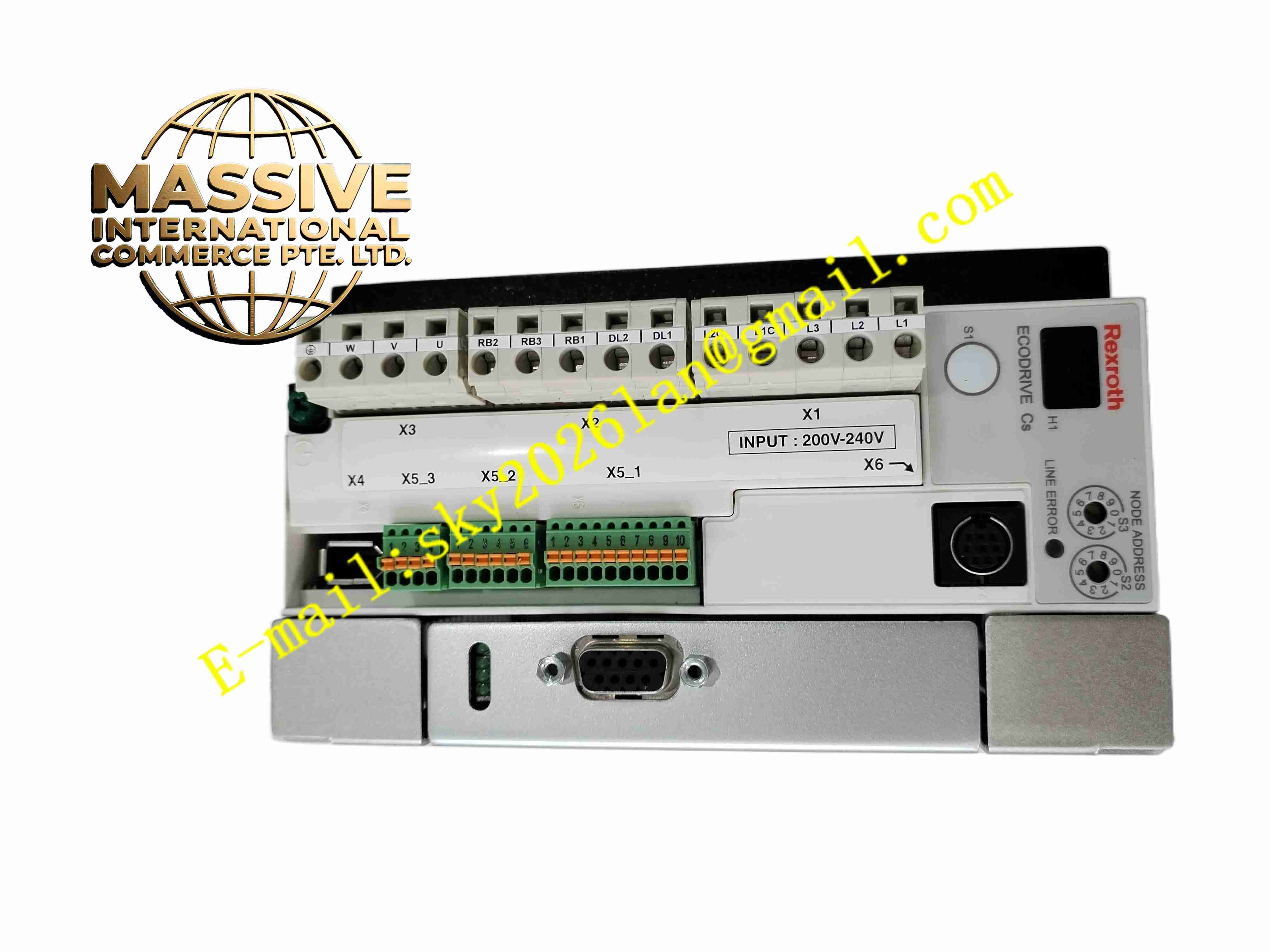
Description
Rexroth DKC10.3-018-3-MGP-01VRS
Technical Specifications
Brand: Bosch Rexroth (Indramat)
Product Series: ECODRIVE DKC
Product Model: DKC10.3-018-3-MGP-01VRS
Product Type: Multi-Axis Motion Control Drive Controller
Rated Current: 18 A class
Supply Voltage: 3-phase AC 200-480 V (typical for ECODRIVE DKC series)
Control Voltage: 24 V DC
Output Frequency: Variable frequency output for servo motor control
Protection Rating: IP20
Cooling Method: Forced air cooling or natural convection depending on installation
Operating Temperature: 0°C to 45°C (32°F to 113°F)
Storage Temperature: -20°C to 70°C (-4°F to 158°F)
Relative Humidity: 5% to 95% (non-condensing)
Communication Interface: Integrated fieldbus communication (Profibus-DP, CANopen, or similar depending on configuration)
Certification Standards: CE, UL, CSA compliant
Functional Features
Multi-Axis Motion Control: Capable of coordinating multiple servo axes for synchronized motion applications
Integrated Motion Controller: Built-in motion control functionality eliminates the need for a separate PLC in many applications
Fieldbus Communication: Integrated fieldbus interface for seamless integration into automated production systems
Programmable Logic: On-board programmable logic functions for local decision-making and sequence control
Camming and Gearing: Electronic cam and electronic gearing functions for complex motion profiles
Multiple Control Modes: Position, speed, and torque control modes with smooth transitions between modes
Extensive I/O: Integrated digital and analog I/O for direct connection to sensors and actuators
Diagnostic Capabilities: Comprehensive diagnostics including fault history, oscilloscope function, and status monitoring
Safety Integration: Compatible with Rexroth safety modules for safe torque off and safe stop functions
Firmware Versioning: Specific firmware version (01VRS) ensures compatibility with particular application requirements
Application Scenarios
Printing Presses: Registration control and web tension management in offset and flexographic printing
Packaging Lines: Synchronized control of multiple axes in form-fill-seal and case packing machines
Converting Machinery: Slitting, shearing, and laminating operations requiring precise material handling
Textile Machinery: Multi-axis coordination in weaving and knitting machines
Automotive Manufacturing: Assembly line automation and component handling systems
Food and Beverage Processing: Packaging and palletizing systems with synchronized motion requirements
Material Handling: Automated storage and retrieval systems with coordinated axis movement
Performance Parameters
Multi-Axis Synchronization: Precise synchronization of multiple servo axes with minimal following error
Motion Profile Generation: Complex motion profiles including trapezoidal, S-curve, and electronic cam profiles
Control Loop Performance: Fast current, speed, and position loop execution for dynamic response
Fieldbus Cycle Time: High-speed fieldbus communication for real-time data exchange with higher-level controllers
Positioning Accuracy: High-resolution feedback processing for precise position control
Reliability: Designed for continuous industrial operation in demanding production environments
Material Composition
Industrial-grade multi-layer printed circuit board with surface-mounted power electronics and digital components, IGBT or MOSFET power modules for motor drive output, high-performance digital signal processor and microcontroller for motion control algorithms, precision gate driver circuitry, current and voltage sensing components, film and electrolytic capacitors for DC bus filtering, aluminum heatsink with fan assembly for forced air cooling (if applicable), reinforced metal or polymer housing, flame-retardant materials compliant with UL94 standards, gold-plated connector pins for reliable signal transmission
Structural Features
Modular housing designed for DIN rail or panel mounting in control cabinets, integrated heatsink with ventilation features for thermal management, front-panel LED indicators for power, run, fault, and communication status, pluggable terminal blocks for motor power, control voltage, and I/O connections, fieldbus communication connector (e.g., Profibus-DP, CANopen), encoder feedback connectors for multiple axes, mounting hardware for secure installation, ventilation openings for cooling airflow, clearly labeled connectors and terminals for easy identification and wiring
Working Principle
The DKC10.3-018-3-MGP-01VRS receives three-phase AC power and converts it to a regulated DC bus voltage. The integrated motion controller executes coordinated motion programs, receiving commands from a higher-level controller via fieldbus or operating autonomously based on its programmed logic. The controller processes encoder feedback from multiple servo motors to close position and speed control loops for each axis. PWM signals generated by the control processor drive the power modules, producing variable-frequency three-phase output to precisely control each connected servo motor. The electronic cam and gearing functions allow complex motion relationships between axes to be established without mechanical linkages. The fieldbus interface enables real-time exchange of process data, status information, and control commands with the plant automation system. Built-in diagnostics continuously monitor drive health, motor conditions, and communication integrity, reporting any anomalies for preventive maintenance.
Installation Requirements
Verify the controller is undamaged and all accessories are complete before installation
Mount the controller securely in a control cabinet with adequate ventilation and clearance for cooling
Connect the three-phase AC power supply using appropriately sized and protected cables
Connect servo motor power cables to the designated output terminals for each axis
Connect motor encoder cables to the corresponding encoder feedback connectors
Connect the 24 V DC control voltage to the control power terminals
Connect the fieldbus communication cable to the appropriate network port
Connect any required digital and analog I/O signals to the terminal blocks
Ensure proper grounding of the controller, motors, and control cabinet
Configure motion control parameters and download the application program using Rexroth’s engineering software
Perform axis identification and tuning procedures for each connected servo motor
Verify all safety circuits are properly connected and tested before commissioning
Usage Precautions
Verify all wiring connections are correct and secure before applying power
Ensure motor and encoder cables are properly shielded to prevent electromagnetic interference
Do not exceed the rated current and voltage specifications for each axis
Monitor the controller’s LED indicators and diagnostic messages for any fault conditions
Back up the motion control program and parameter settings regularly
Keep the controller clean and ensure cooling vents are not obstructed
Handle the controller with care during installation and maintenance
Use only compatible Rexroth servo motors and feedback devices
Refer to the official Bosch Rexroth ECODRIVE documentation for detailed configuration and troubleshooting
Contact Rexroth technical support for multi-axis synchronization and application-specific guidance