


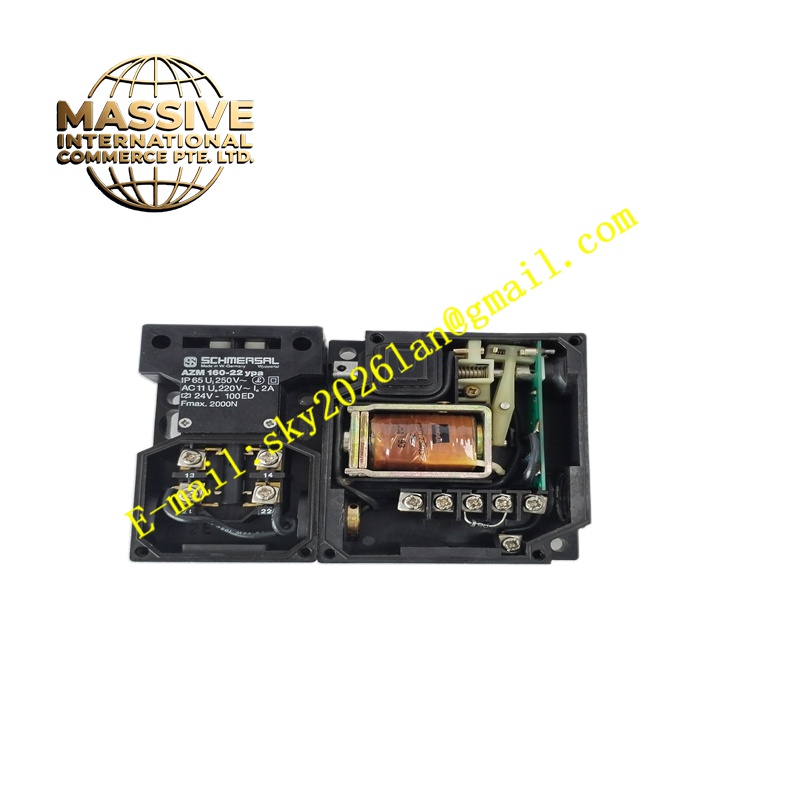
Description
Schmersal AZM160-22YP
Technical Specifications
- Brand: Schmersal (K. A. Schmersal GmbH)
- Model: AZM160-22YP
- Product Family: AZM160 Series Solenoid Interlock Switches
- Product Type: Solenoid Interlock Safety Switch with Guard Locking
- Rated Control Voltage: 24V AC/DC (standard configuration)
- Rated Insulation Voltage (Ui): 250V AC
- Rated Impulse Withstand Voltage (Uimp): 4 kV
- Thermal Test Current: 6 A
- Contact Configuration: 2 safety contacts (NC) + 2 auxiliary contacts (NO/NC)
- Switching Principle: Slow-action (positive opening)
- Contact Material: Silver alloy
- Operating Mode: Power to Unlock (standard) or Power to Lock (application dependent)
- Holding Force (FZh): 3,500 N per EN ISO 14119
- Locking Force: Minimum 150 N, Maximum 400 N
- Positive Opening Travel: 5 mm
- Positive Opening Operating Force: Minimum 15 N
- Actuation Speed: Maximum 0.2 m/s
- Mechanical Life: Minimum 1,000,000 operations
- B10D Value (NC Contacts): 2,000,000 operations per EN ISO 13849-1
- Mission Time: 20 years per EN ISO 13849-1
- Protection Rating: IP54, IP65, or IP67 (configuration dependent)
- Operating Temperature: -25°C to +50°C
- Humidity: Non-condensing, non-freezing
- Connection Type: Screw terminals, M20 x 1.5 cable entries
- Cable Cross Section: 0.75 mm² to 2.5 mm² (including conductor sleeves)
- Certifications: EN IEC 60947-5-1, EN ISO 13849-1, EN ISO 14119, CE, UL, CSA, CCC
Functional Features
- Positive opening safety contacts ensuring reliable disconnection under fault conditions
- Solenoid-operated locking mechanism preventing guard opening during hazardous machine states
- Separate actuator and switch body design enabling flexible installation on sliding and hinged guards
- Power to Unlock mode ensuring guards remain locked during power failure (fail-safe operation)
- Power to Lock mode available for specific applications requiring guard release on power loss
- Multiple contact configurations providing both safety-rated and auxiliary signaling outputs
- Incorrect locking prevention design preventing accidental or improper actuator engagement
- Emergency unlock function allowing authorized personnel to release trapped personnel using a key
- High holding force of 3,500 N resisting forces that could compromise guard integrity
- Robust construction suitable for harsh industrial environments including washdown areas
- Multiple mounting orientations supported for installation flexibility
- Compatible with Schmersal’s range of AZM160 series actuators and accessories
- Conforms to EN ISO 13849-1 safety standards for integration into safety-related control systems
Application Scenarios
- Packaging Machinery: Safety interlocking on cartoners, case packers, and palletizing systems
- Printing Industry: Guard locking on offset presses, digital printers, and finishing equipment
- Food and Beverage Processing: Hygienic area access control on mixing, filling, and packaging lines
- Automotive Manufacturing: Robot cell access control and press line safety interlocking
- Textile Machinery: Guard locking on weaving looms, spinning frames, and fabric finishing equipment
- Plastic Processing: Injection molding machine guard interlocking and extruder access control
- Machine Tools: Safety interlocking on CNC machining centers, lathes, and grinding machines
- Material Handling: Conveyor access point safety and automated storage system guard locking
- Pharmaceutical Manufacturing: Cleanroom equipment access control and batch processing system safety
- Elevator and Escalator Manufacturing: Safety interlocking on test rigs and assembly equipment
Performance Parameters
- Holding Force: 3,500 N maximum resisting force per EN ISO 14119 standard
- Locking Force Range: 150 N minimum to 400 N maximum adjustable locking force
- Positive Opening Travel: 5 mm guaranteed contact separation distance
- Positive Opening Force: Minimum 15 N required to achieve positive contact opening
- Mechanical Endurance: Minimum 1,000,000 mechanical operations without failure
- Electrical Endurance (B10D): 2,000,000 operations for safety-rated NC contacts
- Actuation Speed Limit: Maximum 0.2 m/s actuator insertion speed for reliable engagement
- Response Time: Solenoid engagement/disengagement within milliseconds of command signal
- Operating Temperature Range: -25°C to +50°C continuous operation
- Environmental Protection: IP54 to IP67 depending on configuration and sealing options
- Vibration Resistance: Compliant with industrial vibration standards per IEC 60068
- Shock Resistance: Withstands industrial shock conditions per relevant IEC standards
Material Composition
- Housing: Fiberglass-reinforced thermoplastic or aluminum alloy (configuration dependent)
- Solenoid Coil: Copper wire wound on insulated bobbin with epoxy encapsulation
- Locking Bolt: Hardened steel with corrosion-resistant coating
- Contact Elements: Silver alloy contacts for reliable switching and low contact resistance
- Spring Mechanism: Stainless steel springs for consistent locking force over service life
- Actuator (sold separately): Engineered thermoplastic or steel with precise machining tolerances
- Terminal Blocks: Brass or copper alloy terminals with nickel or tin plating
- Sealing Elements: NBR or silicone rubber gaskets for environmental protection
- Fasteners: Stainless steel or zinc-plated steel screws and mounting hardware
- Internal Wiring: High-temperature insulated copper conductors with strain relief
Structural Features
- Compact rectangular housing optimized for mounting on safety guard frames
- Separate actuator and switch body enabling installation on sliding and hinged guard designs
- Multiple M20 x 1.5 cable entry points for flexible wiring routing
- Front-accessible screw terminals for straightforward wiring and maintenance
- Visual position indicators showing lock engaged/unlocked status
- Key-operated emergency unlock mechanism for authorized personnel access
- Mounting holes positioned for secure attachment to guard structures
- Rugged housing design resisting mechanical impact and environmental contamination
- Modular design allowing actuator replacement without removing switch body
- Color-coded or labeled terminals for correct wiring identification
- Tamper-resistant design preventing unauthorized adjustment or bypass
- Integrated cable gland provisions for secure cable entry and strain relief
Working Principle
The Schmersal AZM160-22YP operates as a solenoid-interlocked safety switch that prevents access to hazardous areas while machinery is in a dangerous state. The device consists of two main components: the switch body containing the solenoid, contacts, and locking mechanism, and a separate actuator (operating key) that is mounted on the movable safety guard.
In the normal locked state (Power to Unlock mode), the solenoid is de-energized and a spring-loaded locking bolt extends into the actuator when the guard is closed. This physically prevents the actuator from being withdrawn, thereby keeping the safety guard locked. The positive-opening NC safety contacts are closed in this state, signaling to the machine’s safety control system that the guard is properly locked and it is safe for the machine to operate.
When the machine has completed its hazardous cycle and all dangers have subsided, the safety control system energizes the solenoid coil in the AZM160-22YP. The energized solenoid retracts the locking bolt against spring force, releasing the actuator. At this point, the guard can be opened. As the guard opens and the actuator withdraws from the switch body, the positive-opening mechanism ensures that the NC safety contacts open with a guaranteed 5 mm contact separation, removing power from the machine’s hazardous functions. The auxiliary contacts simultaneously change state to signal the guard-open condition to the control system.
The positive-opening mechanism is a critical safety feature: it mechanically forces the contacts apart regardless of contact welding or solenoid failure, ensuring that the safety function is maintained even under fault conditions. The incorrect locking prevention design ensures that the actuator can only engage the switch body in the correct orientation, preventing accidental or improper locking that could compromise safety.