


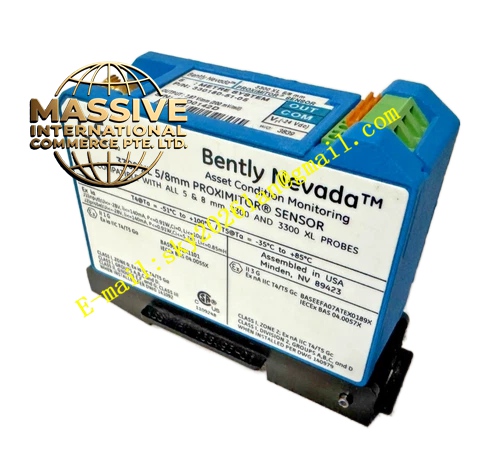
Description
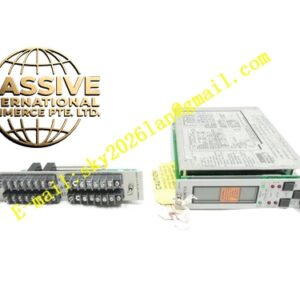
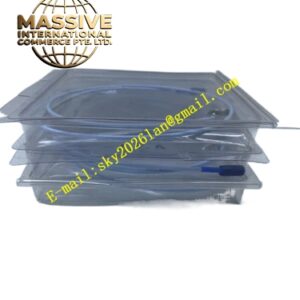
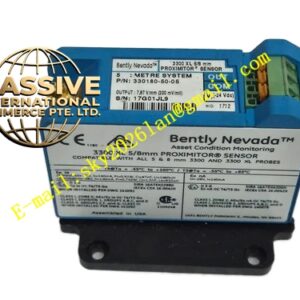
Bently 330910‑00‑15‑10‑02‑00
Technical Specifications:
- Sensing Principle: Eddy‑current non‑contact inductive sensing
- Thread Specification: 1/4‑28 UNF
- Unthreaded Tip Length: 1.5 inch
- Probe Overall Case Length: 1.0 inch
- Integral Cable Length: 10 meters
- Connector Type: ClickLoc miniature gold‑plated coaxial connector
- Nominal Sensitivity: 7.87 V/mm (200 mV/mil), tolerance ±5%
- Linear Measurement Range: 0‑2 mm
- Frequency Response: 0 Hz to 10 kHz (-3 dB)
- Operating Probe Temperature: ‑55 °C ~ +175 °C
- Storage Temperature: ‑60 °C ~ +185 °C
- Insulation Resistance: ≥500 MΩ at 500 VDC
- Shock Resistance: 1000 g peak half‑sine pulse
- Continuous Vibration Rating: 30 g peak, 55 Hz‑2000 Hz
- Ingress Protection Rating: Hermetically sealed, IP68 Functional Features:
- Compact short‑tip structural design, fits narrow mounting cavities within bearing housings where long‑tip probes cannot be deployed.
- Hermetic laser‑welded sealing prevents process oil, steam and water vapor from penetrating internal coil assembly.
- Gold‑plated ClickLoc coaxial connector achieves finger‑tight locking connection, anti‑loosening under sustained equipment vibration.
- Factory‑integrated 10‑meter triaxial cable eliminates field cable splicing, maintains consistent whole‑system electrical length.
- Optimized for 3300 NSv proximitor and 990/991 series NSv two‑wire transmitters, no on‑site sensitivity adjustment required.
- Superior temperature stability, sensitivity drift stays within allowable range under wide temperature fluctuation.
- Small target shaft adaptability, delivers stable measurement output for medium‑diameter rotating shafts. Application Scenarios: Radial shaft vibration monitoring for centrifugal compressors, steam turbines, process pumps; shaft thrust‑position measurement inside limited‑space bearing housings; key‑phasor speed signal pickup; retrofitting NSv‑standard monitoring points for existing turbomachinery; refinery and power plant rotating equipment protection systems. Performance Parameters: Linear error ≤ ±0.5% full‑scale output; low residual noise output; phase deviation ≤5° across full working frequency band; excellent long‑term stability without regular recalibration requirement. Material Composition: AISI 316 stainless steel probe body and threaded sleeve; high‑stability wound copper sensing coil; high‑temperature ceramic insulating core; triaxial cable with FEP fluoropolymer outer jacket; gold‑plated coaxial contact components; high‑temperature fluorosilicone sealing gaskets; laser‑welded metal sealing joints. Structural Characteristics: Short cylindrical probe tip; external 1/4‑28 UNF mounting thread; rear potted integral triaxial signal cable; cable terminal fitted with ClickLoc miniature coaxial plug; part number and serial number laser‑etched onto probe metal housing. Working Principle: Matched proximitor generates high‑frequency alternating excitation signal fed to internal probe coil. Alternating magnetic field radiates from probe tip toward conductive metal shaft target. Eddy currents generate on shaft surface, which change coil impedance according to gap distance between probe tip and target surface. Impedance variation converts into DC gap‑voltage signal output at proximitor terminal, gap‑voltage value corresponds linearly to physical gap clearance. Vibration‑caused gap fluctuation generates dynamic AC vibration signal superimposed onto DC gap voltage. Installation Requirements:
- Clean probe mounting threaded hole completely, remove burrs, rust and residual sealant to guarantee proper thread engagement.
- Apply specified mounting torque to lock probe assembly; excessive torque causes permanent deformation of probe internal coil housing.
- Set static gap between probe tip and shaft target within middle section of probe linear working range.
- Maintain minimum separation distance between adjacent probe tips to eliminate electromagnetic cross‑talk interference.
- Triaxial signal cable minimum bending radius shall exceed ten times cable outer diameter; sharp bending and crushing are forbidden.
- Route probe signal cable separately away from high‑current power and inverter cables to reduce electromagnetic noise coupling.
- Fasten ClickLoc connector by finger‑tight force only; over‑torque damages internal gold‑plated contact structure. Usage Notes:
- Do not disassemble probe housing; laser‑welded hermetic seal will break and void factory calibration.
- Prohibit cutting or modifying factory‑integrated triaxial cable; altered electrical length destroys system linearity and sensitivity.
- Avoid mechanical impact and scratch damage to probe tip ceramic surface; surface defect degrades measurement linearity.
- Prevent cable from long‑term direct contact with high‑temperature hot‑steam pipelines, avoid accelerated jacket aging.
- Inspect connector locking state and probe mounting tightness during each unit overhaul cycle.