


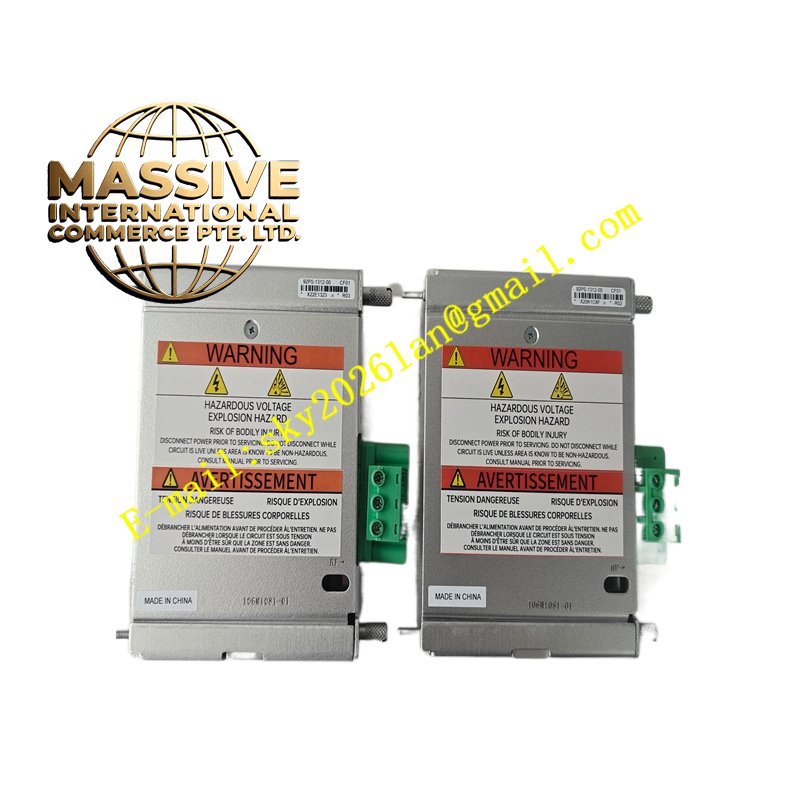
Description
Bently Nevada 177230-01-02-05
Technical Specifications:
- Model Configuration: 177230-AA-BB-CC format
- AA (Range): 01 = 0 to 25.4 mm/s (0 to 1.0 in/s)
- BB (Frequency Response): 02 = 3 Hz to 1 kHz (180 to 60 kcpm) peak
- CC (Approvals): 05 = Multiple Approvals (CSA/NRTL/C, ATEX, IECEx)
- Output Signal: 4-20 mA proportional to vibration velocity (primary); auxiliary dynamic output for diagnostics
- Power Supply: Loop-powered from the 4-20 mA control system
- Operating Temperature: Industrial ambient conditions
- Protection Rating: Sealed housing for 100% relative humidity, non-immersion
Functional Features:
- Standalone vibration transmitter requiring no external monitoring hardware
- 4-20 mA output directly interfaces with PLC, DCS, and SCADA systems
- Auxiliary dynamic signal output enables advanced diagnostics when needed
- Seismic (accelerometer-based) measurement suitable for rolling element bearing machines
- Industry-standard 4-20 mA proportional output eliminates need for signal conditioners
- Multiple international hazardous area certifications (CSA, ATEX, IECEx)
- Replaceable mounting studs included (metric M6×1, M8×1.25, imperial ¼-28 UNF)
- Simple installation and maintenance with minimal wiring
Application Scenarios:
- Electric motors with rolling element bearings
- Centrifugal pumps and fans
- Blowers and centrifuges
- Small reciprocating compressors
- General-purpose rotating equipment in oil and gas, petrochemical, power generation, and water treatment facilities
- Applications where direct 4-20 mA vibration monitoring to DCS/PLC is preferred over rack-based systems
Performance Parameters:
- Velocity Range: 0 to 25.4 mm/s (0 to 1.0 in/s) for the -01 range option
- Frequency Response: 3 Hz to 1 kHz (180 to 60 kcpm) peak for the -02 frequency option
- Output: 4-20 mA proportional to measured vibration velocity
- Sensitivity: Calibrated to the selected range
Material Composition: Piezoelectric accelerometer element housed in a sealed industrial enclosure with stainless steel mounting hardware
Structural Features: Compact, self-contained transmitter body with threaded mounting base. Includes replaceable mounting studs for flexible installation on various machine surfaces. Cable connection via standard industrial connector.
Working Principle: The internal piezoelectric accelerometer senses casing vibration acceleration. The transmitter electronics integrate the acceleration signal to velocity, scale it to the configured range, and produce a proportional 4-20 mA output signal. The auxiliary dynamic output provides the raw acceleration waveform for diagnostic analysis when connected to a compatible data acquisition system.
Installation Requirements:
- Mount directly on the machine bearing housing or structural surface using the provided mounting stud
- Ensure a clean, flat mounting surface for accurate vibration transmission
- Connect the 4-20 mA loop wiring to the PLC/DCS analog input
- Route cables away from high-voltage power sources
- Verify loop power supply meets device requirements
Usage Notes:
- The 177230 is designed for rolling element bearing machines; for sleeve bearing machines, use proximity probe systems
- Verify the range and frequency response options match the application requirements
- The -05 approval option provides CSA, ATEX, and IECEx certifications for hazardous area installation
- Check terminal tightness periodically
- The device is loop-powered; ensure the control system provides adequate loop voltage