


Description
Bently Nevada 330400-02-00
Technical Specifications:
- Sensitivity: 10.2 mV/m/s² (100 mV/g) ±5%
- Acceleration Range: 490 m/s² (50g) peak total acceleration over 10 Hz to 15 kHz frequency range
- Frequency Response: 10 Hz to 15 kHz (600 cpm to 900,000 cpm) ±3 dB; 30 Hz to 10 kHz (1800 cpm to 600,000 cpm) ±10%
- Linearity: ±1% to 490 m/s² (50g) peak
- Input Voltage: -24 ± 0.5 Vdc
- Bias Current: 2 mA nominal
- Output Bias Voltage: -8.5 ± 0.5 Vdc
- Base Strain Sensitivity: 49 mm/s² per microstrain (0.005 g/microstrain)
- Maximum Cable Length: 305 meters (1000 feet)
- Operating and Storage Temperature: -55°C to +121°C (-67°F to +250°F)
- Shock Resistance: 49,050 m/s² (5000g) peak maximum
- Relative Humidity: 100% condensing, non-immersion, sealed housing
- Protection Rating: Equivalent to IP68 (dust and water resistant) for sensor only, not cable
- Weight (without cable): 99g
- Diameter: 23 mm
- Height: 59 mm including mounting stud
- Connector: 3-pin
- Housing Material: 316L stainless steel
- Mounting Angle: Any direction
Functional Features:
- High-sensitivity accelerometer for casing vibration measurement
- Wide frequency response from 10 Hz to 15 kHz captures gear mesh frequencies and high-frequency bearing defects
- API 670 compliant design for critical machinery protection
- 316L stainless steel housing provides corrosion resistance in harsh environments
- Sealed construction for 100% humidity environments
- Compatible with 3500/42M vibration monitor modules and 2300/20, 1900/65A monitors
- Any-direction mounting flexibility
- 3-pin connector for quick field connection
Application Scenarios:
- Gear mesh vibration monitoring on gearboxes and speed increasers
- Bearing condition monitoring on turbines, compressors, and pumps
- High-frequency vibration detection for rolling element bearing diagnostics
- Casing vibration measurement on steam turbines, gas turbines, and generators
- API 670 compliant machinery protection systems
- Power generation, petrochemical, refining, and metallurgical applications
Performance Parameters:
- Sensitivity: 100 mV/g ±5%
- Dynamic Range: 50g peak acceleration
- Frequency Range: 10 Hz to 15 kHz (±3 dB)
- Linearity: ±1% full scale
Material Composition: Shear-mode piezoelectric ceramic crystal element encapsulated in a 316L stainless steel housing with 3-pin connector
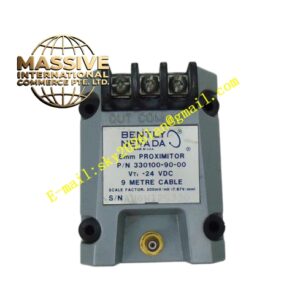
Structural Features: Cylindrical accelerometer body with M8×1 mounting stud (indicated by the -02 suffix). The 3-pin connector is located at the top of the sensor for cable connection. The sensor is hermetically sealed for environmental protection.
Working Principle: The piezoelectric crystal element generates a charge proportional to applied acceleration. The internal electronics convert this charge to a low-impedance voltage output (ICP/IEPE type) that is transmitted through the 3-conductor shielded cable to the monitoring system. The output voltage is directly proportional to the measured acceleration.
Installation Requirements:
- Mount on a clean, flat surface on the bearing housing or machine casing
- Use the M8×1 mounting stud with proper torque (0.6 to 0.9 Nm recommended)
- Connect 3-conductor shielded cable (16710 or 16925 series) to the 3-pin connector
- Route cables away from high-voltage power sources
- Ensure the sensor mounting surface has adequate structural rigidity
- The mounting surface natural frequency should be at least 10 times the highest frequency of interest
Usage Notes:
- Incorrect mounting degrades sensor performance and produces false vibration signals
- If integrating acceleration to velocity, pay careful attention to mounting quality as errors are amplified
- For high-quality velocity measurement, consider using the 330500 Velomitor sensor instead
- Verify -24 Vdc power supply before operation
- Use only Bently Nevada approved cables (16710 or 16925 series)
- The -00 suffix indicates no special agency approvals; select -05 for CSA/ATEX/IECEx or -CN for Chinese certification