


Description
Bently Nevada 330780-90-CN
Technical Specifications:
- Probe Diameter: 11 mm
- Mounting Thread: M14×1.5 metric thread
- Sensitivity: 4.0 V/mm (100 mV/mil)
- Linear Range: 4 mm (0.5 mm to 4.5 mm gap)
- Frequency Response: 0 to 10 kHz
- Recommended Gap Setting: 2.0 mm, corresponding to approximately -10 Vdc output
- Operating Temperature (Probe Tip): -40°C to +177°C
- Connector Type: ClickLoc gold-plated coaxial connector
- Certification: CN suffix indicates compliance with Chinese regional standards
- Protection Rating: IP67 (probe body)
- Compliance: API 670 standard
Functional Features:
- Non-contact eddy current measurement with sub-micron displacement resolution
- Simultaneously capable of dynamic vibration measurement and static displacement monitoring
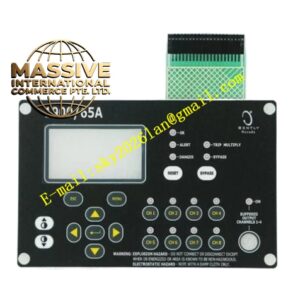
- Compatible with Bently Nevada 3500, 2300/20, and 1900/65A monitoring systems
- Interchangeable within the 3300 XL 11mm system without individual calibration
- ClickLoc connector provides secure, tool-free connection with IP67 environmental sealing
- Designed for installation in bearing housings of oil-film bearing machinery
Application Scenarios:
- Steam turbines and gas turbines for shaft vibration and axial displacement monitoring
- Large centrifugal compressors and pumps for radial vibration protection
- Generators and large motors for bearing condition assessment
- Gearboxes for shaft vibration measurement
- Fans, blowers, and expanders in power, petrochemical, and metallurgical plants
- TSI (Turbine Supervisory Instrumentation) systems in power generation
Performance Parameters:
- Sensitivity: 4.0 V/mm ±5% (standard 5m system) or ±6.5% (standard 9m system)
- Linearity: ±1% full scale
- Resolution: 0.1 μm
- Frequency Response: DC to 10 kHz
- Output: Analog voltage proportional to gap distance
Material Composition:
- Probe Housing: AISI 303/304 stainless steel
- Probe Tip: PPS (polyphenylene sulfide) engineering plastic encapsulation over ferrite core
- Cable: FEP-insulated coaxial cable with ClickLoc gold-plated copper connectors
- Seals: Viton O-ring
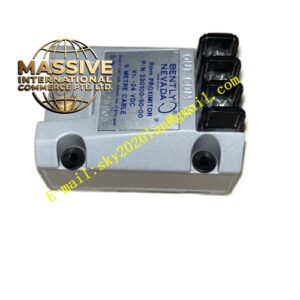
Structural Features: Cylindrical 11mm diameter probe body with M14×1.5 threaded mounting section. The probe features an integrated cable with a ClickLoc connector at the cable end for connection to the extension cable. The probe tip is molded with PPS for mechanical protection and electrical insulation.
Working Principle: The probe contains a high-frequency oscillating coil at its tip. When positioned near a conductive metal target (the rotating shaft), the alternating magnetic field induces eddy currents on the shaft surface. These eddy currents generate a counter magnetic field that interacts with the probe coil, changing its effective impedance. The impedance change is directly proportional to the gap between the probe tip and the shaft surface. The Proximitor electronics demodulate this impedance change into a DC voltage output that is linearly proportional to the gap distance.
Installation Requirements:
- Mount the probe in a standard M14×1.5 threaded bracket or bearing housing
- Use a torque wrench set to 2.0 to 3.0 N·m for final tightening
- Ensure the probe is perpendicular to the shaft surface with angular deviation within 3°
- The total system cable length (probe cable + extension cable) must be exactly 5.0 m or 9.0 m
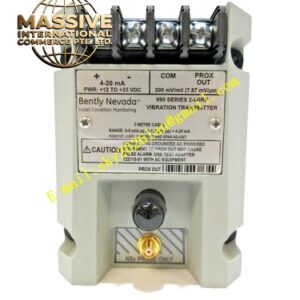
- Connect to a compatible 3300 XL Proximitor via the extension cable
- Adjust the static gap to produce a Proximitor output of -10.0 Vdc ± 0.2 Vdc
- Route signal cables at least 30 cm away from high-voltage power cables
- Shield grounding must be single-point only (at the Proximitor or monitor end)
Usage Notes:
- The target surface must be AISI 4140 steel or a material for which the Proximitor has been specifically calibrated
- The target surface must be smooth, clean, and free of oil, paint, or plating; surface roughness better than 1.6 μm
- Never power on or replace the probe while the system is energized
- Verify cable integrity and connector tightness during each maintenance interval
- The CN suffix confirms Chinese market compliance; verify local certification requirements before installation
- Gap voltage adjustment must be performed with the machine at rest (cold state)