


Description
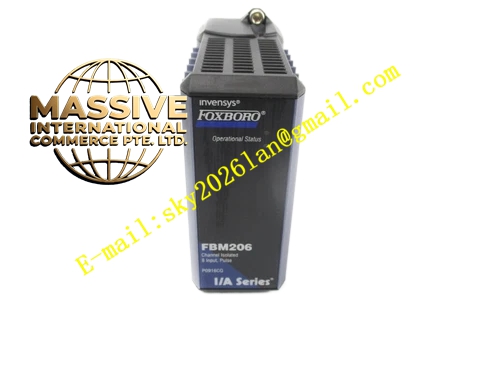
Foxboro FBM206
Technical Specifications
- Channel Configuration: 8 isolated, independent pulse input channels (7 to 27 VDC configurable).
- Pulse Rate: Accepts inputs from 10 Hz up to a maximum of 25 kHz.
- Communication: Redundant 2 Mbps module fieldbus.
- Power Consumption: 7 W maximum.
Functional Features
- No Missing Pulses: Guarantees accurate pulse counting at rates between 10 and 25 kHz.
- Galvanic Isolation: Each channel is isolated from other channels and ground.
- Configurable Scaling: Supports configurable pulse rate totalization, resolution, and meter scaling factors.
- Rugged Design: Suitable for Class G3 (harsh) environments.
Application Scenarios
Used for measuring machine rotational speed, turbine flow meters, vortex meters, and solid-state or electromechanical contacts.
Used for measuring machine rotational speed, turbine flow meters, vortex meters, and solid-state or electromechanical contacts.
Performance Parameters
- Pulse Rate Accuracy: 0.01% of reading, independent of rate.
- Input Channel Impedance: 10 kΩ.
- Loop Power: 24 VDC ±10%, max 30 mA to field device.
Material Composition
Rugged extruded aluminum exterior for physical protection and EMI shielding.
Rugged extruded aluminum exterior for physical protection and EMI shielding.
Structural Characteristics
- LED Indicators: Front-panel LEDs provide visual status of FBM functions.
- Hot-Swappable: Can be removed or replaced without disconnecting field or communication cabling.
Working Principle
The module accepts 2-wire pulse signals from sensors, conditions and isolates the signals, counts the pulses, and transmits the digital data over the redundant fieldbus to the Field Control Processor.
The module accepts 2-wire pulse signals from sensors, conditions and isolates the signals, counts the pulses, and transmits the digital data over the redundant fieldbus to the Field Control Processor.
Installation Requirements
- Must be mounted on a compatible modular baseplate.
- Maximum field device cabling distance depends on compliance voltage, wire resistance, and device voltage drop.
Precautions for Use
- Ensure the pulse signal voltage does not exceed 27 VDC.
- Use shielded twisted-pair cables for pulse inputs to prevent noise interference.