


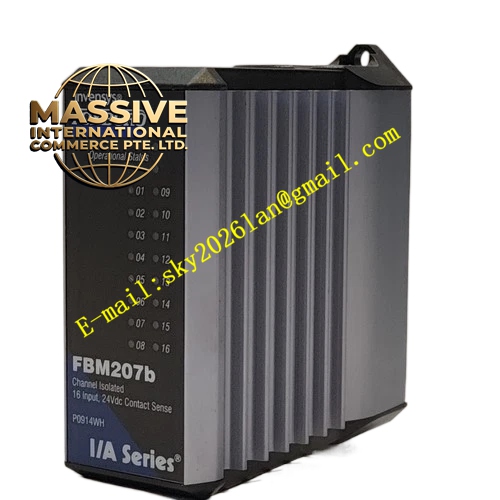
Description
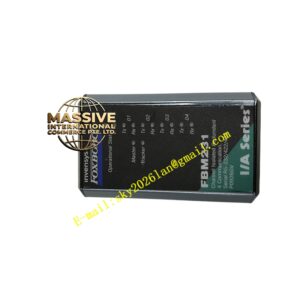
Foxboro FBM207B P0914WH
Technical Specifications
- Input Capacity: 16 channels of 24Vdc contact inputs
- Redundancy: Optional redundant configuration available
- Bus Interface: Redundant 2 Mbps Module Fieldbus
- Mounting: Standard 200 Series baseplate
Functional Features
- High-Density Monitoring: Delivers 16 discrete inputs in a single module footprint, optimizing control panel space.
- Redundant Reliability: Supports redundant configurations to eliminate single points of failure for critical safety and interlock signals.
- Hot-Swappable Design: Allows for online replacement without disrupting the entire I/O node or process.
- Comprehensive Diagnostics: Features integrated LED status indicators and real-time fault reporting to the control processor.
Application Scenarios
Widely utilized in power generation, chemical processing, and refining to monitor valve limit switches, pump run/fault statuses, motor control center (MCC) states, and safety interlocks.
Performance Parameters
- Operating Temperature: -20°C to +60°C
- Ingress Protection: IP20
- Power Requirements: Backplane powered, 24 VDC nominal via 200 Series baseplate
Material Composition
Constructed with a durable extruded aluminum housing and conformal-coated printed circuit boards to withstand severe industrial environments, including high humidity and corrosive gases.
Structural Characteristics
Standard 200 Series FBM form factor. Field wiring is terminated on a matching Terminal Assembly (TA) that ensures secure connections and proper signal routing.
Working Principle
The module continuously scans the 16 input channels, conditioning the 24Vdc signals through optical isolation. The digitized status data is then transmitted over the redundant fieldbus to the controller, updating the system database in real-time.
Installation Requirements
Install on a Foxboro 200 Series baseplate in a well-ventilated cabinet. If utilizing the redundant feature, ensure both redundant paths are correctly wired and configured in the system software.
Usage Precautions
Ensure field wiring polarity is correct for 24Vdc inputs. Verify that the redundancy DIP switches or software configurations match the physical hardware setup before energizing the module.