


Description
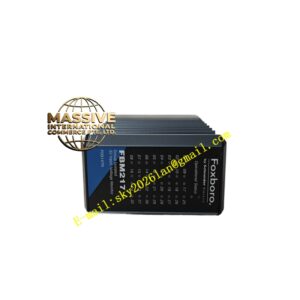
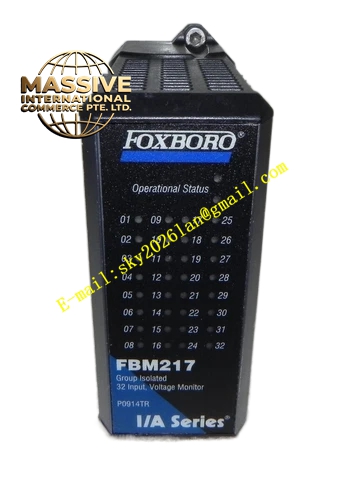
Foxboro FBM217
Technical Specifications
- Product Type: 32-Channel Discrete Input Module.
- Channel Count: 32 isolated inputs.
- Voltage Levels: Typically 24VDC (contact sense) or configurable.
- Communication: Redundant 2 Mbps Fieldbus.
Functional Features
- High Density: Doubles the channel count of standard 16-channel modules.
- Fast Scanning: High-speed input scanning for rapid sequence control.
- Configurable Debounce: Software-selectable filtering for noise immunity.
- Group Isolation: Inputs grouped with isolated excitation for flexible wiring.
Application Scenarios
Ideal for motor control centers, valve manifolds, safety interlock panels, and any application with high discrete I/O requirements.
Performance Parameters
- Scan Rate: <10ms for all 32 channels.
- Input Current: <5mA per channel.
- ON-State Voltage: 15-30VDC (typical for 24VDC modules).
- OFF-State Voltage: 0-5VDC.
Material Composition
High-density PCB with surface-mount components. Rugged aluminum enclosure with efficient heat dissipation design.
Structural Characteristics
Same physical footprint as 16-channel FBM modules, enabling high-density installations. Front panel features compact LED indicators for all 32 channels.
Working Principle
Each channel uses an opto-isolator to convert field contact closure or voltage presence into a digital signal. The module scans all 32 channels in a rapid cycle and updates the controller via the Fieldbus.
Installation Requirements
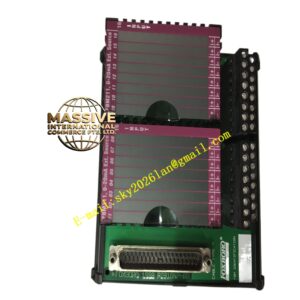
Use high-density terminal assemblies or wiring harnesses designed for 32-channel modules. Ensure adequate power supply capacity for all channels.
Usage Precautions
- Verify power supply can handle the cumulative current of all active channels.
- Be mindful of group isolation boundaries when wiring.
- Use appropriate wire gauges for high-density terminal blocks.