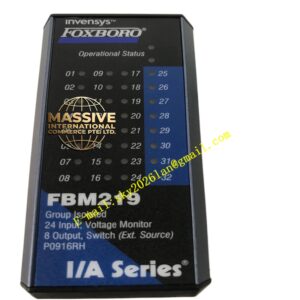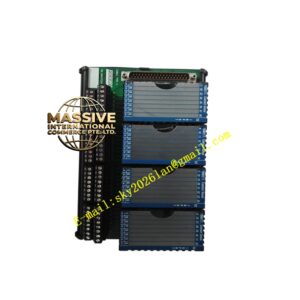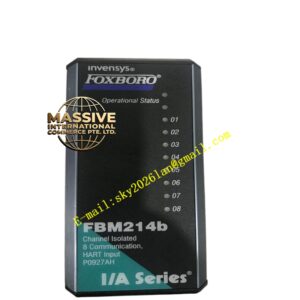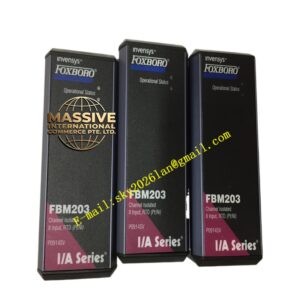



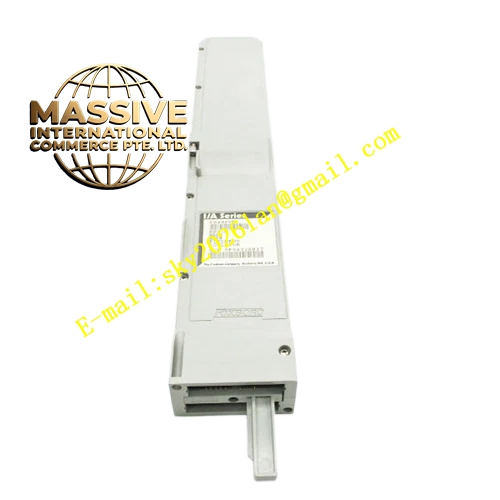
Description
Foxboro P0400VE
Technical Specifications
- Function: Signal conditioning, isolation, or protocol translation.
- Input/Output: Accepts a variety of signal types (mV, V, mA, frequency, etc.).
- System Compatibility: Integrates with Foxboro I/A Series I/O subsystems.
Functional Features
- Signal Integrity: Cleans up noisy or weak signals from the field before they enter the DCS.
- Galvanic Isolation: Protects the control system from high-voltage transients and ground potential differences.
- Flexibility: Can be configured or selected to interface with legacy or third-party instruments.
Application Scenarios
Used when standard FBM modules cannot directly accept a field signal, such as interfacing with specialized analyzers, vibration probes, or older 0-5V instruments.
Performance Parameters
- Linearity: High linearity to preserve measurement accuracy.
- Response Time: Fast enough for the intended control loop dynamics.
Material Composition
Precision analog components and high-quality isolation barriers. Conformal-coated PCB for environmental protection.
Structural Characteristics
Compact module form factor, often designed to mount on a DIN rail or within an I/O chassis. Clear labeling for input and output connections.
Working Principle
Receives a raw field signal, conditions it (e.g., amplifies a millivolt signal, filters out 60Hz noise, or converts a frequency to a 4-20mA signal), and outputs a standard signal that can be read by a standard DCS input module.
Installation Requirements
Install in a location convenient for field wiring. Ensure proper grounding of the module and signal shields.
Usage Precautions
- Verify signal compatibility and power requirements before connecting field devices.
- Be aware of any additional latency introduced by the signal conditioner in fast control loops.