


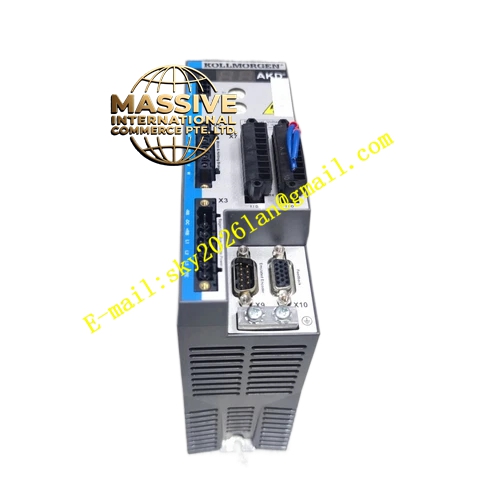
Description
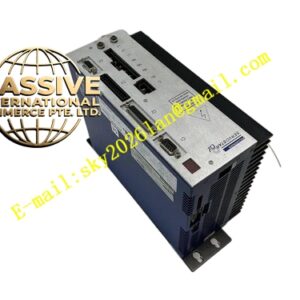
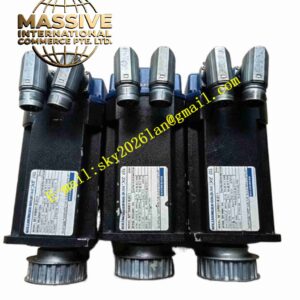
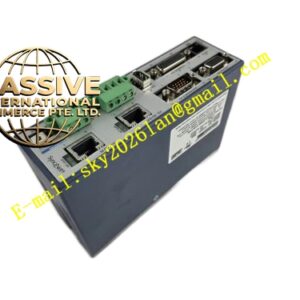
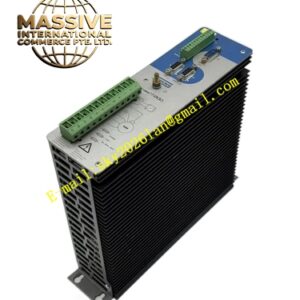
Kollmorgen AKD-P01207-NACN-0056
Technical Specifications
- Series: AKD Series Digital AC Servo Drive
- Drive Variant: Position Indexer (AKD-P Motion Tasking Drive)
- Continuous Output Current: 12.0 Amps RMS
- Peak Output Current: 36.0 Amps RMS for 5 seconds
- Rated Supply Voltage: 240 VAC to 480 VAC, three-phase, 50/60 Hz
- DC Bus Voltage: 320 VDC nominal, up to 680 VDC maximum
- Rated Active Output Power: Up to 8.0 kW
- Communication Protocol: CANopen fieldbus with DS301 and DSP402 profiles
- Control Modes: Torque, velocity, position, and motion tasking indexer modes
- Feedback Support: Incremental encoder, resolver, SFD, EnDat 2.1/2.2, BiSS
- Safety Function: Safe Torque Off (STO) integrated
- Operating Temperature: 5 degrees Celsius to plus 45 degrees Celsius
- Elevation Rating: Up to 1000 meters above sea level
- Protection Rating: IP20
Functional Features
- Complete CANopen device profile implementation with SDO, PDO, and NMT services
- Position Indexer motion tasking firmware with 256 motion task capacity
- 16 homing methods configurable through CANopen parameters
- Electronic gearing and camming functions executable via network commands
- Real-time status feedback through configured Process Data Objects
- Emergency object generation for fault broadcasting
- Auto-tuning capability for velocity and position loop optimization
Application Scenarios
- CANopen-based machine control systems
- Distributed automation architectures
- Packaging machinery with centralized PLC control
- Material handling systems with networked servo axes
- Automated assembly equipment requiring medium-power motion control
Performance Parameters
- 12 Amp continuous current supports motors up to approximately 4 kW mechanical output
- 3:1 peak-to-continuous current ratio for aggressive acceleration profiles
- Deterministic motion performance within properly configured CANopen network cycle times
- High-speed PDO mapping for rapid command and status data exchange
Material Composition and Structure
- Industrial aluminum heatsink chassis with integrated cooling fan
- Standardized AKD series mechanical package with CANopen communication interface
- Heavy-duty terminal blocks for power and motor connections
- Rotary switches or software-configurable node address setting
- Status LEDs for module state, network health, and drive operation
Working Principle The drive operates as a CANopen node on an industrial control network. The host controller transmits motion commands and parameters via CANopen service data objects and process data objects. The internal processor interprets these commands and executes corresponding current, velocity, and position control algorithms. Three-phase sinusoidal current is delivered to the brushless motor through a PWM output stage. Actual position, velocity, and fault status are transmitted back to the network master at each communication cycle.
Installation Requirements
- Install on CANopen network with proper shielded cabling and termination resistors
- Configure node address to unique value within network range
- Match CAN bus baud rate to network master configuration
- Connect to 240/480 VAC three-phase supply with adequate circuit protection
- Mount in ventilated enclosure with IP20 minimum protection
Operating Precautions
- Verify CANopen node ID does not conflict with other network devices
- Monitor CAN bus error counters for communication integrity
- Configure emergency stop behavior via CANopen fault reaction parameters
- Ensure three-phase power quality meets drive specifications
- Maintain network cable integrity to prevent communication dropouts