


Description
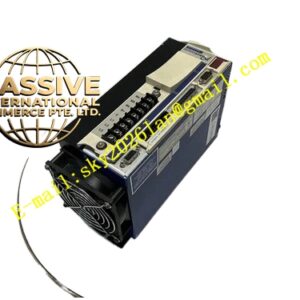
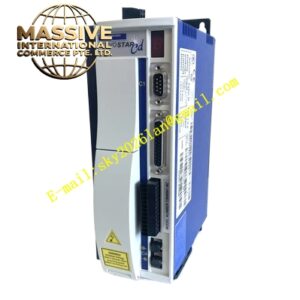
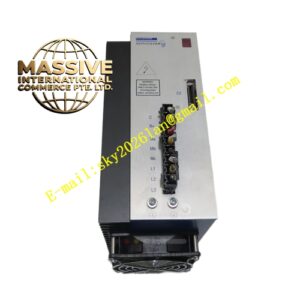
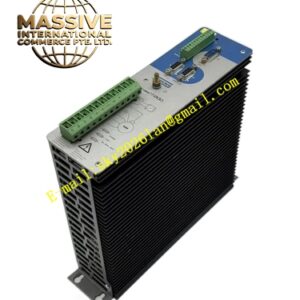
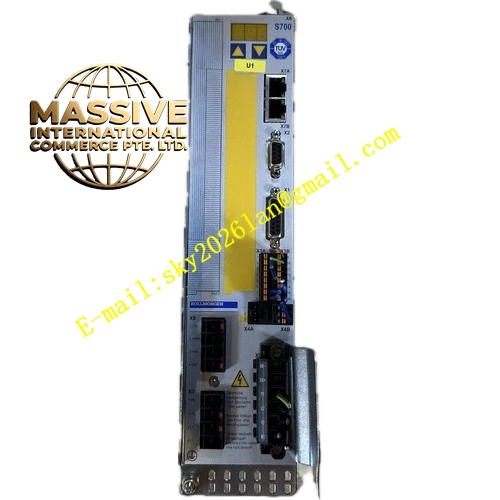
Kollmorgen S71202‑NAF2NA
- Technical Specifications
- Input Power: 3‑phase 208‑480 VAC, 50‑60 Hz grounded industrial power source
- Rated Continuous Output Current: 12 A RMS
- Peak Output Current: 24 A RMS (2‑second duration)
- Rated Apparent Power S1 Operation: 9 kVA
- DC‑link Voltage: 290‑675 VDC
- Auxiliary Supply: 24 VDC isolated control power supply
- Cooling Method: Passive aluminum heat sink plus slot‑2 mounted F2 controlled forced‑air fan module
- Protection Class: IP20
- Weight: 5.5 kg
- Expansion Slot Assignment: Slot 1‑NA, Slot 2‑F2 fan module, Slot 3‑NA
- Functional Features
- Onboard native EtherCAT and CANopen communication, RS232 diagnostic service port
- Comprehensive feedback interface support: resolver, SFD3, Hiperface‑DSL, incremental encoder, Aquad‑B encoder
- MMC memory card slot for parameter backup, unit cloning and firmware field upgrade
- Dual‑channel STO Safe Torque‑Off safety function with SIL 2 / PLd safety rating
- Integrated auto‑tuning, cogging torque suppression, ultra‑fast multi‑loop closed‑loop motion control
- IEC 61131 macro programming runtime for custom motion logic execution
- Vacant slot 1 and slot 3 support later installation of fieldbus or position‑I/O expansion hardware
- F2 fan module provides extra forced‑air cooling to sustain medium‑heavy cyclic load operation
- Application Scenarios: Packaging main axes, material‑handling gantry systems, wood‑working auxiliary axes, medium‑duty CNC auxiliary motion, textile main drive axes, automation equipment with high cabinet internal temperature
- Performance Parameters: Current‑loop cycle 62.5 µs, position‑loop cycle 250 µs; supports electronic gearing, cam profile operation, multi‑axis master‑slave synchronization, encoder emulation output, analog set‑point input
- Material Composition: Large‑size anodized aluminum heat‑sink housing, galvanized steel mounting bracket, FR‑4 printed circuit boards, high‑current IGBT power semiconductor modules, thermoplastic connector housings, F2 brushless fan expansion assembly, blank slot protective plastic covers
- Structural Characteristics: Vertical book‑style cabinet‑mount construction; separated high‑power power compartment and low‑voltage control compartment; high‑current combicon power terminals, D‑Sub feedback and signal connectors; three front‑facing expansion slots; F2 fan module mechanically fixed inside slot 2; slot 1 and slot 3 fitted with blank protective covers.
- Working Principle: 3‑phase AC input converted to DC‑link bus voltage by input rectifier; DSP controller executes high‑speed current‑speed‑position closed‑loop algorithm; PWM power inverter outputs variable‑frequency three‑phase AC to drive servo motor; motor encoder feeds real‑time position‑speed signal back to DSP to close control loops; dual‑channel redundant STO hardware cuts power‑stage output upon safety‑related machine trigger conditions; F2 fan module produces directional airflow to carry away heat generated by high‑current power devices.
- Installation Requirements: Vertical upright mounting inside control cabinet; maintain adequate vertical airflow clearance above and below amplifier unit; mounting surface must be conductive metal plate for reliable EMC grounding; operating ambient temperature range 0‑45 °C with F2 fan module installed; performance derating 1.5 % per 100 m elevation above 1000 m altitude.
- Usage Notes: Mandatory reliable protective earth connection before power‑on; 24 VDC auxiliary supply must keep galvanic isolation; F2 fan module cannot be inserted or removed while drive is powered; MMC card hot‑swap is prohibited during drive running state; complete motor parameter configuration and feedback matching during commissioning; strictly comply with EMC wiring requirements; avoid condensation, corrosive gas and heavy dust environment; conduct regular inspection for fan inlet dust accumulation.