


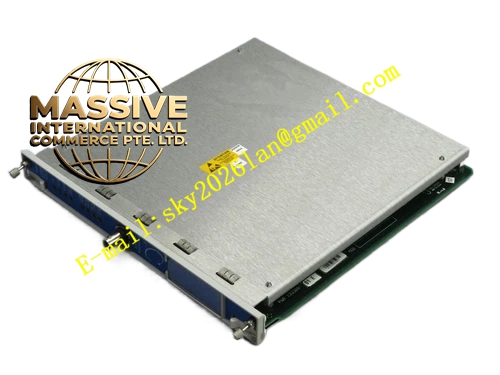
Description
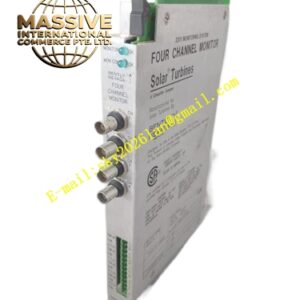
Bently Nevada 3500/77M
Technical Specifications
- Channels: 4 pressure input channels
- Input Signal: Bently Nevada approved positive voltage third-party pressure transducers, psia
- Scale Factor: Ranges from 95,000 µV/psi for 100 psia transducers to 950 µV/psi for 10,000 psia transducers
- Frequency Response: 0 to 5.5 kHz on all configured channels
- Pressure Accuracy: ±0.5% of transducer full-range at +25°C, ±1.0% over -30°C to +65°C
- Input Impedance: 50 kΩ
- Transducer Power Supply: +23.0 ± 0.8 Vdc with 24.5 mA current limiting per channel
- Buffered Outputs: Coaxial connectors, short-circuit protected, inverted and offset by -2.265 Vdc
- Power Consumption: 7.8 watts at full load with transducer supplies
- Operating Temperature: -30°C to +65°C
- Storage Temperature: -40°C to +85°C
- Humidity: 95% non-condensing
Functional Features
- Eight measured variables per channel for comprehensive cylinder analysis
- Configurable Alert setpoints for each active measured variable
- Configurable Danger setpoints for any two active measured variables
- Internal current-limiting transducer power supplies
- Buffered analog outputs for diagnostic cross-analysis
- Front panel LEDs indicating OK, TX/RX, and Bypass status
- Compatible with 3500 Rack Configuration Software
Application Scenarios
- Reciprocating compressor cylinder pressure monitoring
- Rod load and reversal analysis
- Compression ratio tracking
- Valve performance assessment
- Mechanical protection of compressor trains
- Predictive maintenance programs for reciprocating machinery
Performance Parameters
- High accuracy pressure measurement across full temperature range
- Wide dynamic range accommodating multiple transducer sensitivities
- Fast signal conditioning suitable for high-speed reciprocating events
- Stable transducer excitation voltage under varying load conditions
- Reliable alarm detection with programmable time delays
Material Composition
- Module housing: Industrial aluminum with protective anodization
- Internal circuits: Conformal coated printed circuit assemblies
- Connectors: Gold-plated coaxial and terminal block contacts
- Transducer power regulators: Precision voltage reference components
Structural Characteristics
- Standard 3500 monitor module dimensions
- Front panel BNC connectors for buffered outputs
- Rear I/O module for field transducer connections
- LED status indicators arranged for quick visual inspection
- Rack-retained with standard 3500 card guides
Working Principle The monitor supplies regulated DC power to each pressure transducer. The returning analog voltage signal, proportional to absolute pressure, is amplified and digitized. Internal algorithms process the pressure waveform to identify maximum and minimum pressures, calculate compression ratios, and determine rod loading parameters by combining pressure data with user-entered mechanical dimensions. When any calculated parameter exceeds its configured limit, the module activates alarm relays and updates status registers.
Installation Requirements
- Must be installed in a 3500 rack with adequate backplane power
- Requires pairing with the correct I/O module for internal or external terminations
- Pressure transducers must be installed with proper torque and sealing
- Piping connections to transducers must be leak-free
- Mechanical configuration data must be accurately entered during setup
Usage Precautions
- Buffered outputs are inverted and offset; account for this during signal analysis
- Do not mix internal and external termination I/O modules
- Verify transducer full-scale pressure matches the configured scale factor
- Regular calibration of pressure transducers is essential for accuracy
- Monitor rod reversal trends over time to detect wear before failure