


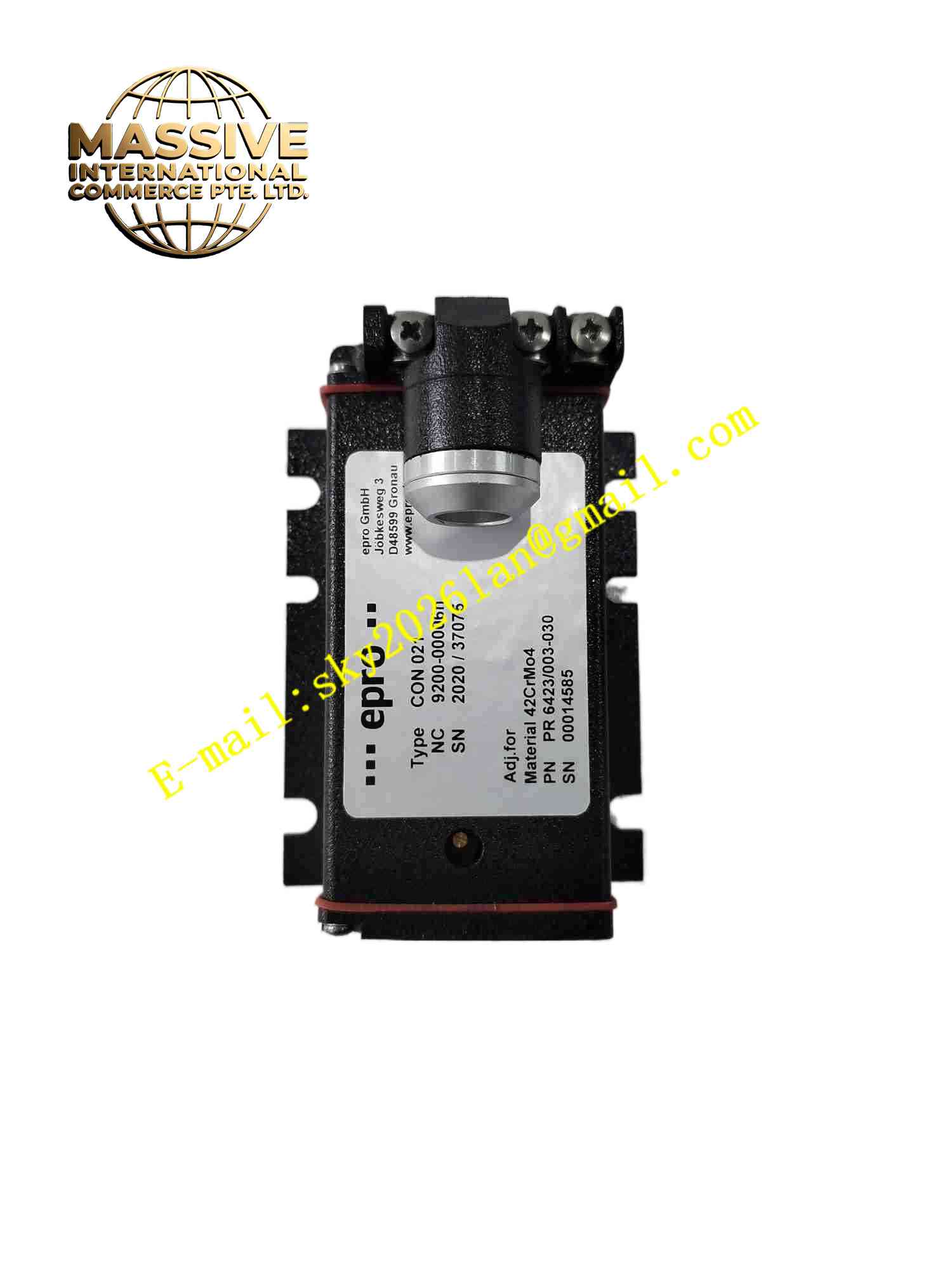
Description
EPRO PR6423003-030
Technical Specifications Model: PR6423003-030 Measurement Principle: Eddy current non-contact sensing Probe Operating Temperature: -35℃ ~ +180℃ Standard Measuring Range: 0 ~ 2mm Mounting Structure: External thread mounting Integrated Cable Length: 3 meters Protection Grade: IP67 Storage Temperature: -40℃ ~ +185℃ Relative Humidity: 5% ~ 95% non-condensing
Functional Features Non-contact measurement, no friction and wear between probe and rotating metal shaft. High temperature resistant stainless steel and ceramic packaging adapts to high temperature bearing housing environment. 3-meter integrated shielded coaxial cable meets medium-distance wiring requirement between probe and converter cabinet. Sensing coil encapsulated by ceramic material has strong anti-vibration performance. Compatible with EPRO series signal converters to generate standard analog output signal. High measurement resolution for capturing micrometer level shaft vibration displacement. Threaded structure supports fine adjustment of installation gap. Stable measurement performance on ferromagnetic metal shaft surface.
Application Scenarios Steam turbine shaft vibration monitoring, centrifugal compressor protection system, large generator set condition monitoring, gas turbine shaft displacement measurement, large fan and pump vibration online monitoring.
Performance Parameters High linearity within full measurement range. High resolution for tiny vibration displacement detection. Probe maintains stable sensing characteristic under long-time high temperature and vibration. Shielded coaxial cable suppresses external electromagnetic interference. Measurement linearity remains stable after long-term continuous operation. Lock nut prevents gap shift caused by mechanical vibration.
Material Composition Probe housing: High temperature resistant stainless steel alloy. Sensing coil: High temperature enameled copper wire winding. Encapsulation material: High temperature ceramic insulator. Cable: Fluorine plastic insulated shielded coaxial cable. Threaded fitting and lock nut: Stainless steel material. Sealing filler: High temperature insulating sealant.
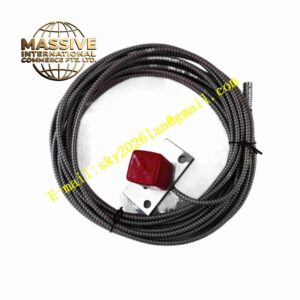
Structural Features Cylindrical probe body with external thread, ceramic tip encapsulates sensing coil. 3-meter shielded coaxial cable integrated at rear of probe body. External thread matched with lock nut to fix probe after gap adjustment. Compact probe tip for installation in limited space near bearing assembly. Sealed joint between probe body and coaxial cable prevents moisture and dust entering internal coil.
Working Principle Matched signal converter outputs high-frequency alternating excitation current, transmitted to probe coil through integrated 3-meter coaxial cable. Alternating magnetic field is generated at probe tip. Eddy current is induced on metal shaft surface. Eddy current creates reverse magnetic field and changes coil impedance value. Coil impedance changes linearly with gap distance between probe tip and metal shaft. The signal converter detects impedance variation and converts gap value into standard analog signal. The machinery monitoring system receives analog signal to calculate shaft vibration amplitude and relative shaft position.
Installation Requirements Tap threaded hole on bearing housing according to probe thread specification. Screw probe into threaded hole, adjust gap between probe tip and rotating shaft into specified working range. Tighten lock nut to lock probe position. Route 3m coaxial cable inside protective conduit, avoid sharp bending and tensile force. Connect coaxial cable to matched EPRO signal converter. Complete calibration with standard metal target block before machine startup. Check no contact between probe tip and rotating shaft after installation.
Usage Precautions Probe tip collision with rotating shaft will permanently damage internal coil and ceramic encapsulation. Do not pull or squeeze integrated coaxial cable, avoid bending below minimum bending radius. Cutting or splicing integrated coaxial cable is forbidden, which destroys measurement linearity. Probe must be used together with matched EPRO signal converter, cannot work independently. Inspect probe and cable integrity during regular equipment overhaul. Strong magnetic field near probe installation point affects measurement accuracy.