


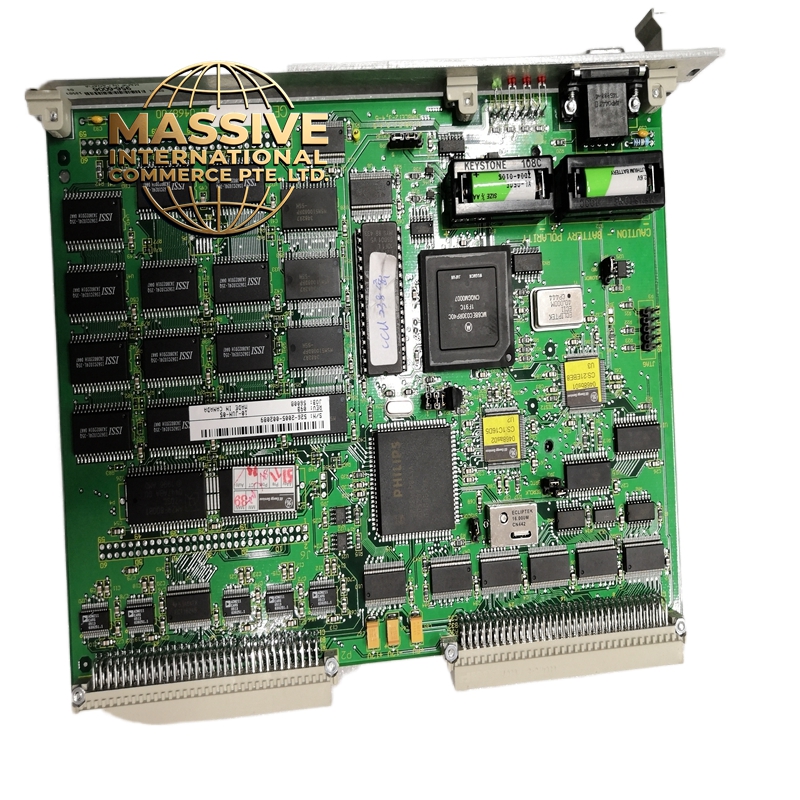
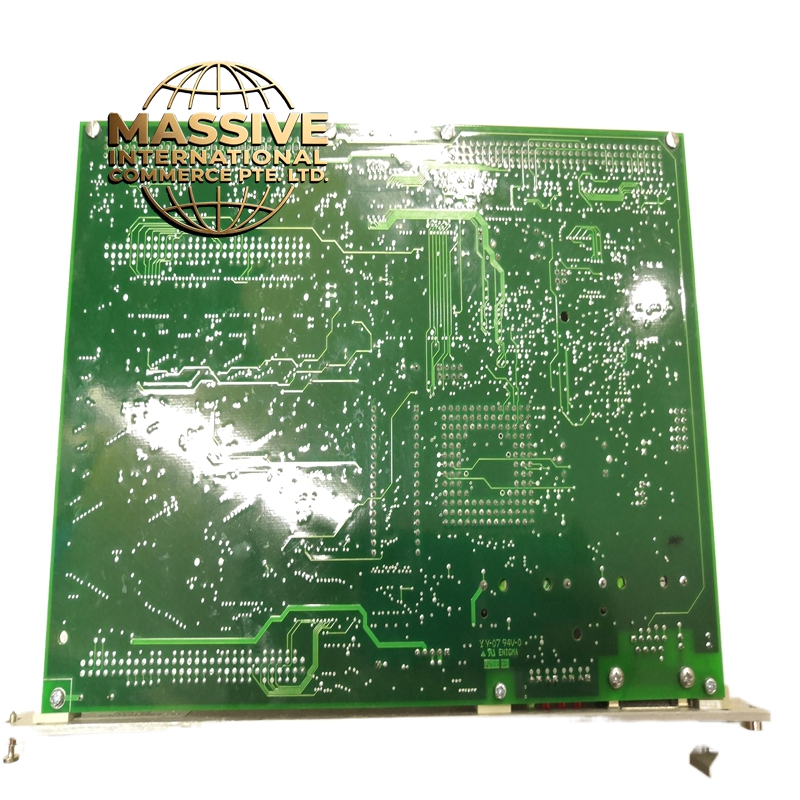
Description
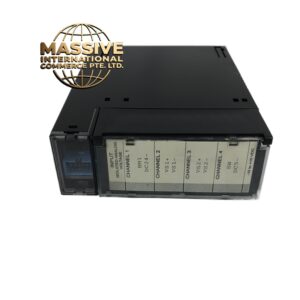
GE Fanuc D20ME-VME
- Technical Specifications:
- Bus Interface: VMEbus (VITA 1 standard compliant), supports DMA and interrupt-driven data transfer
- I/O Channels: 16 channels total, configurable as 8 analog input / 8 analog output, or any mixed combination of digital I/O
- Analog Input Range: 0–20 mA, 4–20 mA, or 0–10 VDC (user-selectable per channel group)
- Analog Output Range: 4–20 mA or 0–10 (user-selectable per channel group)
- Digital I/O: 16 channels of 24 VDC discrete input or output, sourcing/sinking up to 500 mA per channel
- A/D Resolution: 12-bit successive approximation, with ±1 LSB linearity
- D/A Resolution: 12-bit, monotonic output
- Sampling Rate: Up to 100 kHz aggregate across all analog channels; per-channel rate configurable from 1 kHz to 100 kHz
- Isolation: Channel-to-channel and channel-to-logic isolation via high-speed optocouplers rated at 500 continuous
- Power Supply: +5 VDC drawn from VME backplane, maximum power draw 5 W
- Backplane Connector: 96-pin DIN 41612 Eurocard connector
- Field Connector: 37-pin or 50-pin D-sub (depends on configuration)
- Functional Features:
- Multifunction Flexibility: Every single channel can be independently programmed as input or output during system configuration, giving maximum deployment versatility
- Built-in Signal Conditioning: Each analog channel includes hardware low-pass filtering (selectable cut-off: 10 Hz, 50 Hz, 100 Hz, 500 Hz), programmable scaling, and linearization tables stored in on-board EEPROM
- Diagnostics: Per-channel fault detection including overrange, underrange, wire-break detection for current loops, and short-circuit protection
- Hot Swap Support: Fully designed for live insertion and removal in redundant configurations without disrupting system operation
- Watchdog Timer: Internal watchdog monitors communication with the PLC CPU; if communication is lost, outputs default to a safe state (configurable fail-to-zero or fail-to-last)
- LED Indicators: Front panel LEDs show power, communication status, and per-channel activity
- Application Scenarios:
- Power Generation: Turbine speed/position feedback, boiler feedwater flow regulation, generator excitation current control, condenser vacuum monitoring
- Oil & Gas: Wellhead pressure and temperature acquisition, pipeline SCADA remote terminal units, refinery column temperature control, compressor station automation
- Water/Wastewater: Pump station level and flow measurement, chemical dosing control, clarifier sludge blanket monitoring
- Manufacturing: Batch reactor temperature and pressure control, motor drive speed feedback, conveyor system monitoring, injection molding machine control
- Mining: Conveyor belt speed monitoring, hoist position feedback, ventilation fan control
- Performance Parameters:
- Accuracy: ±0.1% of full scale typical for analog channels; ±0.05% after calibration
- Temperature Range: 0°C to 60°C operating; -40°C to 85°C storage
- Relative Humidity: 5% to 95% non-condensing
- Vibration: 5 g peak, 10–500 Hz (compliant with IEC 60068-2-6)
- Shock: 30 g, 11 ms half-sine pulse
- MTBF: Greater than 100,000 hours at 40°C ambient
- EMC Compliance: IEC 61000-6-2 (industrial environment), IEC 61000-6-4 (emission)
- Material & Structure:
- PCB: 6-layer FR-4 fiberglass epoxy with full conformal coating (silicone-based) for moisture and chemical resistance
- Connector: 96-pin DIN 41612 Eurocard connector (VME standard) on backplane side; 37-pin or 50-pin D-sub on field side
- Housing: Anodized aluminum alloy (6061-T6) with black powder-coat finish; includes steel mounting bracket with captive screws
- Weight: Approximately 250 grams
- Dimensions: 160 mm × 100 mm × 20 mm (Eurocard form factor)
- Working Principle:
- Analog input signals pass through an instrumentation amplifier with programmable gain, then through a selectable anti-aliasing low-pass filter before reaching a 12-bit successive-approximation A/D converter. The digital result is stored in a FIFO buffer and transferred to the PLC CPU via the VMEbus DMA controller. For analog output, a 12-bit D/A converter produces a voltage that is either buffered directly (for 0–10 V output) or converted to a 4–20 mA current loop via a precision voltage-to-current converter with active compliance up to 24 V. Digital I/O channels use opto-isolated buffers with Schmitt trigger inputs for noise immunity.
- Installation Requirements:
- Slot: Standard VME slot (Eurocard size 160 mm × 100 mm), any slot in the backplane
- Backplane Power: Must provide stable +5 VDC at minimum 2 A per slot; +12 and -12 VDC optional for some configurations
- Terminal Block: External field wiring connects via the D-sub connector on the front panel; use shielded twisted-pair for analog signals
- Cooling: Natural convection is sufficient; if forced air is used, ensure minimum 10 mm clearance above and below the module and airflow of at least 0.5 m/s
- Grounding: Use star grounding topology; connect the module chassis ground to the rack ground at a single point to avoid ground loops
- Usage Notes:
- Do not exceed the maximum per-channel current of 20 mA; the module includes internal current limiting but sustained overcurrent will degrade accuracy
- Calibration: Perform zero and span calibration at least once every 12 months, or immediately after any firmware update to the Series 90 CPU
- Firmware Compatibility: Series 90-30 requires firmware version 3.0 or higher; Series 90-70 requires firmware version 5.0 or higher
- ESD Protection: Handle the module with an anti-static wrist strap; the connector pins are sensitive to electrostatic discharge
- Replacement: When replacing a failed module, always power down the entire rack and verify the new module’s firmware version matches the CPU before applying power